


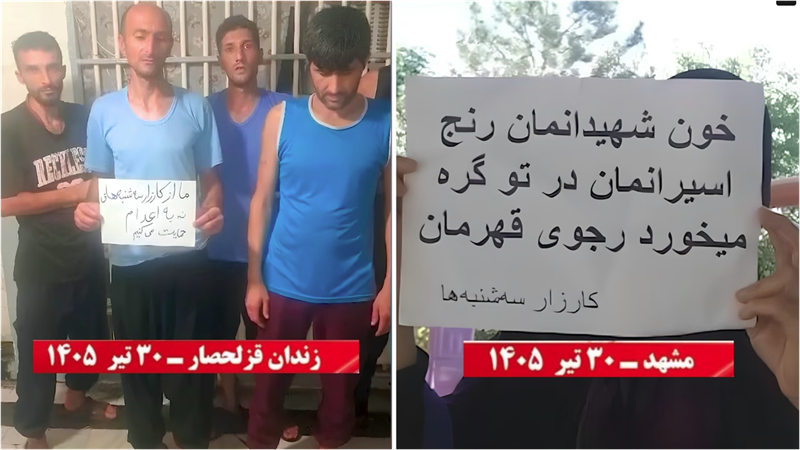

From Tehran to Tabriz, Resistance Units launched coordinated solidarity actions with hunger-striking prisoners in Qezel Hesar, demanding an end to executions and justice for political prisoners.
As the Iran regime continues its escalating execution campaign, Resistance Units across the country have launched a new wave of coordinated actions in support of the “No to Execution Tuesdays” campaign and the ongoing hunger strike by prisoners in Qezel Hesar Prison.
The nationwide initiative reflects growing solidarity with more than 1,500 death-row prisoners who have been protesting the regime’s increasing use of executions as a tool of repression. Through banners, posters, flower tributes, photo actions, and public messages, young activists carried the voices of imprisoned protesters into cities across Iran while calling for an immediate halt to executions.
A Nationwide Campaign Against Executions
The latest actions took place simultaneously in numerous cities, demonstrating the expanding reach of the Resistance Units despite the regime’s extensive security apparatus.
Participants honored those executed by the regime, expressed solidarity with the hunger-striking prisoners in Qezel Hesar, and urged the public to support the growing movement against capital punishment.
Their activities ranged from distributing protest leaflets and displaying banners to organizing symbolic flower tributes for victims of the regime’s executions.
Honoring Fallen Resistance Figures
In Isfahan, Resistance Units placed flower baskets commemorating Behrouz Ehsani and Mehdi Hassani, paying tribute to their sacrifice with messages emphasizing that their path toward freedom continues to inspire future generations.
The tributes declared that their memory remains alive and that their struggle would continue until victory.
These symbolic acts reflected a broader effort to preserve the memory of those executed while transforming remembrance into renewed resistance.
Messages of Solidarity Across Iran
Resistance Units organized coordinated actions in cities including Mashhad, Karaj, Shiraz, Tehran, Chalous, Sowme’eh Sara, Eslamshahr, Kermanshah, Rasht, Tabriz, and Ramsar.
The slogans carried a consistent message:
- “No to executions.”
- “Political prisoners must be freed.”
- “Justice cannot be achieved through executions.”
- “Stop the executions.”
- “Support the hunger strike of Qezel Hesar prisoners.”
- “The executions of prisoners reveal the regime’s fear of uprising and overthrow.”
In Tehran, activists explicitly expressed support for the hunger-striking prisoners, praising those who, in their words, “stood against oppression with empty hands.”
Several actions also condemned the executions of Aref Khoshkar and Mohammad Amini, describing them as further examples of the regime’s reliance on capital punishment to silence dissent.
Qezel Hesar Hunger Strike Inspires Wider Resistance
The ongoing hunger strike inside Qezel Hesar Prison has become a focal point for anti-execution activism throughout Iran.
Prisoners participating in the strike have protested the dramatic rise in executions carried out by the Iran regime, warning that capital punishment has become one of its principal instruments for intimidating society and suppressing political opposition.
Outside the prison walls, Resistance Units have echoed that message by urging citizens to become the voice of prisoners facing execution and by calling for greater international attention to the regime’s human rights abuses.
The campaign has increasingly linked the fate of imprisoned activists with the broader struggle for freedom, arguing that defending those on death row is inseparable from defending fundamental human rights.
Organized Resistance Under Intensifying Repression
The breadth of these coordinated actions illustrates both the persistence of organized resistance and the regime’s growing dependence on executions to maintain control.
Rather than silencing dissent, each new execution has fueled wider expressions of solidarity across the country. Resistance Units have responded by maintaining public visibility through decentralized actions that are difficult for security forces to suppress completely.
Their activities also underscore the evolving role of the “No to Execution Tuesdays” campaign, which has grown beyond prison walls into a nationwide movement uniting prisoners, families, activists, and Resistance Units around a common demand: an end to executions.
A Growing Challenge to the Regime
As executions continue to rise, the Iran regime increasingly relies on fear to deter public opposition. Yet the expanding participation in the “No to Execution Tuesdays” campaign suggests that this strategy is producing the opposite effect.
From symbolic flower tributes to public banners and coordinated protest actions, Resistance Units are demonstrating that each execution strengthens public resolve rather than extinguishing it.
Their message remains consistent across cities and provinces: the campaign against executions is not only a defense of individual prisoners but also part of a broader struggle for justice, human dignity, and a democratic future for Iran.