


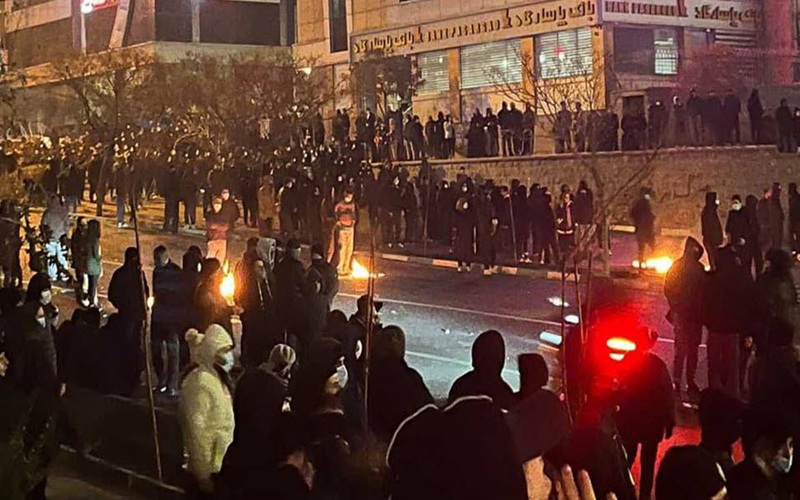

As international internet access gradually returns after months of restrictions, social media has become a platform for survivors, victims’ families, and witnesses to document the lasting impact of January’s deadly crackdown and challenge competing political narratives.
When Iranian regime authorities shut down international internet access on February 28, 2026, following the targeting of Ali Khamenei’s compound and the outbreak of war, the objective appeared clear: isolate the population, control the flow of information, and prevent public outrage from gaining momentum.
The regime may have assumed that a prolonged internet blackout, combined with the distractions of war, would push the memory of January’s bloody crackdown into the background. It likely also relied on its extensive propaganda apparatus, built over decades and financed with enormous resources, to shape public perception during the crisis.
Nearly three months later, that calculation appears to have failed.
Despite the continued filtering of online content and only limited restoration of international internet access, Persian-language social media platforms have been flooded with testimony, images, and personal accounts from survivors, victims’ families, and Iranians inside the country. Their message is remarkably consistent: life has been permanently divided into two periods—before January and after January.
The Return of Suppressed Voices
Since international connectivity began gradually returning on June 26 after nearly three months of near-total isolation, users have increasingly turned to platforms such as X and Instagram to share stories that remained hidden during the blackout.
Previously unseen images showing large public gatherings in streets and squares across various cities have emerged online. Other users have posted photographs and videos of those killed or wounded during the crackdown, many of which had never been publicly shared.
At the same time, new names of victims have begun to surface, suggesting that the full human toll of the violence may still not be completely known.
For many families, the reopening of communication channels has provided the first opportunity to publicly commemorate loved ones whose deaths had remained largely invisible to the outside world.
Memory as a Form of Resistance
Families of victims have posted videos from graveside memorials, remembrance ceremonies, and private gatherings honoring those who lost their lives. Witnesses who were present during the violence have shared detailed recollections of what they observed in streets, hospitals, and detention facilities.
Many of these accounts reveal a common theme: the psychological impact of January has not diminished despite months of war, censorship, and political turmoil.
The war itself has failed to eclipse the trauma of the crackdown. For countless Iranians, January remains the defining event that reshaped their understanding of both the regime and their future.
Social media posts repeatedly express the belief that the country can no longer return to its previous condition. Users describe a profound transformation in public consciousness and a growing conviction that coexistence with the current political system has become impossible.
Families Refuse to Let Victims Be Forgotten
Among the most widely shared content are personal videos released by families who had been unable to publish them during the internet blackout.
These recordings show victims celebrating birthdays, attending weddings, spending time with relatives, working, laughing, and participating in ordinary moments of life. Accompanied by favorite songs or local music, the videos serve as powerful reminders that behind every statistic was a human being with dreams, relationships, and a future that was cut short.
Other families have shared images of Nowruz celebrations, birthday commemorations, and memorial gatherings held at the graves of loved ones over the past three months. These moments had remained unseen due to the communications blackout and are now emerging one by one.
Together, they form a collective archive of remembrance that challenges official attempts to erase or minimize the events of January.
Growing Criticism of Reza Pahlavi on Social Media
One of the most notable developments accompanying the return of online activity has been the visible criticism directed at Reza Pahlavi and the monarchist movement.
Across social media platforms, numerous users have accused him of pursuing personal and dynastic ambitions rather than representing the aspirations of the Iranian people. Critics argued that he appeared to view foreign military intervention and external pressure as a pathway to political power and the possible restoration of a monarchy that Iranians overthrew nearly five decades ago.
Many users described Reza Pahlavi as politically opportunistic, accusing him of attempting to capitalize on national crises in much the same way that Ruhollah Khomeini exploited the revolutionary upheaval of 1979. These critics argued that Iranian society has no desire to exchange one form of authoritarian rule for another and rejects both clerical dictatorship and any return to hereditary governance.
Social media discussions also focused on claims repeatedly made by Pahlavi and his supporters regarding alleged defections from within the regime. Many users openly mocked assertions that tens of thousands of members of the security apparatus had joined his cause and would soon bring about the collapse of the government. Critics characterized such statements as exaggerated promises that failed to match realities on the ground.
The Limits of Censorship
The regime’s internet blackout delayed the flow of information, but it did not erase memories. The return of online communication has demonstrated that trauma, grief, and political anger cannot be indefinitely suppressed through technological restrictions.
What is emerging from social media today is not simply a collection of personal stories. It is a broader narrative about a society still processing one of the most traumatic episodes in recent Iranian history.
The images, testimonies, and memorials now circulating online suggest that January’s crackdown remains a defining reference point for many Iranians. Despite war, censorship, and months of enforced silence, the memories endured.
For countless citizens, the events of January were not merely another chapter in the country’s turbulent history. They became a dividing line between the past and the future—a moment that fundamentally changed how many view the regime, the opposition, and the struggle for Iran’s future.