


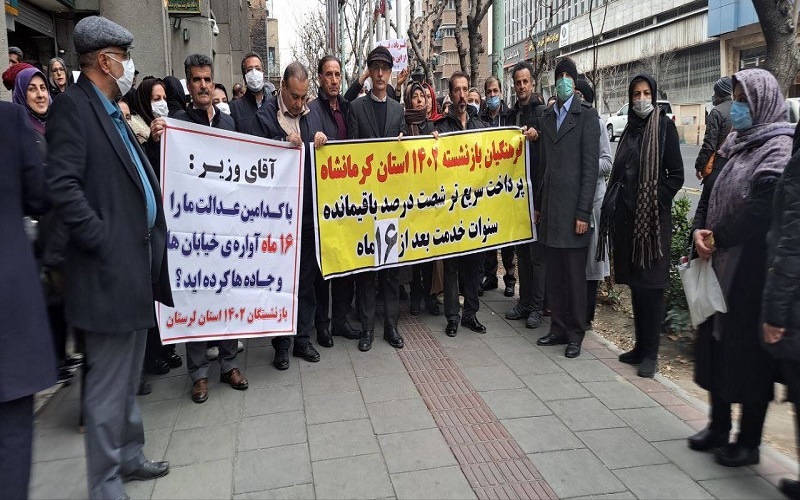

On Sunday, January 5, thousands of workers and retirees took to the streets across Iran to protest against worsening economic conditions. These demonstrations were driven by mounting livelihood challenges, unpaid wages, low salaries, and skyrocketing inflation and prices.
The protesters openly criticized the regime’s policies, particularly those of Supreme Leader Ali Khamenei, whose strategies they blamed for exacerbating Western economic sanctions and plunging Iran deeper into economic crises. They called on regime officials to prioritize resolving the nation’s livelihood issues.
Admissions of Economic Struggles by Regime Officials
In recent weeks, several high-ranking regime officials, including President Masoud Pezeshkian, Parliament Speaker Mohammad Bagher Ghalibaf, and Chief Justice Gholam-Hossein Mohseni-Eje’i, have acknowledged the intensifying economic crisis. Despite these admissions, the regime continues its controversial policies, including significant financial support for militia groups and substantial investments in military and nuclear programs.
For instance, Pezeshkian has repeatedly stated in speeches over the past two months that the government lacks the economic capacity to improve conditions or combat rising poverty. Similarly, the head of the research center of the Iranian Chamber of Commerce declared that the government’s ability to fund development projects is “almost zero.” Iranian media has also reported that the government struggled to pay November subsidies.
Protests Across Provinces
Retirees in provinces such as Kermanshah, Khuzestan, Isfahan, Tehran, and Gilan rallied to demand better living conditions. In Kermanshah, demonstrators gathered outside the Department of Labor and Cooperatives, chanting slogans such as:
- “Gas, electricity, and basic needs were stolen from the people.”
- “Let our bodies perish, but freedom must not be lost.”
- “Enough of warmongering; our tables are empty.”
- “Under the weight of inflation, the people’s backs are breaking.”
They also voiced anger over regime repression and the arrests of union activists.
In Ahvaz, retirees protested outside the Khuzestan Social Security Administration building against “harsh living conditions, violations of rights, and rampant inflation.” Their slogans included:
- “They have plundered Iran and made us poorer.”
- “The result of the government’s actions: stealing from the nation’s pockets.”
In Shush, protesters demanded the immediate implementation of Articles 96 and 111 of the Social Security Law, which would increase economic support and ensure free medical treatment. Steel retirees in Isfahan chanted, “Forget the headscarf, curb inflation” and “High-income country, what happened to you?” Meanwhile, in Gilan, retirees condemned the government’s apathy towards the declining purchasing power of workers and retirees.
Workers Join the Protests
Contracting workers from the National Company of Southern Oil Regions in Khuzestan also staged demonstrations, highlighting wage disparities and poor working conditions. Speaking to the ILNA news agency, the workers said:
“We are the main pillars of oil, not the third pillars. There is a massive gap in wages, bonuses, and benefits between us and official employees. For instance, oil company employees receive loans of 300 million tomans, but we receive no support at all.”
Additionally, the secretary of Mazandaran Labor House revealed that approximately 6,000 workers in Sari municipality and affiliated organizations have not received salaries for over two and a half months. Similarly, contractor workers involved in the Lipar tourism project in the Chabahar Free Zone reported four months of unpaid wages.
Worsening Economic Outlook
Abdolnaser Hemmati, the regime’s Minister of Economic and Financial Affairs, announced that the 2025 budget deficit would exceed 850 trillion tomans. However, Jahan Sanat newspaper warned that the deficit could surpass 50% of the total budget.
As economic conditions deteriorate, more citizens are likely to fall below the poverty line. This could lead to an increase in the frequency and intensity of protests in the coming months and years. Despite these alarming trends, Khamenei has avoided addressing the worsening livelihood issues in his numerous speeches over the past three months.
The growing discontent among workers and retirees underscores the deep economic and political challenges facing the Iranian regime. With no tangible solutions in sight, the protests serve as a stark reminder of the urgent need for systemic reform.