


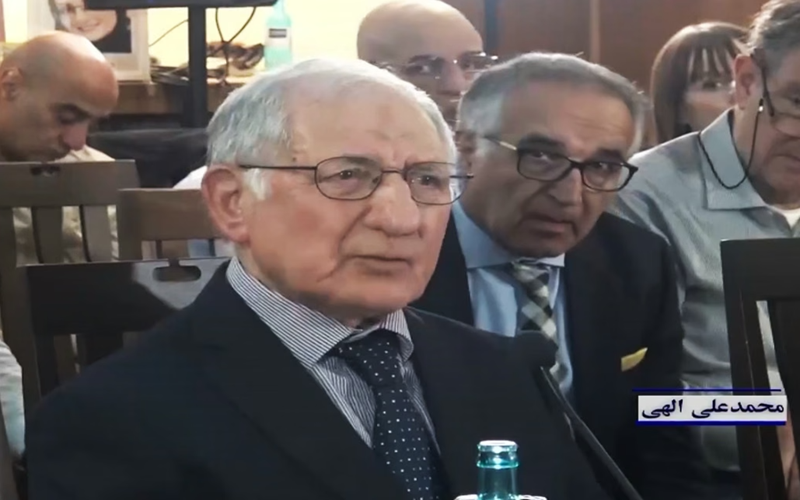

Mohammad Ali Elahi recounts five years of imprisonment under the Shah and his eyewitness account of the September 8, 1978, massacre, warning that honoring Reza Pahlavi disregards the victims of the former dictatorship.
Mohammad Ali Elahi, a former assistant professor of mathematics at Mashhad University and survivor of torture under Iran’s former monarchy, delivered a powerful testimony at the Berlin conference “The Crisis in Iran and the Democratic Solution.” He described the abuses committed by the Shah’s secret police, SAVAK, and argued that the repression of democratic activists helped pave the way for the 1979 revolution to be seized by Ruhollah Khomeini.
Elahi also condemned the decision to award the 2026 Freedom Prize on behalf of the Iranian people to Reza Pahlavi, the son of the deposed Shah, saying the move disregards the suffering of the former dictatorship’s victims.
Five Years of Imprisonment and Torture Under SAVAK
Elahi recalled that armed SAVAK agents abducted him from his workplace in 1972 because he distributed leaflets, books, and publications of the People’s Mojahedin Organization of Iran (PMOI/MEK).
Blindfolded and taken to a SAVAK prison, he endured 25 days of torture, including repeated beatings with a whip. The beatings caused severe infections in his feet, resulting in the loss of all his left toenails. He was also burned with cigarettes, leaving scars on his right thigh that remain visible.
He spent four months in solitary confinement in a cell just 90 centimeters wide. Elahi described the psychological torment of being forced to hear other prisoners screaming as they were tortured.
Although initially sentenced to three years in prison, he remained incarcerated for five years.
His ordeal continued into the final months of the monarchy. Elahi said he was among those detained during the demonstrations of September 8, 1978, known as Black Friday. He recalled witnessing the Shah’s Imperial Guard opening fire on demonstrators and seeing the bodies of young people killed in the massacre.
Elahi stressed that his experience was not an isolated case but part of a systematic pattern of repression under SAVAK.
How the Shah’s Repression Helped Khomeini Seize the Revolution
According to Elahi, the monarchy’s systematic use of torture, arrests, censorship, and the elimination of intellectuals and political leaders seeking a democratic republic weakened the forces capable of leading the Iranian people toward a democratic alternative.
With many democratic activists imprisoned or killed, he argued, the country faced a leadership vacuum that helped Khomeini and his supporters take control of the 1979 revolution.
He summarized the outcome in stark terms: “The crown left, the turban came; the boots left, the slippers came.”
His testimony challenged narratives that portray the former monarchy as a democratic alternative to the current Iranian regime. Instead, he emphasized the historical consequences of suppressing independent political movements and denying the population a peaceful path to democratic change.
Awarding Reza Pahlavi Would Insult the Victims
Elahi said news that Reza Pahlavi had been selected to receive the Freedom Prize on behalf of the Iranian people had revived painful memories of torture and the Black Friday massacre.
He questioned the decision to honor the heir of a military dictatorship, particularly given Pahlavi’s public expressions of pride in his family’s legacy.
For Elahi, the issue extends beyond a ceremonial award. He argued that presenting Pahlavi as a representative of the Iranian people disregards those who suffered under his father’s rule and risks strengthening the current regime politically.
He described the decision as an insult to the victims of SAVAK and a political gift to Iran’s ruling theocracy.
Elahi called for the experiences and testimony of former political prisoners to be heard, insisting that the Iranian people should not be forced to choose between two forms of authoritarian rule.
Iran Deserves Freedom and a Democratic Republic
Concluding his speech, Elahi called for a future based on popular sovereignty, republican government, freedom, and national independence.
His central message was that rejecting the current theocracy does not require endorsing a return to hereditary monarchy. Iran’s future, he argued, must be determined by its people rather than imposed through dynastic succession or religious dictatorship.
He ended with an emphatic distinction between honoring the Iranian people and selecting their political representatives:
“A prize for the Iranian people, yes—but for the Shah’s son, never, never, never.”