


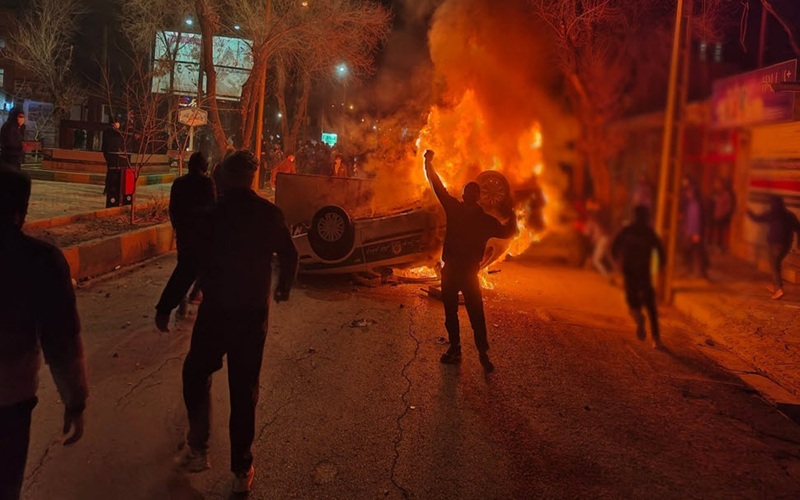

Iran has repeatedly witnessed nationwide uprisings, yet the regime has survived them. The decisive question is whether future unrest can overcome an organized machinery of repression.
For years, Iran has experienced waves of nationwide protest driven by economic hardship, political repression, corruption, and a deepening rejection of the ruling system. From the 2009 protests to the nationwide uprisings of 2017–18, November 2019, and 2022, millions of Iranians have demonstrated that the regime’s claim to social legitimacy is increasingly hollow.
Yet a difficult question remains: Why have these uprisings, despite their scale and determination, not brought about the regime’s downfall? And what could make a future uprising different?
The answer lies partly in the asymmetry between mass anger and organized repression.
The Iranian regime possesses an extensive coercive apparatus, with the Islamic Revolutionary Guard Corps (IRGC), the Basij, intelligence agencies, police forces, and other security institutions forming the backbone of its survival strategy. A nationwide uprising may overwhelm the streets with numbers, but the regime can respond through coordinated arrests, killings, intimidation, internet shutdowns, surveillance, and the deployment of organized security forces.
This is precisely why the question of organization has become increasingly important.
Even the regime anticipates a different kind of uprising
An illuminating indication comes not from opposition sources but from within the regime’s own media ecosystem.
A commentary published by the state-linked Jamarān website on August 16 warned against assuming that a future uprising would simply repeat the November 2019 protests. It argued that future protests could be “multilayered” and “networked,” shaped by the overlap of economic and political grievances.
The significance of this warning goes beyond its immediate wording. It reflects an awareness inside the regime that the next wave of unrest may not necessarily follow the pattern of previous protests.
Iran’s underlying grievances have not disappeared. Inflation, unemployment, poverty, corruption, deteriorating public services, energy shortages, and political repression continue to generate social pressure. The regime may suppress one protest movement, but it cannot eliminate the conditions that produce the next one.
What concerns the authorities, therefore, is not simply another eruption of anger. It is the possibility that such anger could become connected, persistent, and organized.
Anger can ignite an uprising. Organization can sustain it.
There is an important distinction between a spontaneous social explosion and a sustained political movement.
Spontaneous anger can bring enormous numbers of people into the streets within hours. It can paralyze cities, expose the regime’s vulnerability, and demonstrate the depth of public opposition. But spontaneous movements are also vulnerable to a highly organized state apparatus capable of isolating neighborhoods, cutting communications, arresting activists, and using lethal force.
Organization changes that equation.
A network capable of maintaining communication, preserving continuity between successive waves of protest, and keeping resistance alive during periods of intense repression can prevent an uprising from disappearing when the streets temporarily fall silent.
This is the strategic argument behind the Resistance Units, or “Rebel Units,” promoted by the People’s Mojahedin Organization of Iran (PMOI/MEK). Their stated purpose is not simply to participate in moments of mass unrest but to maintain an organized resistance infrastructure between those moments.
Whether one accepts the Resistance’s broader political strategy or not, the underlying political question is difficult to dismiss: Can a movement defeat a highly organized authoritarian state without developing forms of organization capable of surviving repression?
From mass uprisings to continuity
The history of Iran’s recent protests illustrates the problem.
Each major uprising has left behind memories, martyrs, political demands, and a deeper rejection of the ruling establishment. But repression has repeatedly interrupted the continuity between one wave and the next.
The regime’s strategy has therefore been more sophisticated than simply dispersing demonstrations. It seeks to prevent protest from developing into a durable political challenge.
That makes continuity crucial.
A movement that exists only when millions simultaneously take to the streets can be extraordinarily powerful but difficult to sustain under systematic repression. By contrast, a movement with an organizational backbone can preserve political momentum during periods when open protest becomes too dangerous.
This is where the concept of organized resistance enters the broader equation of political change in Iran.
The PMOI/MEK has described its Resistance Units as part of a strategy intended to preserve resistance during periods between major uprisings and help connect local acts of opposition with broader national movements. The organization presents this strategy as an evolution from earlier phases of its confrontation with the regime, including the period in which it established the National Liberation Army.
The stated objective is ultimately to transform scattered resistance into a force capable of challenging the regime’s political and security structure.
Why the regime is increasingly concerned about networks
The regime’s own rhetoric offers an important clue.
Iranian authorities routinely describe opposition networks as security threats. Their concern is understandable from the regime’s perspective: a government can more easily suppress isolated demonstrations than a movement capable of regenerating itself after arrests and repression.
That is why the language surrounding “networks,” “organization,” and the coordination of protests has become so significant.
The regime can attempt to control the streets. It can arrest demonstrators. It can censor information. It can impose internet restrictions. But it cannot permanently eliminate the grievances that drive people into opposition.
The harder challenge is preventing those grievances from acquiring organizational continuity.
This is also why the future of Iran’s protest movement should not be measured simply by the size of the next demonstration. A protest involving millions would demonstrate the depth of popular anger, but the more consequential question would be whether that anger can withstand repression and translate into sustained political pressure.
The equation of the next uprising
Iran’s crisis is therefore not merely a question of whether another uprising will occur. The country’s repeated cycles of protest suggest that the underlying causes remain firmly in place.
The more consequential question is what happens when the next uprising arrives.
Will it again emerge as a massive but largely spontaneous explosion, allowing the regime to concentrate its organized coercive power against an uncoordinated population? Or will years of accumulated experience, social networks, and organized resistance give the next movement greater capacity to survive repression and maintain momentum?
The regime itself appears to recognize that this distinction matters.
For the Iranian people, the lesson of previous uprisings is not that popular anger is ineffective. On the contrary, every uprising has exposed another layer of the regime’s vulnerability. The lesson is that anger must become sustained political force if it is to produce lasting change.
The streets may provide the spark. But organization determines whether the flame survives.
That is ultimately what could change Iran’s uprising equation.