


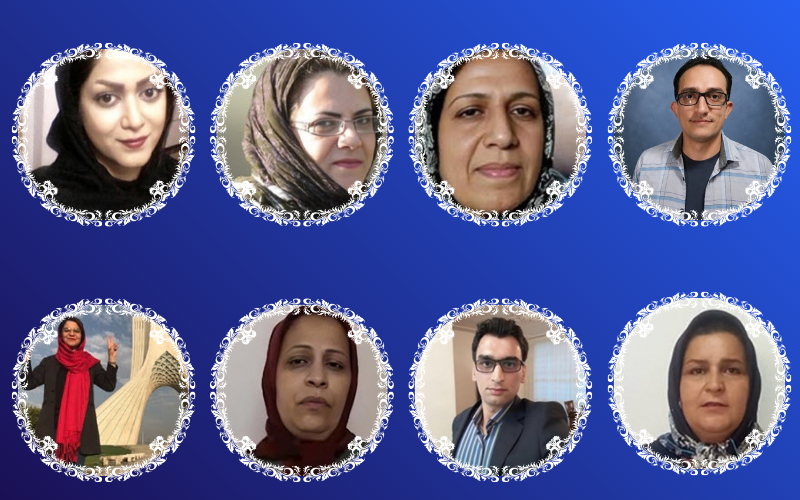

From Evin to Qezel Hesar, PMOI-supporting political prisoners reaffirm their defiance of executions, honor fallen comrades, and call on the international community to recognize the Iranian people’s right to resist dictatorship and establish a democratic republic.
From Eight Prisons, a Message of Resistance
On the occasion of World Day Against the Death Penalty, political prisoners supporting the People’s Mojahedin Organization of Iran (PMOI/MEK) have issued messages from prisons across Iran, reaffirming their determination to resist executions and continue the struggle for freedom despite the threat to their own lives.
The messages, broadcast by Simay-e Azadi at the prisoners’ repeated insistence that their words reach the Iranian people and especially the country’s youth, came from eight prisons: Evin Prison’s Ward 7 in Tehran, Karaj Central Prison, Vakilabad Prison in Mashhad, Qezel Hesar Prison, Urmia Prison, Khorramabad Prison, Iranshahr Prison, and Gonbad-e Kavus Prison.
Their statements are not merely appeals against capital punishment. They are testimonies from people who have experienced imprisonment under the clerical regime, witnessed the execution of comrades, and continued to resist despite the risks. They portray executions as an instrument of political repression and insist that intimidation will not extinguish the demand for freedom.
Their collective message is unequivocal: neither the gallows nor the threat of execution will force them to abandon their struggle for a democratic Iran.
A Country Bearing the Burden of Executions
The prisoners cite figures attributed to Amnesty International for 2025, according to which 2,707 executions were recorded worldwide, including at least 2,270 in Iran. By their calculation, Iran accounted for approximately 84 percent of the global total. They also note that executions took place in only 17 countries during that year.
These figures, they argue, expose the extraordinary scale of executions under the Iranian regime and the central role capital punishment plays in its system of repression.
The prisoners also distinguish these executions from the mass killing they say accompanied the January uprising, referring to the thousands of bodies and black body bags that became symbols of the violence against protesters.
Their argument is that executions cannot be understood simply as individual judicial punishments. In their view, the regime uses the death penalty to intimidate society, prevent renewed uprisings, and prolong its hold on power.
That conviction is expressed most forcefully by Sepahr Emam Jom’e, a political prisoner held in Qezel Hesar Prison, whose message draws on personal loss, years of resistance behind bars, and his experience of the campaign against executions.
Sepahr Emam Jom’e: “Every Execution in Iran Is Carried Out to Intimidate and Repress Society”
Emam Jom’e identifies himself through several overlapping experiences: as one of thousands of political prisoners participating in the “No to Execution Tuesdays” campaign, as a supporter of an organization whose members have faced mass executions, and as an Iranian who has watched fellow citizens be killed for demanding freedom.
He writes:
“As one of the thousands of political prisoners belonging to the ‘No to Execution Tuesdays’ campaign, which has been on hunger strike every Tuesday for 141 weeks in 66 prisons across the country.”
He then recalls the personal cost of that struggle:
“As a political prisoner from whom 11 of my dearest and most honorable brothers have been taken away and sent to the gallows to this day, whose loss I still carry in my heart.”
His testimony extends beyond his own prison and the people he knew personally. He describes himself as a supporter of an organization whose members have been executed for their political convictions, and as a prisoner who has known or heard the stories of many condemned inmates in Qezel Hesar, a prison associated with executions.
He also invokes the killing of fellow Iranians during protests:
“And also as an Iranian whose compatriots have been shot down in the streets by the thousands for the crime of seeking freedom.”
From these experiences, he draws a direct conclusion:
“I testify that every execution in Iran has been and continues to be carried out solely to intimidate and repress society.”
For Emam Jom’e, the gallows are a means by which the ruling dictatorship attempts to escape its own political fate.
“Erecting the gallows and carrying out executions, under any pretext, is nothing but the ruling dictatorship’s way of escaping its inevitable fate: overthrow at the hands of these same enraged and rebellious people.”
He questions why Iran accounts for such a disproportionate share of executions worldwide and recalls that the Iranian people rose up to consign the shah’s military courts and their predetermined verdicts to history.
His message ends with a pledge grounded in the hope that the death penalty will one day disappear from Iran:
“As the smallest son of this land, I swear and believe that the day the gallows are dismantled in Iran, freedom will arrive.”
He concludes: “In hope of that blessed day.”
The testimony carries particular weight because it comes from a prisoner who says he has watched comrades disappear behind prison walls and has continued to participate in a hunger-strike campaign for more than two and a half years.
Women Prisoners at Evin: “Do Not Merely Condemn Human Rights Violations”
Five PMOI-supporting women prisoners in Evin Prison’s women’s ward—Zahra Safaei, Marzieh Farsi, Shiva Esmaeili, Elaheh Fooladi, and Forough Taghipour—issued a joint message calling on the international community to move beyond statements of condemnation.
They place the current wave of executions within a longer history of authoritarian rule in Iran, under both monarchy and theocracy.
For 120 years, they write, their country has endured executions under successive systems of dictatorship—an experience that defies adequate description.
They condemn rulers who use the taking of human life as a means of preserving their power, describing executions as a permanent instrument of repression intended to prevent an uprising they believe cannot ultimately be avoided.
Their appeal to international institutions is explicit:
“On World Day Against the Death Penalty, we, the prisoners supporting the PMOI, Zahra Safaei, Marzieh Farsi, Shiva Esmaeili, Elaheh Fooladi, and Forough Taghipour, call on international bodies not to limit themselves to condemning human rights violations in Iran.”
They add a second demand:
“They must not appease this bloodthirsty regime. They must recognize organized resistance and the Iranian people’s right to struggle to overthrow the government of executions.”
This is a central distinction in the prisoners’ message. They are not asking the international community merely to criticize individual executions. They want governments and international institutions to acknowledge the political character of the repression and recognize the right of the Iranian people to resist the system responsible for it.
Their statement closes with a declaration of their political objective:
“Long live the democratic republic.”
They also reaffirm their allegiance to the Resistance movement, ending with the words “Greetings to Rajavi,” and dating their message October 7, 2026.
Shiva Esmaeili’s Poem: “My Life Be Sacrificed for the Freedom of the Homeland”
Alongside the joint statement, Shiva Esmaeili, a prisoner in Evin, sent a poem dedicated to the struggle against executions. Her verses portray a person confronting the machinery of dictatorship and refusing to abandon the cause of freedom, even when others warn that resistance will cost him his life.
The poem opens with an image of a night of humiliation and a bloody dawn, followed by the figure of a defiant man whose voice challenges the structures of oppression.
He declares:
“I will let the flood of my own blood flow until I tear down the palace of the Shah and the spider’s web of the Mullah.”
The poem then presents the warnings directed at those who resist: pause, reconsider, look at the powerful men who will destroy your life.
The answer is a refusal to retreat:
“May there be no hesitation, even for a moment, in our cause!”
The poem continues:
“To die on the path of freedom for the homeland is better than living in disgrace under a vile Mullah!”
Its final declaration captures the spirit of sacrifice that runs through the prisoners’ messages:
“My life be sacrificed for the freedom of the homeland.”
Esmaeili concludes with a definition of mortality that reverses the logic of a state built on fear:
“The one who makes the freedom of the people perish is the one who is truly mortal.”
The poem is not an abstract meditation on courage. Written from Evin Prison, it expresses the conviction that preserving life at the price of surrendering freedom is not the kind of survival for which political prisoners have struggled.
Its rejection of both the shah and the clerical ruler also places the demand for freedom beyond the restoration of a previous system of authoritarian rule.
Parisa Kamali: “The People Are the Owners of This Land”
From prison in Hormozgan Province, Parisa Kamali addresses the Iranian people directly, focusing on the relationship between executions, public fear, and the regime’s refusal to answer the demands of society.
She argues that those who hold power have become so hostile to freedom and awareness that they respond to people seeking answers by issuing death sentences instead of accepting accountability.
By escalating executions and spreading terror, she writes, the rulers imagine they can preserve their position indefinitely.
But she insists that they have forgotten a fundamental principle:
“They have forgotten that the people are the owners of this land.”
Kamali expresses confidence that the bloodshed will not erase the demand for justice:
“The martyrs remain, and blood will find its way toward truth and justice.”
She then frames freedom and reconstruction as basic human rights:
“Living in a free and prosperous country is the right of every human being, and we demand all of our rights.”
Her message turns to the families of prisoners and those who remain silent in the face of executions. She asks people to listen to the voices of young Iranians whose aspirations for a free and prosperous country have been met with death sentences.
She writes:
“Be the voice of the children of our land, who today have been sentenced to death by these fascists for even a video or a story, and simply for the dream of living in freedom and seeing their homeland flourish.”
Kamali also warns those who assume that repression will never touch their own families:
“Let those who remain silent know: perhaps tomorrow the pens of these bloodthirsty mullahs and judges in this fake judicial system will turn toward sentencing their own loved ones to death—and then it will be too late.”
Her appeal is both a warning and a call for solidarity. The struggle against executions, she argues, cannot be left solely to prisoners, bereaved families, and those already targeted by the state. Silence does not guarantee safety.
She closes with a concise declaration:
“No to executions, in hope of a free and prosperous Iran.”
Bijan Kazemi: The Tyrant Who Feeds on the Blood of the People
In his message from Ward 7 of Evin Prison, Bijan Kazemi places Iran’s executions within a broader historical and moral struggle against tyranny.
He begins by invoking God, the Iranian people, and those who have sacrificed their lives. He also cites verse 32 of the Quran’s Surah Al-Ma’idah, which equates the unjust killing of one person with killing all humanity and saving one life with saving all humanity.
The passage establishes the moral foundation of his argument: human life is not a resource that rulers may destroy to preserve their authority.
Kazemi then turns to the legendary tyrant Zahhak, whose rule in Persian mythology is sustained by the brains of young people. For him, the figure symbolizes rulers who cannot tolerate independent thought because new ideas may lead to rebellion.
He draws a parallel between that ancient image and the contemporary Iranian ruler, arguing that dictators repeatedly fail to learn from the fate of their predecessors.
He invokes the example of tyrants such as Hitler, Mussolini, and Gaddafi, as well as the shah, to illustrate what he sees as the arrogance of rulers who imagine themselves immune to history.
In Kazemi’s account, the pursuit of power becomes inseparable from the destruction of human life:
“The dictator needs the brains and blood of the people to survive, because the thirst for power and despotism can only be quenched by drinking the blood of the innocent.”
He also accuses the authorities of worsening poverty and deprivation, then arresting and executing people whose lives have been shaped by those very conditions.
Turning to Lorestan Province and the city of Kuhdasht, he condemns the authorities for failing to provide young people with jobs and economic opportunities while subjecting them to the threat of execution. His criticism is directed at a system that, in his view, invests in repression rather than enabling people to build secure lives.
Kazemi connects the renewed executions to the regime’s fear of another uprising. He writes that, having sensed the approach of revolt, the authorities have resumed executions to prevent a repeat of the 2025 uprising.
He also describes displays of security preparedness and the atmosphere of intimidation as attempts to frighten the population into submission.
But he ends with a warning that the logic of repression will ultimately turn against those who employ it:
“Seize, arrest, kill—and you dig your own grave with your own hands.”
The message is an indictment of a system that, in Kazemi’s view, mistakes fear for stability. Its resort to violence may intensify suffering, but it cannot resolve the political grievances that drive people to resist.
The Faith Behind the Resistance
The prisoners’ statements draw on different sources of conviction: religious teachings, historical memory, revolutionary commitment, personal grief, and the hope of national liberation.
Kazemi invokes the Quran’s defense of human life. Esmaeili’s poem celebrates sacrifice for freedom. Kamali calls for solidarity with young people facing death sentences. The women prisoners demand international recognition of organized resistance and the people’s right to struggle against the government. Emam Jom’e testifies to the loss of comrades and the repeated use of executions to intimidate society.
These voices differ in form, but converge on a common argument: the death penalty under the Iranian regime cannot be separated from the political system in which it operates.
Their opposition to executions is therefore inseparable from their opposition to dictatorship. They reject the notion that a government can secure legitimacy by killing its opponents, or that the threat of death can permanently extinguish demands for freedom.
They also insist that the struggle is not confined to prison walls. Their repeated efforts to have their messages broadcast reflect a determination to reach the younger generation and the wider population despite censorship and isolation.
The prisoners’ words carry the particular authority of people who continue to speak while facing the consequences of their convictions. Their sacrifice should not be reduced to statistics, even when the scale of executions makes those figures indispensable to understanding the crisis.
“No Shah, No Mullah”: A Pledge to Continue Until Freedom
The collective message from the eight prisons concludes with a pledge to continue the struggle alongside the Resistance Units and the Iranian people, guided by the principle of “No Shah, No Sheikh.”
The prisoners declare that they will spare no effort until the roots of oppression are removed from Iran and a democratic republic is established. They support the formation of a provisional government based on Maryam Rajavi’s Ten-Point Plan, which includes the abolition of the death penalty.
Their commitment is expressed in words that link personal sacrifice to a national objective:
“We, the political prisoners and supporters of the PMOI, together with the Resistance Units and the courageous people who keep the flame of resistance alive at any cost and are not intimidated by unjust and inhuman death sentences, have sworn that we will spare no effort until the roots of oppression are torn out of our beloved Iran, a democratic republic is established, and a provisional government based on Sister Maryam’s Ten-Point Plan—one of whose provisions is the abolition of the death penalty—is formed, until the sun of freedom rises over our beloved homeland, Iran.”
This pledge gives the messages their unifying purpose. The prisoners are not simply asking that executions stop, though that demand is urgent. They are calling for a future in which the state no longer possesses the power to use the gallows to silence political opposition.
Their vision rejects both the hereditary monarchy of the past and the clerical dictatorship of the present. It places the abolition of executions within a broader program for a democratic republic and the restoration of popular sovereignty.
For the prisoners, the campaign against the death penalty is thus part of a larger struggle over who has the right to determine Iran’s future: an authoritarian state that rules through fear, or a people determined to live in freedom.
Their final appeal is directed toward the Iranian people, particularly the young, and toward the international community. They ask that the voices of those behind bars be heard, that the victims of executions not be forgotten, and that condemnation of the death penalty be accompanied by meaningful solidarity with those resisting it.
From Evin and Qezel Hesar to prisons across Iran, their message remains consistent: the gallows will not erase the demand for freedom, and the threat of execution will not compel them to abandon their struggle for a democratic Iran.