


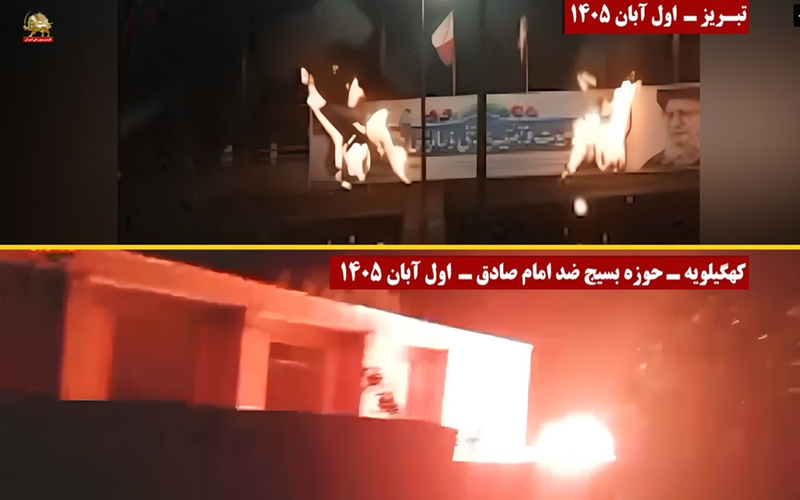

The Iranian Resistance reports a new series of actions targeting Basij facilities, IRGC installations, and regime symbols in several cities following the demolition of waterfront cafés in Khorramshahr, which it describes as a devastating blow to the livelihoods of disadvantaged residents.
Café Demolitions in Khorramshahr Trigger New Wave of Resistance Actions
The Iranian Resistance has reported ten actions against regime-linked facilities and symbols in several Iranian cities following the demolition of cafés along Khorramshahr’s coastal boulevard by municipal authorities.
According to the Resistance’s statement, the cafés provided a source of income for disadvantaged residents and vulnerable families. Their demolition was carried out by the government-controlled municipality on the orders of a judicial official, the statement said, condemning the operation as another example of pressure on people struggling to make a living.
The Resistance presented the subsequent actions as responses to the destruction of these small businesses and to the wider repression exercised by Iran’s regime.
The reported incidents included fires at Basij bases and an Islamic Revolutionary Guard Corps (IRGC) installation, explosions at two Basij facilities, and the burning of banners depicting Supreme Leader Ali Khamenei.
Basij Bases and IRGC Installations Targeted
According to the Resistance’s account, several reported incidents involved facilities associated with the Basij, the paramilitary organization closely linked to the IRGC and the regime’s domestic security apparatus.
In Kohgiluyeh, an explosion was reported at a Basij facility. Another explosion was reported at an IRGC-affiliated Basij base in Khash, in Sistan and Baluchestan Province.
In Shahriar, west of Tehran, two separate incidents reportedly involved fires at Basij bases associated with the IRGC, including one identified in the statement with the name of the Imam Hussein-linked Hamzeh Seyyed al-Shohada unit.
In Kermanshah, a Basij facility was reportedly set on fire. A separate incident in Rask, in Sistan and Baluchestan Province, involved a reported fire at an IRGC battalion headquarters.
Another Basij base was reportedly set on fire in Chabahar, also in Sistan and Baluchestan Province.
The Resistance’s statement did not provide independently verified details about casualties or the extent of damage at these locations.
Regime Symbols Targeted in Tabriz and Islamabad-e Gharb Region
The reported actions also included two incidents in Tabriz involving banners depicting Ali Khamenei.
In one incident, a banner positioned above a bridge was reportedly set on fire. A second banner depicting the supreme leader was reportedly burned elsewhere in the city.
In Eslamshahr, near Tehran, a sign directing people to a Basij intelligence-gathering headquarters was reportedly set on fire. The Resistance characterized the facility as part of the regime’s network for monitoring and gathering information on the population.
These reported incidents accompanied the actions against Basij and IRGC facilities, reflecting the Resistance’s broader campaign against the institutions and symbols it associates with the clerical establishment.
Livelihoods Under Pressure
The demolitions in Khorramshahr form the central grievance highlighted in the Resistance’s statement. For residents operating small cafés, the destruction of their businesses can mean the sudden loss of income and the disappearance of an important source of financial security.
The statement accused the authorities of depriving disadvantaged people of their livelihoods through municipal action backed by the judiciary. It framed the demolitions as part of a wider pattern in which the regime’s institutions impose pressure on ordinary citizens rather than protect their economic interests.
The reported response extended across multiple provinces, from East Azerbaijan in the northwest to Sistan and Baluchestan in the southeast. The ten incidents listed by the Resistance included locations in Tabriz, Kohgiluyeh, Khash, Shahriar, Kermanshah, Rask, Chabahar, and Eslamshahr.
The individual incidents and their circumstances have not been independently verified.
The episode highlights the intersection of economic hardship, local government action, and political opposition in Iran. For the Resistance, the demolition of the Khorramshahr cafés is not merely a municipal dispute but another example of the pressure faced by people whose livelihoods depend on small businesses.
The statement links that grievance to a wider confrontation with the ruling establishment, presenting the reported actions as expressions of opposition to the regime’s security apparatus and its symbols of authority.