


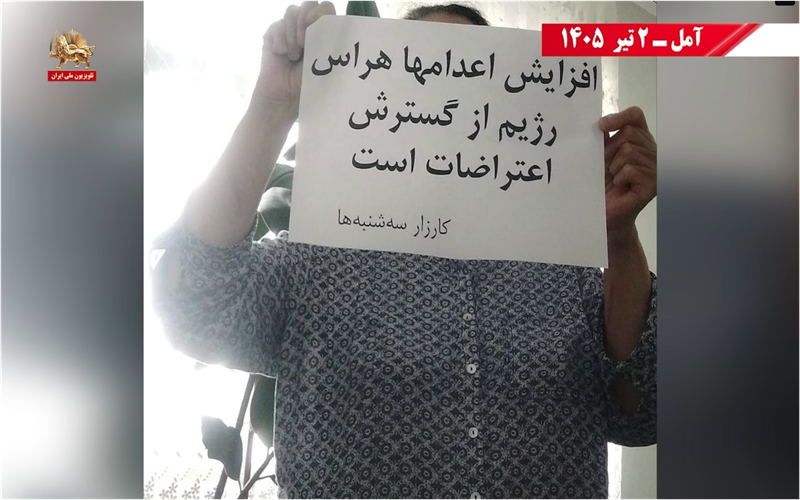

Coordinated activities across dozens of Iranian cities combined anti-execution protests, pro-democracy messaging, and symbolic actions marking the anniversary of organized resistance.
Resistance Units affiliated with the Iranian Resistance carried out a new wave of coordinated activities across Iran this week, combining anti-execution protests, pro-democracy campaigns, and symbolic actions marking the anniversary of June 20, 1981—the beginning of the organized resistance against the clerical regime.
The activities, which spanned dozens of cities, reflected three central themes: opposition to the regime’s escalating use of executions, rejection of both religious and monarchical dictatorship, and support for a democratic republic as the alternative to the current system.
Nationwide Support for the “No to Execution Tuesdays” Campaign
Coinciding with the ongoing “No to Execution Tuesdays” campaign, Resistance Units organized protest activities in cities across the country to condemn the regime’s increasing use of capital punishment.
The campaign included flower tributes honoring recently executed political prisoners Behrouz Ehsani and Mehdi Hassani in Mashhad, while activists in numerous other cities—including Amol, Hamedan, Urmia, Behbahan, Chalus, Rafsanjan, Lahijan, Shahrekord, and Abadan—displayed banners and posters carrying anti-execution messages.
Among the slogans featured during the campaign were calls declaring that the increase in executions reflects the regime’s fear of expanding public protests, alongside messages emphasizing continued resistance, solidarity with political prisoners, and determination to oppose repression. Other banners called for an end to executions and denounced the Islamic Republic’s use of capital punishment as a political tool.
The coordinated actions underscored the Resistance’s argument that the growing number of executions is intended to intimidate society amid continuing social unrest rather than address criminal justice concerns.
Pro-Democracy Messages Displayed in Zahedan
On Friday, Resistance Units in Zahedan launched another coordinated campaign by displaying large banners carrying messages from NCRI President-elect Maryam Rajavi and Iranian Resistance leader Massoud Rajavi, together with the slogan “Neither Shah, Nor Mullah.”
The banners promoted themes repeatedly emphasized by the Iranian Resistance, including democratic change through organized resistance, the establishment of a democratic republic, gender equality, national independence, secular governance, and the rejection of both the current theocratic system and any return to monarchy.
Several messages stressed that lasting change in Iran cannot be achieved through foreign military intervention or external political arrangements but depends on the organized struggle of the Iranian people. Others emphasized that the Resistance Units represent an engine for democratic change inside the country and called for the overthrow of the ruling establishment by the Iranian people themselves.
The campaign also highlighted the slogan “Neither Shah, Nor Mullah,” presenting it as a rejection of all forms of dictatorship and a call for a democratic alternative independent of both the former monarchy and the current clerical regime.
Activities Mark June 20 Anniversary
Resistance Units also marked the anniversary of June 20, 1981, widely regarded by supporters of the Iranian Resistance as the beginning of the organized struggle against the Mullahs’ regime.
According to statements released by the Resistance, activists carried out coordinated actions in numerous cities, including Tehran, Isfahan, Mashhad, Karaj, Shiraz, Kermanshah, Zahedan, Sari, Kerman, Qazvin, Yazd, Hamedan, Bandar Abbas, Zanjan, Amol, Saveh, Shahroud, Brojen, Khash, Saqqez, and Sabzevar.
The reported activities targeted symbols and institutions associated with the ruling establishment, including banners featuring Supreme Leader Ali Khamenei and other senior officials, Basij facilities, and government buildings. The Resistance described these operations as acts of defiance against state repression and commemorations of those who have participated in the movement over the past four decades.
In its accompanying statement, the Resistance argued that both the ruling clerical establishment and advocates of restoring the former monarchy oppose the emergence of an organized democratic alternative. It reiterated its longstanding position that Iran’s future lies neither in religious dictatorship nor in monarchical rule, but in the establishment of a democratic republic based on popular sovereignty.
Expanding Domestic Resistance
Taken together, this week’s coordinated activities illustrate the Resistance Units’ continued strategy of maintaining a visible presence inside Iran despite ongoing security crackdowns. By linking opposition to executions with broader calls for democratic change and commemorating the movement’s historical origins, the campaign sought to project both organizational continuity and political resilience.
The simultaneous actions across dozens of cities also reinforce the Resistance’s message that opposition to the Islamic Republic extends beyond isolated protests and is increasingly framed around an organized movement advocating a secular, democratic republic under the slogan: “Neither Shah, Nor Mullah.”