


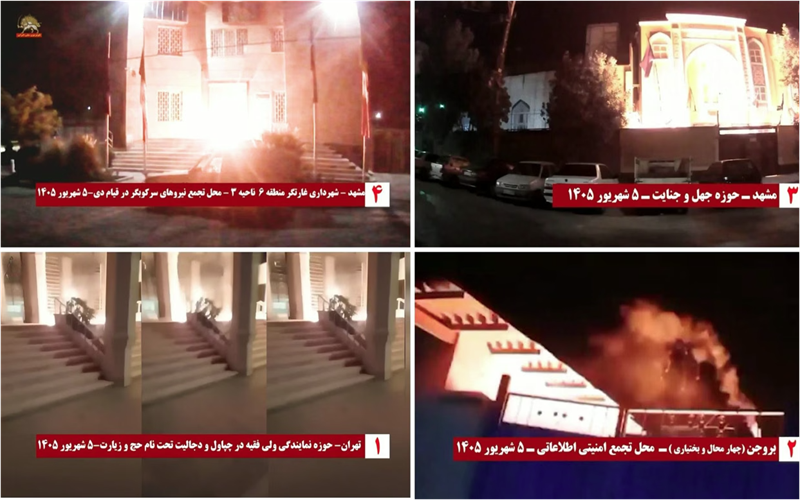

Resistance Units carried out 60 coordinated acts of protest across Iran, targeting regime propaganda and symbols of repression in response to plans to increase gasoline prices.
The Iranian regime’s decision to increase gasoline prices has triggered a new wave of defiant actions by Resistance Units across the country, sending a direct warning that another fuel-price shock could once again ignite widespread popular anger.
In a nationwide campaign described as “60 fiery warnings against raising gasoline prices,” Resistance Units carried out actions in dozens of cities, targeting regime propaganda, symbols of its leadership, and centers associated with the security and repression apparatus.
The message accompanying the campaign was unequivocal:
“If you raise [the price], like 2019, all of Iran will be on fire!”
The reference to 2019 is significant. The November 2019 gasoline-price increase triggered one of the largest nationwide uprisings in the history of the regime, which responded with a brutal crackdown and mass killings of protesters.
The latest actions demonstrate that the memory of that uprising remains deeply embedded in Iranian society and that the regime’s economic decisions continue to carry significant political consequences.
60 Actions Across Iran
The Resistance Units reported a broad campaign spanning Tehran, Karaj, Mashhad, Kermanshah, Shiraz, Zahedan, Chabahar, Iranشهر, Dezful, Babol, Isfahan, and numerous other cities.
The reported actions included attacks against regime-affiliated centers as well as the removal or burning of images and banners associated with the regime’s leaders and security forces.
Among the reported actions were incidents targeting regime-affiliated centers in Tehran, Karaj, Mashhad, Kermanshah, Shadgan, Iranshahr, Borazjan, Chabahar, Brojen, and Dezful.
In several locations, Resistance Units also targeted propaganda displays featuring the regime’s leaders and senior figures.
These included images of former supreme leader Ruhollah Khomeini, Ali Khamenei, Mojtaba Khamenei, Qassem Soleimani, and President Masoud Pezeshkian.
The campaign extended across a remarkably wide geographic area, including Tehran, Karaj, Mashhad, Kermanshah, Shiraz, Yazd, Bandar Abbas, Khorramabad, Ilam, Damghan, Zahedan, Saravan, Sarbaz, Zabol, Babol, Bam, Aligoodarz, Azna, Saveh, Semirom, and Noorabad.
The geographical spread is a central feature of the campaign. Rather than being confined to a single city or region, the actions were reported across northern, southern, eastern, western, and central Iran.
A Direct Challenge to the Regime’s Economic Policy
The gasoline-price issue carries particular weight in Iran because fuel prices have repeatedly acted as a catalyst for broader social unrest.
For ordinary Iranians already confronting inflation, declining purchasing power, unemployment, and deteriorating living standards, higher gasoline prices can have consequences far beyond the cost of filling a vehicle.
Higher fuel prices can feed directly into transportation costs and, consequently, the prices of food and other essential goods. The measure therefore risks intensifying economic pressures that are already generating widespread public dissatisfaction.
The Resistance Units’ campaign seeks to connect this economic pressure with the regime’s broader system of political and security repression.
One of the slogans reported in the campaign offers a direct challenge to the regime’s claim that gasoline shortages require higher prices. It proposes reducing allocations to the Islamic Revolutionary Guard Corps (IRGC), the Basij, the intelligence apparatus, and the police, arguing that cutting their daily fuel consumption would eliminate the alleged shortage and even create a surplus.
The political message is clear: the Resistance Units are portraying the gasoline-price increase not simply as an economic measure, but as a choice about where the regime directs the country’s limited resources.
Remembering the November 2019 Uprising
The repeated reference to 2019 gives the campaign an additional dimension.
In November 2019, a sudden increase in gasoline prices sparked protests that rapidly spread across Iran. Demonstrators in numerous cities challenged the regime, and the authorities responded with lethal force, mass arrests, and an internet shutdown.
The slogan “like 2019, all of Iran will be on fire” therefore functions as both a warning and a reminder.
It warns the regime that another increase in gasoline prices could become a catalyst for renewed unrest.
At the same time, it invokes a previous moment when economic grievances rapidly transformed into a nationwide political confrontation.
The current campaign suggests that the Resistance Units want the regime to understand that the underlying causes of the 2019 uprising have not disappeared.
Beyond Gasoline Prices
Although the immediate trigger for these actions is the proposed gasoline-price increase, the targets and slogans demonstrate that the campaign is directed at the regime as a whole.
The burning of images of Khomeini, Ali Khamenei, Mojtaba Khamenei, Soleimani, and other regime figures reflects rejection of the political system they represent.
The reported actions against Basij facilities and other regime-affiliated centers similarly underscore opposition to the security apparatus used to suppress protests.
In Sarbaz, one reported slogan explicitly rejected both forms of hereditary or authoritarian rule:
“Down with the oppressor, whether Shah or Leader.”
Other actions carried messages such as “Down with Khamenei,” “Long live the National Liberation Army of Iran,” and “Salute to Rajavi.”
These slogans place the gasoline-price dispute within a much broader political struggle over the future of Iran.
A Warning as Public Anger Builds
The latest campaign comes at a time when economic hardship and social grievances are continuing to put pressure on the regime.
For the authorities, raising gasoline prices may be presented as an economic necessity. But the experience of 2019 demonstrates the political risks involved.
The Resistance Units’ 60 reported actions are therefore more than a reaction to the price of fuel. They are intended to demonstrate that organized resistance continues to operate across Iran and that the regime’s economic decisions cannot be separated from the country’s broader political crisis.
The central warning is unmistakable: another gasoline-price shock could once again become the spark for a much larger explosion of public anger.
By invoking 2019 while carrying out actions across dozens of cities, the Resistance Units are signaling that the memory of that uprising remains alive—and that the regime should not assume that repression has eliminated the forces driving popular resistance.