


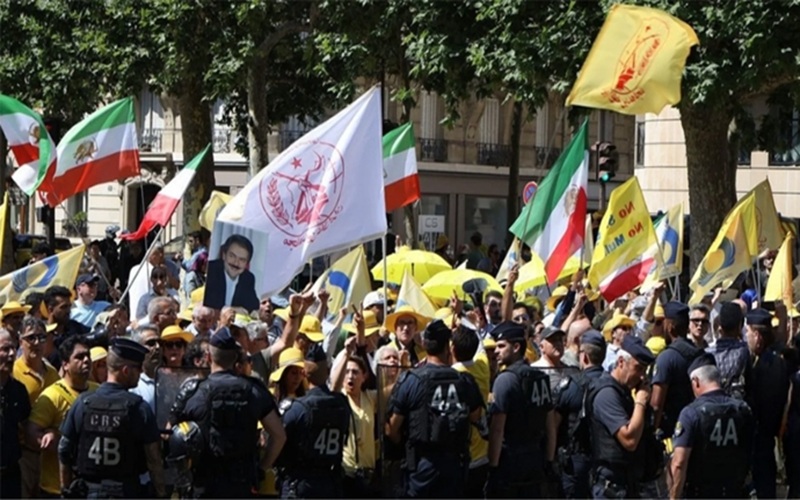

A lengthy attack by the regime’s own religious news agency reveals more than its authors intended: growing anxiety over the PMOI’s organizational endurance, the Resistance Units, and the prospect of a new generation joining the struggle for regime change.
There is a revealing contradiction in the Iranian regime’s latest propaganda campaign against its principal organized opposition.
The regime’s official religious news agency, Hawza News, has published an unusually detailed account of the People’s Mojahedin Organization of Iran (PMOI/MEK), tracing what it describes as four decades of changes in the organization’s strategy—from armed struggle and the formation of the National Liberation Army to political activity, intelligence operations, and the establishment of “Resistance Units” inside Iran.
On the surface, the article is another familiar exercise in demonization. But beneath the accusations and hostile language lies something considerably more significant: the regime is worried.
Hawza News is not merely recounting the history of an opposition organization. It is attempting to explain to its own audience—and apparently to its own security apparatus—why the Resistance has survived decades of repression and why its organizational model remains a concern for the regime.
Most revealingly, the article identifies the Resistance Units as a continuing threat inside Iran and describes them as the evolved form of the National Liberation Army under new circumstances.
That admission deserves attention.
An Unusually Detailed Enemy Profile
Authoritarian regimes do not normally devote extensive space to organizations they consider irrelevant.
Yet Hawza News spends considerable effort reconstructing the evolution of the PMOI’s methods, from its early years through its political and international activities and ultimately to the Resistance Units.
The article itself acknowledges that the organization has repeatedly adapted its methods to changing circumstances. It discusses the shift from military organization to political, media, diplomatic, and intelligence activities, before focusing on the emergence of decentralized cells inside Iran.
The purpose is clearly hostile. The narrative seeks to portray the PMOI as a persistent threat and to discredit its activities.
But that very effort produces an unintended admission: the regime does not believe that the Resistance disappeared.
Instead, it is studying how it changed.
That distinction is crucial.
For decades, the regime has attempted to convince Iranian society that organized resistance is either dead, irrelevant, foreign-controlled, or incapable of surviving. Hawza News inadvertently undermines that narrative by documenting the opposite: an opposition movement that, according to the regime’s own account, has repeatedly altered its methods in response to changing political and security conditions.
The Real Source of Anxiety: The Resistance Inside Iran
The most revealing section of the Hawza News article concerns the “Resistance Units.”
50 Resistance Actions Across Iran Back Simay-e Azadi Solidarity Campaign
The regime’s outlet acknowledges that the PMOI has sought to replace the model of a conventional force operating from outside Iran with small, decentralized and dispersed networks inside the country.
It goes further, describing these units in the organization’s own terminology as potential and active units of the National Liberation Army adapted to new conditions. It also explicitly connects them to nationwide protests.
This is the point at which the article ceases to be merely a historical attack and becomes a window into the regime’s security concerns.
The regime can portray an opposition movement abroad as distant. It can censor its statements, suppress its media, and restrict access to its events. It can dismiss political activity outside Iran as irrelevant to ordinary citizens.
What it cannot easily dismiss is organized activity inside Iran.
That is why the Resistance Units represent a qualitatively different problem.
The regime’s fear is not simply that the PMOI continues to exist. Its deeper concern is that an organized resistance network can connect political opposition with social unrest and transform spontaneous anger into sustained resistance.
This explains the extraordinary attention devoted to the subject.
The Younger Generation Is the Regime’s Deeper Concern
The opening analysis accompanying Hawza News’ article identifies an even more fundamental source of anxiety: the possibility that younger Iranians are increasingly receptive to the Resistance and its message.
This concern is especially significant because it strikes at one of the regime’s most important propaganda objectives.
For years, the regime has invested enormous resources in demonizing the PMOI. State media, clerical institutions, security organizations, and official cultural bodies have repeatedly portrayed the organization as an obsolete or discredited force.
Yet the regime continues to campaign against it.
That persistence raises an obvious question: if the Resistance were truly irrelevant, why does the regime remain so determined to explain, denounce, and monitor it?
The answer lies in the changing social environment.
Iran’s younger generation has grown up amid economic collapse, political repression, corruption, censorship, unemployment, and repeated waves of protest. Increasing numbers have little attachment to the ideological narratives that the regime used to justify its rule.
For the regime, the emergence of an organized opposition capable of reaching this generation represents a strategic danger.
A young person who merely dislikes the regime is a problem.
A young person who becomes politically organized is a much greater problem.
And a network of organized young people capable of sustaining resistance is precisely the scenario that authoritarian security institutions seek to prevent.
The Regime’s Propaganda Reveals Its Weakness
The language of Hawza News is also revealing.
The article attempts to portray the Resistance as constantly changing tactics because its previous strategies supposedly failed. But the same chronology can be read in an entirely different way: the organization survived successive political, military, regional, and security transformations by adapting to them.
That is precisely what appears to trouble the regime.
A movement that remains fixed can eventually be neutralized.
A movement that adapts is harder to eliminate.
The regime has spent decades trying to destroy the PMOI through executions, imprisonment, propaganda, diplomatic pressure, intelligence operations, and physical attacks. Yet its own media continues to analyze the organization’s structure, history, political activities, international campaigns, and Resistance Units.
This is not the behavior of a government dealing with an irrelevant historical remnant.
It is the behavior of a regime that continues to regard the organization as a security and political threat.
Even the Nuclear Exposures Remain a Source of Anger
Hawza News also returns to the Resistance’s international revelations concerning the regime’s nuclear program, including the exposure of facilities at Natanz and Arak in 2002.
Whatever political conclusions the regime attempts to draw from those events, the fact that its own media continues to revisit them demonstrates their enduring significance in the regime’s narrative.
The point is not merely historical.
The regime remains deeply sensitive to the Resistance’s ability to expose information that it would prefer to keep hidden.
This explains why the regime’s campaign against the PMOI has never been limited to physical repression. It has also involved an extensive information war: demonization, disinformation, censorship, and efforts to prevent the organization from gaining credibility among the Iranian population and the international community.
The persistence of that campaign is itself evidence of the regime’s concern.
A Regime Fighting on Two Fronts
The political significance of the Hawza News article becomes clearer when viewed against the regime’s broader crisis.
The regime is struggling simultaneously with internal discontent and external pressures. Its response has increasingly relied on repression, militarization, censorship, and the presentation of permanent confrontation as a means of maintaining control.
But these measures cannot resolve the underlying crisis.
They can suppress a protest.
They cannot eliminate the reasons for the protest.
They can arrest activists.
They cannot arrest an entire generation’s accumulated anger.
And they can censor opposition voices.
They cannot permanently prevent people from organizing.
This is why the regime’s attention to the Resistance Units matters. It reflects an understanding within the regime’s own apparatus that the decisive arena is not simply international diplomacy or propaganda abroad.
It is Iran itself.
The Contradiction at the Heart of the Regime’s Campaign
The more the regime attempts to prove that the Resistance is insignificant, the more it demonstrates how seriously it takes it.
Hawza News wanted to produce a case against the PMOI.
Instead, it produced a remarkably detailed account of why the regime continues to monitor the organization.
It acknowledged the organization’s ability to adapt its methods. It discussed its political and international activities. It revisited its nuclear revelations. Most importantly, it highlighted the emergence of decentralized Resistance Units and their connection to protests inside Iran.
These are not the concerns of a regime that believes the opposition has disappeared.
They are the concerns of a regime that sees the possibility of organized resistance converging with widespread social discontent.
That is the real story behind this propaganda piece.
The Resistance the Regime Cannot Erase
The Iranian regime has spent decades trying to erase the PMOI from the political landscape.
It has not succeeded.
Instead, its continued obsession has become increasingly revealing.
Every new campaign of demonization carries an implicit acknowledgment that the organization remains sufficiently relevant to require attention. Every warning about Resistance Units reveals concern about organized activity inside Iran. Every attempt to discredit the Resistance before a younger generation demonstrates fear that the regime’s narrative is losing its effectiveness.
The most important message emerging from Hawza News, therefore, is not the accusations contained in its report.
It is the fear behind them.
The regime understands that its greatest vulnerability is not merely economic hardship, political isolation, or social discontent in isolation. Its deeper vulnerability lies in the possibility that a deeply dissatisfied society can connect with an organized resistance capable of sustaining the struggle for fundamental political change.
That is why the regime keeps talking about the Resistance.
And that is why, beneath the anger of its propaganda, Hawza News has inadvertently revealed something far more important: the regime remains deeply afraid of what an organized, determined resistance can mean when it meets a population that has lost its fear.