
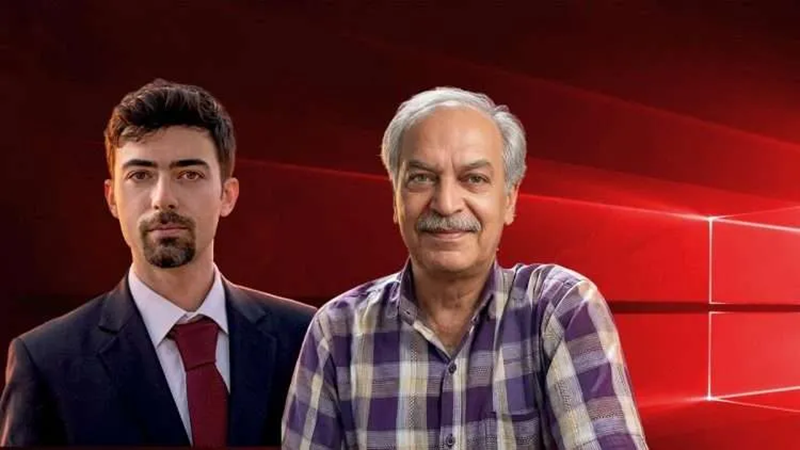

From pre-revolution resistance to modern-day protests, the executions of two political prisoners reflect the continuity of dissent—and repression—in Iran.
In the early hours of April 4, 2026, before dawn had broken, two more names were added to Iran’s long and painful record of political executions. Vahid Bani-Amerian and Abolhassan Montazer—men from two different generations but united by a shared commitment to opposition—were hanged in Ghezel Hesar Prison.
They joined a growing list of executed prisoners in recent days, including Mohammad Taghavi, Akbar Daneshvar Kar, Babak Alipour, and Pouya Ghobadi. Their alleged crime was not an act of violence in the conventional sense, but rather their involvement in efforts to challenge an entrenched system of power. For that, they were sentenced to death.Yet their executions mark not an end, but a continuation—embedding their stories more deeply into the historical memory of resistance in Iran.
Vahid Bani-Amerian: A Life Shaped by Resistance
Vahid Bani-Amerian, 33, was born in 1992 in the city of Songhor, in Kermanshah province. He grew up in a politically conscious household; his father had been arrested in the 1980s for opposing the ruling system. This early exposure to political repression helped shape his worldview.
Academically, he pursued higher education in management at Khajeh Nasir Toosi University in Tehran, eventually earning a master’s degree. During his university years, he became actively involved in student organizations and political discussions—activities that soon drew the attention of security agencies.
His first arrest came in 2017 during student protests. It marked the beginning of a cycle of detentions and prosecutions. In 2018, he was arrested again on charges of “acting against national security” and spent months in prison. Over the following years, he was repeatedly detained, ultimately spending around six years behind bars.
In March 2023, after a temporary release, he was exiled to the remote and underdeveloped Bashagard region in Hormozgan province. The exile imposed harsh living conditions and social isolation, yet it failed to weaken his resolve.
His final arrest took place in January 2024 in Tehran. He was transferred to Ward 209 of Evin Prison, a facility controlled by the Ministry of Intelligence, where numerous reports indicate he was subjected to severe physical and psychological torture. These included beatings, sleep deprivation, threats against his family, and coercion to extract confessions. The abuse left him with serious injuries, including broken ribs.
In October 2024, his trial was held behind closed doors without legal representation. By December, he had been sentenced to death—a ruling later upheld by the Supreme Court. The charges included “armed rebellion,” membership in the People’s Mojahedin Organization of Iran (PMOI/MEK), and “collusion against national security.”
For long periods, his family had no information about his condition. Their repeated attempts to seek answers from Evin Prison authorities were met with silence, and even their public protests were suppressed.
Following a series of prison transfers in mid-2025—reportedly after unrest linked to an attack near Evin Prison—he was eventually moved to Ghezel Hesar. These transfers, combined with a wave of executions, heightened fears that his sentence would soon be carried out.
In his final days, Bani-Amerian wrote a letter expressing his enduring commitment to his beliefs and a sense of responsibility toward his cause. Shortly thereafter, he was executed.
Abolhassan Montazer: A Lifetime of Struggle
Abolhassan Montazer, 67, represented an earlier generation of Iranian political activists. Born in Tehran in 1959, he began his political activism before the 1979 revolution. A trained architect, he was also a husband and father of two, but much of his life was defined by imprisonment.
His first arrest occurred in 1977 under the Shah’s regime, when he was detained by SAVAK in Mashhad and spent six months in Vakilabad Prison. Even before that, he had experienced detention during his military service.
After the revolution, he was arrested again in June 1981 by the Revolutionary Guards and sentenced to over four years in prison, serving time until 1985. This marked the beginning of decades of intermittent arrests, including in 2017, 2018, and 2020.
In 2018, he was detained once more and later sentenced to five years in prison in 2020. During this period, he underwent open-heart surgery. He was eventually released in 2022, but his freedom was short-lived. In January 2024, he was arrested again and transferred to Ward 209 of Evin Prison.
Montazer suffered from multiple serious health conditions, including heart and lung disease, kidney stones, diabetes, arthritis, prostate issues, and psoriasis. Despite this, he was repeatedly denied adequate medical care.
His protest against prison conditions, including poor food quality, led to punitive transfers, including to Ghezel Hesar Prison’s quarantine section, where his health deteriorated further. Reports indicate he was severely beaten during detention, causing chest injuries and reopening surgical wounds. Although he was transferred to Rajaei Hospital in Karaj, he did not receive sufficient treatment.
In May 2024, he was formally charged with “armed rebellion,” “baghi,” membership in the PMOI, and destruction of public property. By October 2024, Branch 26 of the Tehran Revolutionary Court had sentenced him to death, along with an additional five-year prison term.
His case drew international attention. Amnesty International called for the sentence to be overturned, while Iran Human Rights and the Flemish Parliament of Belgium condemned the ruling. Hundreds of international experts urged the United Nations to intervene, and members of the U.S. Congress also voiced opposition.
Despite his age and deteriorating health, Montazer remained steadfast. In a written pledge in 2023, he reaffirmed his commitment to continue resisting, regardless of the personal cost.
A Shared Fate Across Generations
The execution of Vahid Bani-Amerian and Abolhassan Montazer illustrates a continuity that spans decades: different generations, shaped by different political contexts, arriving at the same point—execution for their opposition.
Their lives trace a line through Iran’s modern history, from pre-revolution struggle to contemporary unrest. Their deaths, coming amid a wave of executions, raise renewed questions about the role of capital punishment as a political tool and the broader trajectory of dissent in the country.
While the state may view these executions as a means of deterrence, the historical pattern suggests a more complex outcome. In many cases, such actions deepen grievances and reinforce the narratives of resistance they aim to suppress.
For now, their names join a growing list—marking not only lives lost, but a continuation of conflict between the authorities and those who challenge them.