


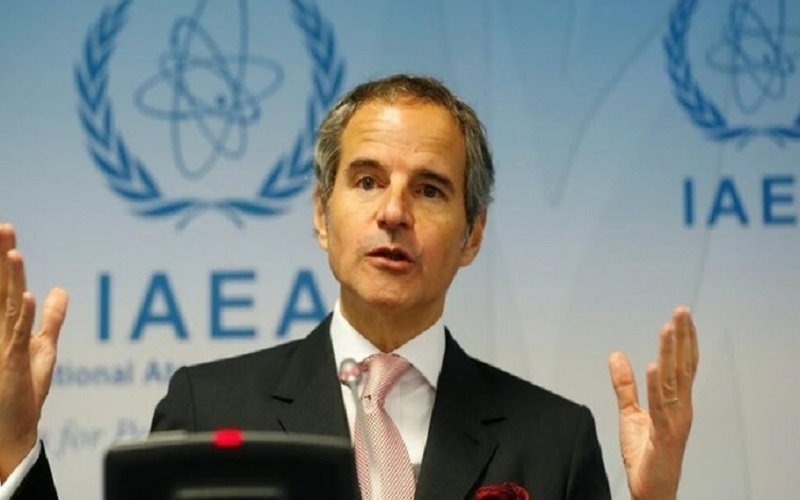

The head of the International Atomic Energy Agency (IAEA), Rafael Grossi, cautioned on Tuesday that diplomatic opportunities to negotiate a renewed international agreement on the Iranian regime’s nuclear program are diminishing. This statement came as he prepared for an upcoming visit to Tehran.
“The Iranian regime must understand that the international situation is becoming increasingly tense,” Grossi stated in an interview with AFP. “It is imperative to explore diplomatic solutions before the space for negotiation disappears.”
The IAEA, which is responsible for monitoring the Iranian regime’s nuclear activities, currently has inspection access to Iranian facilities. However, Grossi emphasized that this access remains insufficient. “We need to see more,” he asserted, citing the expanding scope and ambition of the regime’s nuclear program. Grossi called for increased transparency, adding, “We need to find ways of giving the agency more visibility.”
The Iranian Regime’s Escalating Nuclear Program
Reports from the IAEA reveal that the Iranian regime has significantly expanded its nuclear program, including increasing its enriched uranium stockpile with levels reaching up to 60% purity—just below the 90% threshold necessary for weapon-grade material.
In a recent interview with CNN, Grossi remarked, “They have a big, big nuclear program. They have a lot of nuclear materials that could eventually be used to make a nuclear weapon… This is one of the reasons I’m heading to Tehran.”
Grossi’s last visit to Iran in May included a tour of the Natanz uranium enrichment facility in Isfahan province. During that visit, he urged Iranian officials to take concrete steps to address international concerns over their nuclear activities. However, the regime has continued to enrich uranium to near-weapon levels, raising alarms within the international community. The IAEA estimates that the regime’s enrichment activities could yield enough material for approximately four nuclear bombs.
Despite these concerns, the Iranian regime insists that its nuclear pursuits are peaceful and non-military in nature.
Negotiations for a New Nuclear Agreement
In earlier statements to the Associated Press, Grossi referenced remarks by the regime’s president Masoud Pezeshkian on Tehran’s alleged willingness to cooperate on a nuclear agreement, which Grossi viewed as a potential opening for diplomacy. “What I would like to hear from him,” Grossi added, “is what he thinks about going back to an agreement.”
While Grossi has acknowledged the possibility of renewing the Joint Comprehensive Plan of Action (JCPOA), he noted that any new agreement would need to be far stronger than the original, as the Iranian regime’s nuclear capabilities have significantly advanced since the JCPOA was first established.
According to Reuters, Iranian officials have welcomed Grossi’s upcoming visit and expressed willingness to collaborate with the IAEA to address existing issues, though specific details of this proposed cooperation remain unclear.
Ongoing Disputes Over Undeclared Sites and Uranium Traces
Grossi’s diplomatic push comes amid ongoing tensions surrounding the Iranian regime’s refusal to fully cooperate with the IAEA’s investigations. Tehran’s obstruction of IAEA inspectors and lack of transparency about undeclared sites, where traces of uranium were previously detected, remain key points of contention.
These developments occur as Grossi has described the JCPOA as an “empty shell” in its current form, underscoring the urgency of addressing Iran’s stockpile of 60% enriched uranium—dangerously close to weaponization levels.
With the IAEA’s threshold criteria indicating that the regime has accumulated enough enriched uranium to produce four nuclear weapons with additional enrichment, the need for more decisive solutions against the regime and heightened transparency is critical.