



Calls by regime officials and parliamentary figures to revise Iran’s nuclear doctrine and pursue an atomic bomb serve both to rally demoralized supporters and intimidate regional countries, as mounting economic and social crises fuel fears of another uprising.
As Iran’s economic crisis deepens and social tensions intensify, officials and affiliated figures of the ruling establishment have increasingly raised the prospect of revising the country’s nuclear doctrine and pursuing nuclear weapons. The growing calls, coming from Friday prayer leaders, members of parliament, and regime supporters, point to an effort to turn the nuclear issue into an instrument of domestic propaganda and external intimidation.
The timing is significant. With widespread economic hardship, declining public confidence, and growing concern within the establishment about another popular uprising, the regime is attempting to project an image of strength and strategic capability. Its increasingly explicit nuclear rhetoric appears designed to serve two purposes: restore the morale of its own weakened ranks and create fear among regional countries amid continuing military tensions.
Regime officials manufacture public support for nuclear weapons
One of the most explicit calls came from Abdolali Haj-Ali Akbari, Tehran’s Friday prayer leader, who questioned why the regime should not reconsider its nuclear doctrine.
He claimed that more than 70 percent of Iranians supported such a change, citing an unspecified opinion poll without providing information about its date, methodology, or where it had been conducted.
The claim was presented as evidence of popular demand for a more aggressive nuclear policy. However, no verifiable information was offered to establish the alleged public consensus.
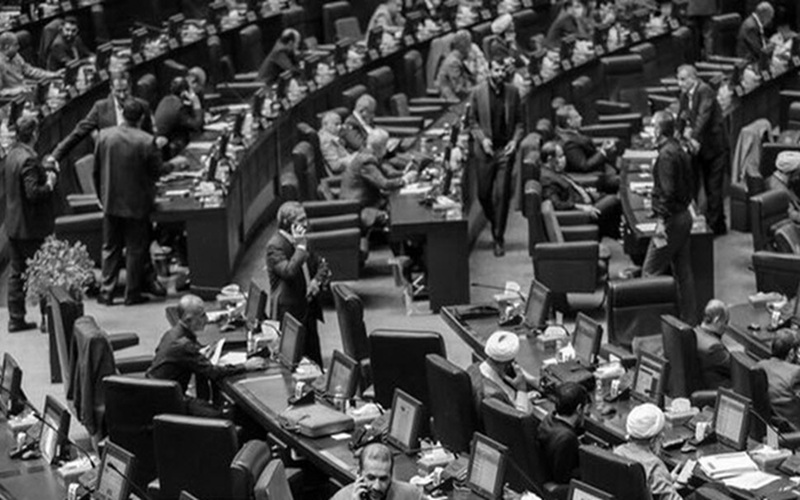
Similar statements have emerged from members of the regime’s parliament. Alireza Salimi, a member of parliament’s presiding board, described a revision of the country’s defense policy and nuclear doctrine as a consensus among the elites and a demand of the general population. He also raised the possibility of introducing an expedited parliamentary motion and withdrawing from the Nuclear Non-Proliferation Treaty (NPT).
Another parliamentary figure, Mahmoud Nabavian, had previously sought authorization for the development of nuclear weapons during the 12-day war, according to accounts of his remarks.
These statements indicate that the nuclear issue is being deliberately elevated beyond technical discussions about the country’s nuclear program and presented as a matter of national strategy and political mobilization.
A nuclear weapons ambition exposed decades ago
The prospect of the regime pursuing nuclear weapons is not new. Approximately 25 years ago, the Iranian Resistance exposed previously undisclosed aspects of the regime’s nuclear program, bringing international attention to activities that had not been transparently reported.
Subsequent revelations about concealed nuclear facilities and activities further intensified international concerns and contributed to the referral of Iran’s nuclear file to the United Nations Security Council.
The repeated revelations of undeclared activities have reinforced concerns that the regime has sought to advance its nuclear capabilities while concealing important aspects of its program from international scrutiny.
Against this background, the latest calls to revise the nuclear doctrine are particularly significant. Rather than representing an isolated political debate, they come after decades of controversy surrounding the regime’s nuclear ambitions and its relationship with international monitoring and nonproliferation obligations.
Two objectives: Rallying supporters and intimidating regional countries
The increasingly open nuclear rhetoric serves two interconnected political objectives.
First, the regime is attempting to restore the morale of its own supporters. Faced with mounting internal difficulties, the ruling establishment needs to convince its weakened and increasingly disillusioned ranks that it retains the capacity to confront its adversaries and achieve strategic objectives.
Promises of technological and military advancement, including the prospect of building an atomic bomb, are used to project strength and maintain the loyalty of supporters.
But this propaganda carries risks. The regime has repeatedly made promises of retaliation and military achievements that have not necessarily materialized. When such promises remain unfulfilled, they can deepen frustration among supporters who expect concrete results.
Second, the nuclear rhetoric is intended to influence the regional balance of power. By openly discussing the possibility of acquiring nuclear weapons and abandoning existing international commitments, the regime seeks to increase the perceived cost of confronting it.
Regional countries, in particular, are meant to consider the potential consequences of an Iran governed by an establishment openly threatening to revise its nuclear doctrine.
The strategy is therefore not simply about nuclear development. It is also about using the threat of nuclear escalation as political leverage at a time when the regime faces serious vulnerabilities.
Fear of another uprising dominates the regime’s calculations
Behind the increasingly aggressive external rhetoric lies a deepening domestic crisis.
Warnings issued by regime officials and Friday prayer leaders reveal growing concern about public attitudes, particularly among younger generations. Their statements increasingly focus on controlling people’s access to information, monitoring social interactions, and treating ordinary citizens with suspicion.
Hosseini Hamedani, Khamenei’s representative and Friday prayer leader in Karaj, urged his audience to place guards at the entrances to their hearts, referring to their eyes and ears. The warning reflected concern about the ideas and information reaching people and influencing their political outlook.
Another Friday prayer leader, in Zabarah, called on people to be suspicious of anyone approaching them and to report immediately any suspicious movements or visits to residential properties.
Such appeals reveal the atmosphere of suspicion and insecurity that the establishment is attempting to cultivate. Even ordinary social interactions are being framed through the lens of potential threats to the regime.
The repeated warnings about ideological influence, suspicious individuals, and the need for vigilance point to a leadership increasingly preoccupied with developments within society.
Economic hardship compounds political and security fears
The regime’s anxiety is also closely connected to the deteriorating economic situation.
President Masoud Pezeshkian has acknowledged the difficulties facing his government, describing the pressures associated with war and the country’s broader crisis as overwhelming. He has also referred to instructions from Ali Khamenei to resolve the problems, highlighting the difficulties of translating the leadership’s directives into practical results.
Meanwhile, the country’s economic conditions have become a growing source of public anger. Officials themselves have acknowledged the extent of poverty and hardship, while the economy minister has publicly apologized over the economic situation.
These admissions come against a background of declining purchasing power, rising living costs, and widespread dissatisfaction among workers, retirees, and other sections of society.
For the ruling establishment, the danger is that economic grievances can develop into broader political opposition. The memory of previous uprisings and the possibility of renewed nationwide protests remain central concerns.
Nuclear threats cannot resolve the regime’s domestic crisis
The increasingly explicit calls for nuclear weapons emerge at a moment when the regime is struggling simultaneously with economic deterioration, social discontent, internal divisions, and regional tensions.
By promoting the prospect of an atomic bomb, officials seek to project an image of power and determination. Yet the same rhetoric also exposes the establishment’s need to compensate for its growing domestic vulnerabilities through displays of military strength.
The nuclear issue thus serves as both an instrument of external intimidation and a propaganda tool aimed at maintaining internal cohesion.
But nuclear ambitions cannot address the underlying causes of public anger: poverty, corruption, repression, unemployment, and the destruction of economic security.
The regime may attempt to portray nuclear weapons as a symbol of national strength, but its increasingly defensive rhetoric, combined with repeated warnings about social unrest, reveals a leadership deeply concerned about the forces gathering within Iranian society.