


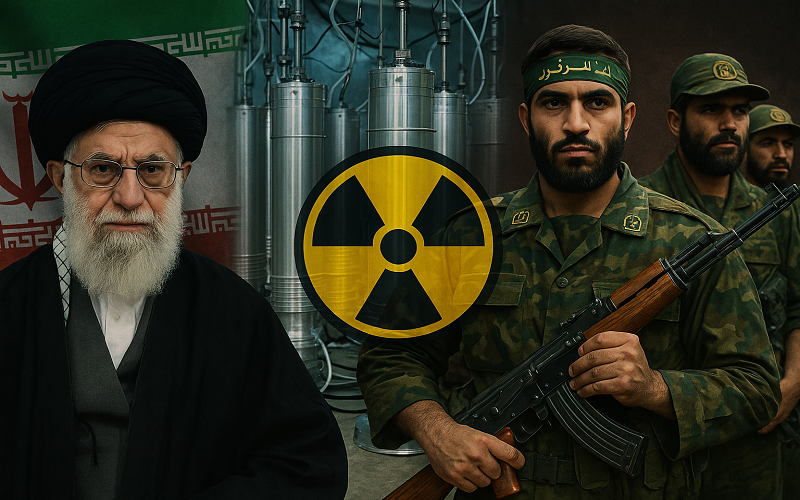

In 2003, the Iranian regime publicly claimed to have frozen its nuclear program. However, this narrative changed in July 2015, when the United States, under President Barack Obama, pursued a policy of appeasement through the Joint Comprehensive Plan of Action (JCPOA), commonly known as the Iran Nuclear Deal.
While promoted as a diplomatic breakthrough, the agreement provided Iran with the opportunity to clandestinely continue its nuclear activities while simultaneously expanding its destabilizing influence across the Middle East.
Rather than containing Iran, the JCPOA enabled the regime to escalate its regional interference and bolster its support for terrorist proxy forces throughout the region and beyond. The policy of appeasement allowed Tehran to consolidate power, eliminate opposition, and inch closer to the nuclear threshold.
By 2021, Iran had significantly curtailed the International Atomic Energy Agency’s (IAEA) monitoring access, making it increasingly difficult for the agency to verify the peaceful nature of the country’s nuclear program.
Since 2019, Iran has expanded its uranium enrichment efforts, enriching uranium to 60%—a level dangerously close to weapons-grade and with no plausible civilian application. It has also deployed advanced centrifuges capable of enriching uranium with greater efficiency. The technical knowledge Iran has gained from these activities is irreversible.
Iran’s Current Nuclear Capabilities
As of November 2024, Iran’s stockpile of enriched uranium includes:
-
182 kg enriched to 60%
-
840 kg enriched to 20%
-
2,595 kg enriched to 5%
These levels of enrichment have drastically reduced Iran’s breakout time—the period required to produce enough weapons-grade uranium for a nuclear bomb. Today, the regime can theoretically produce sufficient material for five to six nuclear weapons in less than two weeks.
Iran has also vastly expanded its enrichment infrastructure. At its Natanz and Fordow facilities, the regime has installed:
-
42 cascades of operating IR-1 centrifuges
-
37 cascades of IR-2 centrifuges (15 operating)
-
13 cascades of operating IR-4 centrifuges
-
15 cascades of IR-6 centrifuges (7 operating)
In late 2024, the regime announced plans to further accelerate its enrichment activities. It notified the IAEA of its intention to install 32 additional centrifuge cascades and increase the production of 60% enriched uranium by feeding 20% material into two IR-6 cascades. According to the IAEA, this change would raise monthly production of 60% uranium at Fordow from 4.7 kg to 37 kg.
Alarming Reductions in Oversight
Compounding these developments, Tehran has suspended critical monitoring provisions, further obstructing the IAEA’s ability to oversee the program. These suspended measures include:
-
Implementation of the Additional Protocol – expanding IAEA access to sites and information
-
Daily access to Natanz and Fordow
-
Continuous surveillance of sensitive nuclear sites
-
Modified Code 3.1 – requiring early disclosure of new facility designs
Without these safeguards, there is an increasing risk that Iran could carry out a “breakout” between inspections. The IAEA is unable to verify whether critical nuclear materials such as centrifuges and uranium ore concentrate have been diverted to secret locations. It cannot conduct short-notice inspections, nor does it have access to early design data for new facilities—vital tools for enforcing effective oversight.
Questioning the Supreme Leader’s Fatwa
Further casting doubt on Iran’s intentions, regime officials have recently questioned the credibility and permanence of Supreme Leader Ali Khamenei’s so-called fatwa against nuclear weapons. This decree has long been used by Iran’s defenders as evidence of its peaceful intentions. However, history shows that such proclamations are often tactical, not principled. In November 2024, Kamal Kharrazi, a senior advisor to Khamenei, openly stated that Iran could revise its nuclear doctrine if the regime’s survival were threatened.
Meanwhile, both current and former heads of Iran’s Atomic Energy Organization have acknowledged that Iran possesses the technical know-how to build nuclear weapons.
A Region Under Siege
Iran’s growing nuclear capabilities are only part of the threat. The regime continues to wield enormous influence in the Middle East, particularly in Lebanon, Iraq, and Yemen, where it supports armed militias and fosters instability. Without significant setbacks imposed on Iran’s regional agenda, any new deal will likely strengthen the Islamic Revolutionary Guard Corps (IRGC) and the Basij paramilitary—two pillars of Iran’s domestic repression.
If Tehran receives sanctions relief through a new agreement without meaningful concessions, it will use the windfall to further suppress dissent and cement its regional hegemony. The regime understands that dismantling its nuclear program would likely weaken its grip on power and provoke internal unrest, potentially triggering a broader collapse of influence in the region.
The Path Forward: Strength Through Resolve
Tehran will exploit any hint of weakness at the negotiating table. Therefore, future negotiations must begin not with appeasement but with resolve. The international community must send a clear message: Iran’s aggressive behavior, nuclear brinkmanship, and human rights abuses will no longer be tolerated.
Since July 2024, during President Masoud Pezeshkian’s tenure, the Iranian regime has executed more than 1,051 individuals—a grim testament to its ongoing brutality, enabled by global inaction.
The most effective strategy for confronting the Iranian regime is to support its democratic opposition and apply maximum pressure. A key step would be for the European Union to officially designate the IRGC as a terrorist organization. This would directly target the regime’s repressive apparatus and send a strong signal to the Iranian people.
In the absence of such bold actions, any alternative will be insufficient—and, at best, cosmetic.