


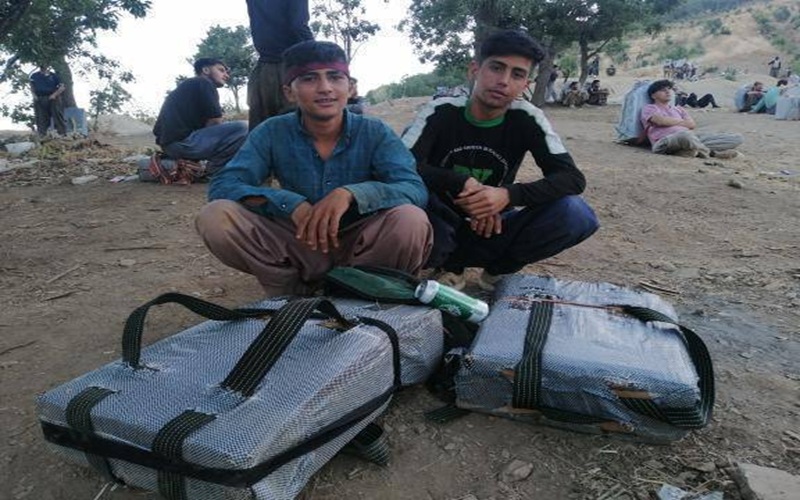

Economic hardship and the lack of stable employment in Iran’s border regions are pushing children and young people into kolbari, exposing them to shootings, landmines, and fatal accidents.
Iran’s deepening economic crisis is pushing an increasingly vulnerable population into dangerous forms of informal labor. In the country’s border regions, poverty and the absence of stable employment are reportedly forcing children and teenagers to join the ranks of kolbars—people who carry goods across mountainous border routes under extremely hazardous conditions.
The warning was raised on August 30 by labor activist Abdullah Balwasi in an interview with the state-run ILNA news agency. He said the economic pressures facing families in border areas are increasingly affecting children and adolescents as well.
“A teenager who goes down a path where there is a possibility of being shot, stepping on a landmine, or suffering an accident simply to help his family or pay for school and living expenses should be a serious warning to society,” Balwasi said. “A child should be sitting behind a school desk, not on a kolbari route.”
His remarks highlight a particularly grim dimension of Iran’s poverty crisis: children are being pulled into dangerous work not because of personal choice, but because families lack sufficient income to meet basic needs.
Poverty leaves young people with few choices
According to Balwasi, the shortage of employment opportunities in border areas has left many young people—including university graduates and even accomplished athletes—with an impossible choice: undertake the risks of kolbari or leave their homes in search of opportunities elsewhere.
He specifically pointed to the high rate of migration among young people in Kurdistan, saying unemployment and the absence of a clear future are encouraging many to consider leaving their cities or even the country.
The problem is rooted in a broader economic crisis that has steadily eroded household purchasing power. The declining value of Iran’s currency, high inflation, unemployment, and the absence of sustainable investment have made it increasingly difficult for families to secure stable livelihoods.
In many border communities, where economic opportunities are already limited, these pressures can be particularly severe.
For some residents, kolbari has consequently become a means of survival. But the work comes with potentially fatal consequences. Kolbars carrying goods across mountainous and often dangerous routes have been killed or injured in recent years, including through shootings by Iranian security forces, landmine explosions, and accidents.
When deaths become “normal”
Balwasi warned that the deaths of kolbars are gradually becoming normalized in Iranian society.
A death may receive media coverage and generate public outrage for several days, he said, before disappearing from public attention. But behind every reported casualty is a family facing potentially devastating consequences.
“When a kolbar is killed, a family is harmed,” Balwasi said. “The breadwinner may be lost, children may be left without a father, or a family may have to deal with medical expenses and disability.”
Reducing these deaths to statistics, he argued, obscures the human cost of the crisis.
His criticism also points to the limitations of treating kolbari primarily as a security problem. Increased enforcement against people engaged in the trade cannot eliminate the economic conditions that drive them toward it.
“If the underlying causes—poverty, unemployment, and the lack of stable employment opportunities—are not addressed, the problem will return,” Balwasi said.
A wider employment crisis
The crisis extends beyond Iran’s border regions.
Growing disparities between wages and living costs, reductions in working hours, and the movement of skilled workers into informal employment have increasingly exposed the scale of the country’s employment crisis.
On August 28, Iran’s Workers’ House in Hormozgan reported that approximately 20,000 workers had become unemployed following economic stagnation and the closure of businesses.
These developments reveal a broader pattern: as formal employment becomes less available and wages lose purchasing power, Iranian households are increasingly forced toward precarious and informal forms of work.
In border regions, that reality can mean kolbari. For young people, it can mean migration. For children, it can mean leaving school for work.
The fact that children are being drawn into a profession where gunfire, landmines, and fatal accidents are known risks should be viewed not as an isolated social problem but as a stark indicator of the country’s deepening poverty.
A child carrying goods across a dangerous mountain route is ultimately a symptom of an economy that has failed to provide families with a safe and sustainable means of survival.