


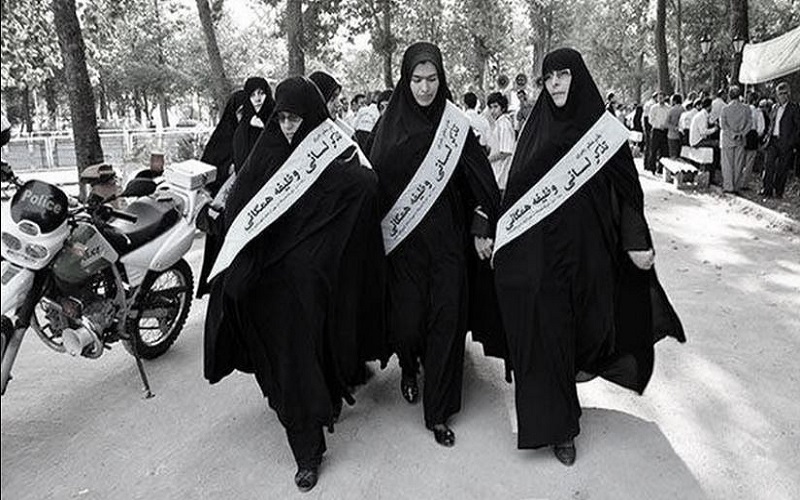

The recent publication of the full text of Iran’s “Chastity and Hijab” law has ignited widespread protests among citizens, legal experts, and social activists. This law, perceived as a continuation of the regime’s systematic policies to suppress individual freedoms—particularly those of women—has drawn sharp criticism online and offline.
A Continuation of Repression
Positioned as a targeted tool to enforce mandatory hijab regulations, this law contradicts the election promises of officials like Masoud Pezeshkian, who had suggested more lenient approaches to social issues. Instead, the legislation pushes forward a punitive framework, further eroding personal freedoms and imposing significant financial burdens.
Harsh Fines and Penalties
The law introduces escalating penalties for violations. For example:
- First-time violations of the mandatory hijab law can result in fines of up to 18 million tomans.
- Repeated violations incur even heavier penalties, multiplying the initial fines.
- Criticizing or protesting against hijab enforcement is punishable by fines ranging from 8 to 18 million tomans.
- Girls aged 9 to 15 who fail to comply face fines and mandatory “educational measures.”
The legislation extends to clothing that reveals body parts such as the neck, forearms, or ankles, whether in public spaces or online images. After two warnings, a third violation triggers fines starting at 8 million tomans, increasing to 18 million tomans for subsequent offenses. Unpaid fines can lead to judicial punishments, creating further legal jeopardy for offenders.
Surveillance and Control
The law also mandates harsh measures for non-compliance with enforcement mechanisms:
- Residential complex managers who refuse to provide CCTV footage of women opposing the hijab law face fines of 18 to 36 million tomans.
- Internet taxi drivers are required to report female passengers who defy mandatory hijab rules.
Failure to pay fines within 10 days results in restrictions on essential services, including passport issuance, vehicle registration, and driver’s license renewal.
Targeting Cultural Expression
The law extends its reach to cultural and creative spaces, banning designs, toys, artwork, and mannequins deemed to “promote hijab violations.” Violators face fines, travel bans, and restrictions on digital activities.
Men who enter women-only sections of public transport or mock the mandatory hijab can also be penalized, underscoring the pervasive reach of this legislation.
Enlisting Institutions for Enforcement
The law assigns enforcement responsibilities to an array of governmental bodies, including:
- The Ministry of Culture and Islamic Guidance
- Islamic Republic of Iran Broadcasting (IRIB)
- The Ministry of Science, Research, and Technology
- The Police Force and Basij militia
- Local municipalities and village heads
This extensive network of enforcement aims to suppress opposition under the guise of promoting “Islamic culture.”
Controversial Provisions
Among the more contentious articles:
- Article 22 tasks the Ministry of Roads and Urban Development with constructing housing “in line with Islamic culture.”
- Islamic clothing mandates require the establishment of permanent stores for “appropriate” clothing, support for Islamic textile production, and bans on garments contrary to Islamic values.
Broken Promises and Public Backlash
Notably, the law contradicts earlier promises by regime officials to curtail guidance patrols and end arrests for hijab violations. This about-face has fueled public outrage, especially in light of the transformative social changes following the 2022 protests.
A Society in Flux
The regime’s ability to enforce such sweeping laws appears increasingly tenuous. The 2022 uprising marked a turning point, with many women and girls openly defying mandatory dress codes. Even regime officials now concede that laws widely ignored by the populace are difficult, if not impossible, to enforce.
Conclusion
The “Chastity and Hijab” law underscores the Iranian regime’s ongoing efforts to control personal freedoms and enforce rigid societal norms. However, its harsh measures and widespread unpopularity risk further alienating a society already in flux. As the gap between the government and the people widens, the potential for sharp and unpredictable reactions grows. This law, rather than stabilizing the regime’s hold, may further destabilize it by igniting renewed dissent.