



June 5 marks World Environment Day, a day when nations across the globe prioritize environmental protection and address pressing issues like climate change.
In many developed and industrialized countries, presidential candidates often highlight environmental policies as a core component of their platforms, garnering the trust and votes of the populace by promising to tackle environmental challenges head-on.
In stark contrast, as Iran prepares for its upcoming presidential elections with 80 candidates registered, environmental concerns seem to be absent from their agendas.
This pattern is not new; successive governments have consistently sidelined environmental issues, viewing them as non-essential to their development goals.
Environmental Neglect in the Name of Development
For the regime in Iran, the environment is often sacrificed under the pretext of progress and development. Environmental considerations are incompatible with the regime’s so-called development plans.
Many officials treat the environment as a consumable resource rather than a renewable asset critical for future generations.
Globally, countries spend hundreds of billions of dollars annually to reduce carbon emissions and combat climate change.
However, Iran’s international isolation and confrontational stance exacerbate its economic woes, leading to environmental degradation.
As poverty deepens, environmental destruction accelerates, creating a vicious cycle where short-term survival trumps long-term sustainability.
The High Cost of Short-Term Gains
Iran’s approach to development disregards four fundamental principles: economic justification, social stability, environmental preservation, and security.
None of these principles are prioritized by the regime. The result is rampant environmental destruction under the guise of development.
The devastation of Iran’s oak forests, which have thrived for hundreds of years, is a glaring example. In the 1980s, extensive soil plowing and erosion exposed the source rock in the Zagros forests, disrupting the natural water absorption process essential for oak tree survival.
This led to the gradual weakening and eventual death of these ancient trees by the 2010s, primarily due to increased vulnerability to diseases.
Policies Fueling Environmental Degradation
The regime’s disregard for environmental issues is evident in its policies and actions. Iran produces vehicles that consume twice as much fuel as global standards.
It neglects to modernize refineries, resulting in the production of substandard gasoline that exacerbates air pollution. Additionally, fuel shortages force factories and power plants to burn mazut, further polluting the air.
Agricultural practices also contribute to environmental degradation. The regime diverts 60% of water resources meant for nature towards food production, consuming 100% of the country’s renewable water.
These unsustainable practices deplete water resources, undermine long-term agricultural productivity, and degrade the environment.
Water Crisis and Soil Erosion
In 1979, Iran had 132 billion cubic meters of renewable water, with consumption below 50 billion cubic meters.
Today, renewable water stands at approximately 95 to 100 billion cubic meters, with consumption nearly matching this supply, marking one of the highest water consumption rates globally.
Iran’s per capita carbon production is also alarmingly high, placing the country among the top carbon emitters despite its modest economic standing.
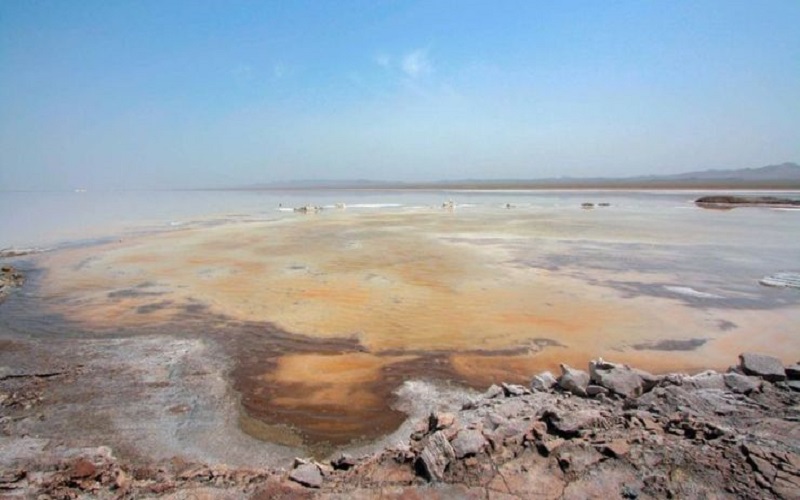
The drying up of wetlands and lakes, such as Jazmurian, Bakhtegan, Lake Urmia, Gavkhoni, and Hawizeh Marshes, has led to dust and salt storms that plague local populations.
Soil erosion further exacerbates the environmental crisis, with wind erosion depleting one millimeter of soil annually. Given that it takes about 40 years to form one millimeter of soil, Iran’s average soil depth of 210 millimeters is at risk of being completely eroded within 210 years. In comparison, European soil averages over four meters in depth, with robust conservation efforts in place.
Conclusion: A Call for Sustainable Development
Iran’s environmental crisis underscores the urgent need for a paradigm shift in its development policies. Sustainable development requires a balanced approach that considers economic, social, environmental, and security factors.
The regime’s current trajectory threatens not only the environment but also the well-being of future generations. Addressing these challenges is not just an environmental imperative but a necessity for the country’s sustainable development and survival.