


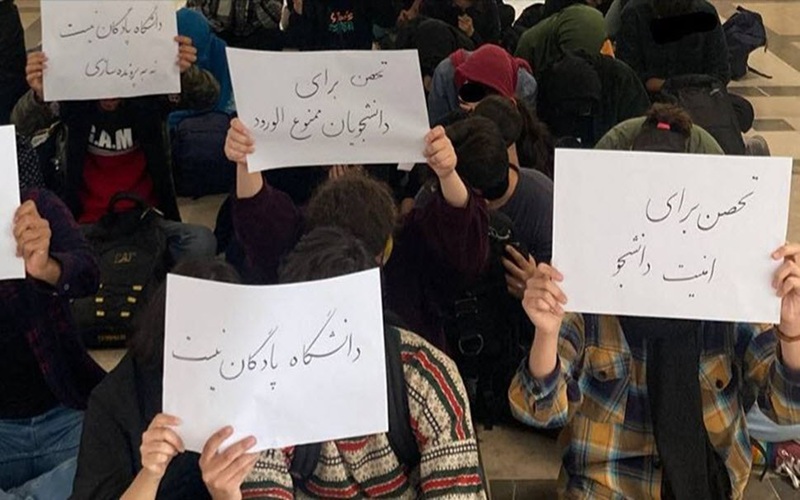

Expulsions, suspensions, disciplinary prosecutions, and surveillance of online activity signal an escalating crackdown on students as authorities tighten control over universities amid growing political and social tensions.
Universities Once Again Become Targets of State Pressure
Iran’s universities are witnessing a renewed wave of repression as authorities intensify disciplinary actions against students across several major academic institutions. Reports published by the regime-affiliated newspaper Shargh and student organizations indicate that hundreds of students have been summoned before disciplinary committees, while many have received suspension or expulsion orders.
The latest measures come as Iranian universities continue to struggle with the consequences of war-related disruptions, prolonged closures, internet restrictions, and an increasingly securitized environment. Student activists and academic organizations argue that the disciplinary campaign is aimed not at maintaining academic standards but at suppressing dissent and preventing universities from once again becoming centers of social and political activism.
According to reports, the current wave of disciplinary cases began shortly after universities reopened in March 2026 and has intensified again in recent weeks despite the continued disruption of normal academic activities.
Student Organizations Protest Disciplinary Rulings
The growing concerns were highlighted when 53 student organizations, publications, and associations at Sharif University of Technology issued a joint letter protesting recent disciplinary rulings.
The signatories called on university authorities to immediately revoke the penalties imposed on students and halt what they described as an increasingly arbitrary disciplinary process.
According to the letter, a number of students have been summoned in recent weeks because of their online activities, including content posted on social media platforms. Student groups argue that disciplinary proceedings have frequently violated established regulations and basic principles of due process.
The letter followed earlier reports from Sharif University’s Student Council indicating that at least 30 students had been summoned and a minimum of six expulsion orders had already been issued. Some of the cases reportedly involved personal social media posts, messages exchanged in private online groups, and the sharing of content on digital platforms.
Expulsions and Suspensions at Sharif University
Reports from Sharif University suggest that between five and seven students have received expulsion orders, while more than 20 others have been suspended for periods ranging from one to three academic semesters.
Students have alleged that some summonses were issued without any clear explanation of the charges. In several cases, disciplinary hearings and verdicts reportedly occurred on the same day, raising serious concerns about the fairness and transparency of the process.
Particularly alarming are reports that some students were punished solely because of their online activities. According to students cited in the reports, several individuals received expulsion orders based on activity on Telegram and X. In one reported case, even a student’s profile picture was allegedly cited as evidence in disciplinary proceedings.
Students have also criticized the reliance on reports from unidentified informants rather than documented evidence, describing the process as opaque and politically motivated.
Hundreds of Students Targeted Across Multiple Universities
The crackdown extends far beyond Sharif University.
At Shahid Beheshti University, reports indicate that the educational accounts of approximately 25 students have been blocked, preventing them from accessing essential academic services. Students say these restrictions were imposed without formal disciplinary hearings, disrupting course registration, grade access, and participation in online classes.
At the University of Tehran, students report that disciplinary files have been opened against between 100 and 200 individuals. Some students living outside Tehran were reportedly informed of accusations by telephone and instructed to submit written defenses via email.
Similar developments have been reported at Iran University of Science and Technology, where disciplinary cases have reportedly been opened against more than 100 students. Some hearings have been conducted virtually, further raising questions about procedural fairness.
Taken together, these reports suggest a coordinated effort to expand disciplinary controls across multiple campuses rather than isolated administrative actions.
Violations of Students’ Rights and Due Process
Critics argue that many of the disciplinary proceedings violate the regime’s own regulations governing student conduct.
According to reports, authorities have disregarded principles such as the presumption of innocence, impartial review, protection from arbitrary surveillance, and the requirement that accusations be formally presented in person.
The lack of transparency surrounding the cases has further fueled concerns. Despite mounting criticism, the regime’s Ministry of Science has remained largely silent, while attempts by journalists to obtain explanations from university officials and ministry representatives have reportedly gone unanswered.
For many students, this silence reinforces the perception that disciplinary committees are increasingly functioning as instruments of political control rather than academic oversight.
Academic Life Under Multiple Pressures
The disciplinary crackdown is occurring against a backdrop of extraordinary challenges facing Iran’s higher education system.
Universities have already been severely affected by months of disruption caused by war, security restrictions, and widespread internet limitations. Educational institutions have struggled to maintain normal operations while students and faculty face growing obstacles to research, communication, and academic engagement.
Internet restrictions have compounded these difficulties. During the prolonged nationwide internet disruptions, university officials acknowledged that faculty members often lacked reliable access to online resources necessary for research and teaching.
Meanwhile, several universities have suffered direct physical and operational disruptions linked to the broader conflict environment. Educational activities, thesis defenses, and classes have frequently been moved online, despite ongoing connectivity problems that have made remote learning increasingly difficult.
Fear of a Return to Campus Security Rule
For decades, Iranian universities have played a central role in political and social movements. Student activists have often been among the first groups targeted during periods of heightened repression, reflecting the regime’s longstanding concern about the influence of universities as centers of independent thought and political mobilization.
The latest wave of disciplinary prosecutions appears to many observers as part of a broader effort to prevent student activism from re-emerging at a time when public dissatisfaction remains widespread.
By targeting social media activity, expanding surveillance, imposing expulsions, and opening disciplinary cases against hundreds of students, authorities appear determined to reassert control over campuses that have historically served as important voices for change.
As universities remain under pressure from political restrictions, security measures, and educational disruptions, many students fear that academic institutions are being transformed from spaces of learning and debate into environments increasingly governed by intimidation and control.
The growing number of disciplinary cases suggests that the regime continues to view independent student activity as a threat—one that it is prepared to confront with increasingly severe measures despite widespread criticism from the academic community