


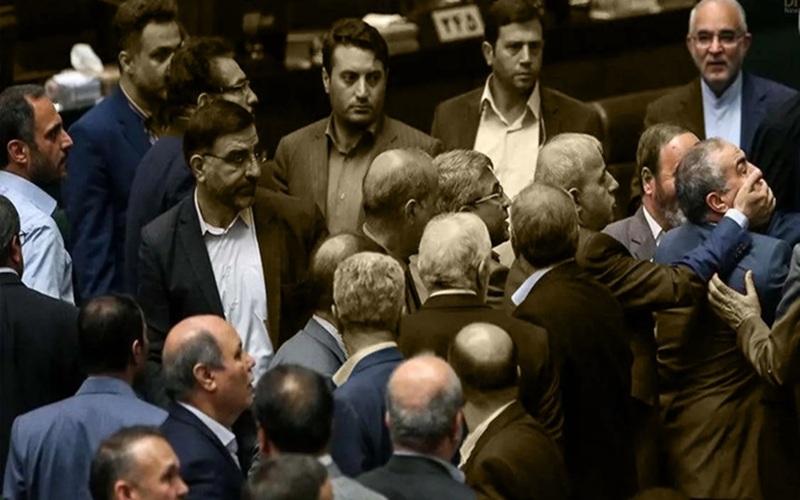

As competing factions battle over negotiations with Washington, the nuclear file, and the Strait of Hormuz, the regime’s internal fractures reveal a growing inability to manage economic collapse, social unrest, and strategic challenges.
The latest round of infighting among Iran’s ruling factions over negotiations with the United States has entered a more volatile and revealing phase. What appears on the surface to be a dispute over diplomacy is, in reality, a struggle over power, resources, and political survival. The confrontation between hardline factions and the fragile coalition surrounding President Masoud Pezeshkian and Parliament Speaker Mohammad Bagher Ghalibaf has exposed the depth of the regime’s internal fragmentation at a time when it faces mounting economic pressure, diplomatic isolation, and widespread public discontent.
At the center of the dispute lies the possibility of a new nuclear agreement, relations with Washington, and the strategic future of the Strait of Hormuz. The intensity of the debate reflects not confidence within the ruling establishment but fear. Fear of concessions, fear of accountability, and above all, fear of the political consequences that any major policy shift could unleash.
Hardline figures have reacted aggressively to reports of possible understandings with the United States. Hossein Shariatmadari, editor of the regime-affiliated Kayhan newspaper, accused government officials of failing to adequately counter statements by U.S. officials regarding progress toward an agreement. He portrayed any movement toward accommodation with Washington as a surrender of national interests and expressed particular concern about discussions involving the Strait of Hormuz.
His criticism also revealed another important dimension of the conflict: economic interests. Questions raised about collecting transit fees from international shipping passing through Hormuz suggest that the debate is not merely ideological. Control over strategic economic assets remains a crucial source of influence within the regime, and competing factions are eager to protect their respective interests.
On the other side, media outlets aligned with the so-called reformist and moderate camp have warned against reckless policies that could provoke international backlash. They argue that attempts to exploit the Strait of Hormuz for short-term political or financial gain could trigger new diplomatic confrontations and even encourage the formation of broader international coalitions against Tehran.
The conflict has also spilled into parliament. Hardline lawmakers such as Hamid Rasaei and Mahmoud Nabavian have intensified accusations that key elements of any potential agreement are being hidden from public scrutiny. Their criticism extends beyond the content of negotiations and challenges the decision-making process itself.
Rasaei has openly questioned the sidelining of parliament and accused authorities of bypassing constitutional mechanisms in order to advance secret understandings. Such statements reflect a deeper struggle over who controls foreign policy and who bears responsibility for the consequences of any future agreement.
The presidential administration has responded forcefully. Officials close to Pezeshkian argue that hardline factions are engaged in a deliberate campaign to weaken the executive branch and undermine governmental authority. Habibollah Abbasi, head of public relations at the presidential office, described these attacks as part of an organized effort to erode public trust and create political instability.
This exchange highlights a broader reality: the regime’s internal disputes are no longer confined to ordinary political competition. They increasingly resemble a battle between rival power centers seeking to preserve their influence during a period of unprecedented uncertainty.
Government-aligned analysts have gone further, arguing that resistance to negotiations is rooted in entrenched economic networks that benefit from sanctions, isolation, and political confrontation. According to this interpretation, certain factions fear that any diplomatic breakthrough could threaten long-established structures of power and wealth.
The regime’s security apparatus appears equally concerned about the consequences of escalating factional warfare. Officials from the Interior Ministry have emphasized the importance of maintaining unity and warned against public statements that could damage cohesion. Such warnings reveal growing anxiety within the state about the possibility that elite divisions could fuel broader social unrest.
Meanwhile, media outlets associated with Mohammad Bagher Ghalibaf have rushed to defend both the parliamentary speaker and the negotiating team. They portray criticism from hardline factions as irresponsible and damaging, insisting that negotiators remain committed to the strategic guidelines established by Supreme Leader Ali Khamenei.
Yet regardless of which faction prevails, the most significant development is the visible paralysis affecting the entire system. The regime faces a convergence of crises: a collapsing economy, rising public dissatisfaction, international pressure, and unresolved questions regarding its future relationship with the West. Instead of producing a coherent strategy, these challenges have intensified factional competition.
Perhaps the greatest concern among regime insiders is not the outcome of negotiations but the reaction of the Iranian people. As economic hardships deepen and political disputes become increasingly public, fears of social unrest continue to grow. Even regime-affiliated newspapers have warned that inflammatory attacks against political rivals risk igniting public anger and further fueling dissatisfaction.
The current factional struggle is therefore more than a dispute over diplomacy. It is a symptom of a political system increasingly unable to reconcile its internal contradictions. The debate over negotiations, the nuclear issue, and the Strait of Hormuz has become a window into a larger crisis of governance. What emerges from this confrontation is not a picture of strength or strategic confidence, but of a regime trapped between competing interests, growing public resentment, and a shrinking range of viable options.
As these divisions deepen, the ruling establishment’s greatest challenge may no longer be external pressure from Washington or the international community. It may be its own inability to maintain cohesion in the face of mounting political, economic, and social pressures.