
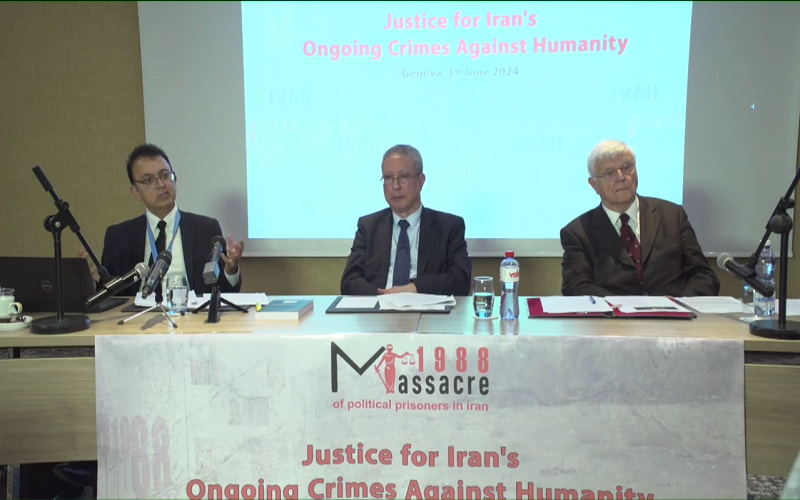

Javaid Rehman, the United Nations Special Rapporteur on the human rights situation in the Islamic Republic of Iran, has strongly condemned the killing of political prisoners in the 1980s by the Iranian regime, labeling them as heinous crimes against humanity and genocide. He has demanded that the Iranian regime be held accountable for committing these atrocities.
Calls for Accountability and Investigation
Speaking at a side meeting of the United Nations Human Rights Council in Geneva, Switzerland, on Wednesday, June 19, Rahman urged the international community to take concrete steps to hold the perpetrators of these crimes accountable and end their immunity. He called for activating an investigation mechanism to uncover the full extent of these crimes.
Rehman described the arbitrary and extrajudicial executions and the killing of thousands of political prisoners by the Iranian regime in the 1980s as a crime against humanity. He highlighted the Iranian regime’s efforts to conceal evidence of this massacre and demanded that the regime provides an honest narrative and clarify the dimensions of these crimes.
Torture, Executions, and Oppression
The UN special rapporteur emphasized that the perpetrators of these crimes should be held accountable, and the immunity of the Iranian regime should be stopped.
He noted that thousands of political prisoners were murdered without access to fair trials, and extensive torture of political prisoners was carried out as an example of a crime against humanity.
According to Rehman’s report, these executions included women, some of whom were raped before execution, and many teenagers and minors who were considered children.
He stated that many survivors of these executions are still struggling with the consequences of their loved ones being killed.
The report also examines the violence and physical abuse of women, as well as the oppression of minorities in the first decade of the establishment of the Iranian regime in 1979.
Impunity and Lack of Accountability
Despite the availability of evidence, Rehman noted that those who have committed severe and serious violations of human rights remain in power, and the international community has not been able or willing to hold these individuals accountable.
Thousands of political prisoners were executed in the 1980s, especially in the summer of 1988, because of their support or membership in groups and organizations such as the People’s Mojahedin Organization of Iran (PMOI/MEK) and other parties.
The report states that the executions in the summer of 1988 were carried out with the fatwa and approval of Ruhollah Khomeini, the founder of the Iranian regime, through a committee known as the ‘Death Committee’.
Ebrahim Raisi, the former head of the 13th government, and Mostafa Pourmohammadi, a current candidate for the regime’s presidential elections, were members of this committee.
Recommendations and Calls for Action
The report made recommendations to the Human Rights Council and its members, calling on the international community to establish an international accountability mechanism to conduct prompt, impartial, thorough, and transparent criminal investigations into the crimes described in the report and to ensure that all actors are held responsible.
Additionally, the report calls on the Human Rights Council to compel the Iranian regime authorities to provide the truth about the facts of the events of 1981-1982 and 1988 and, in accordance with international law, provide compensation and appropriate measures for victims, survivors, and the families of those who were tortured, executed, or forcibly disappeared.