
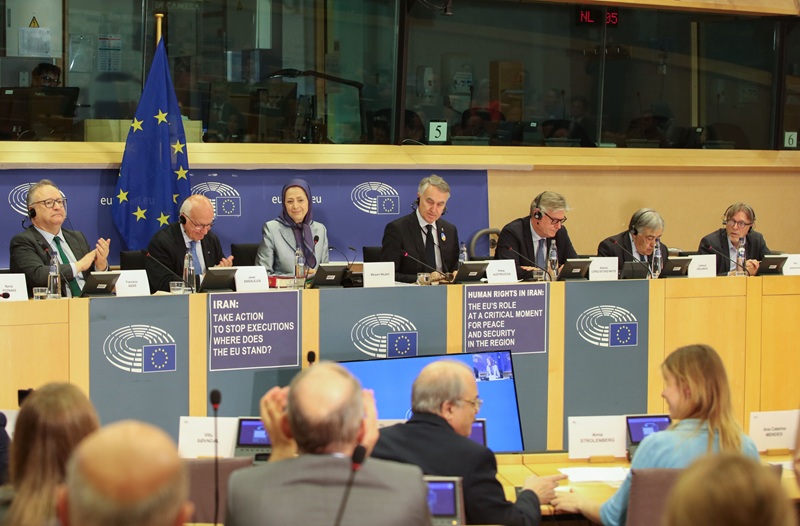

Iranian opposition leader tells European Parliament that the regime fears internal uprising more than war and demands a decisive shift in EU policy
On April 22, 2026, Maryam Rajavi addressed a major conference at the European Parliament, urging European leaders to take immediate action against executions in Iran and to abandon what she described as a long-standing policy of appeasement toward the ruling clerical regime.
Maryam Rajavi Addresses Conference at European Parliament: Take Action to Stop Executions in Iran
Speaking before lawmakers and international figures, Rajavi framed the central conflict in Iran not as a geopolitical struggle, but as a domestic confrontation between the Iranian people and the ruling religious dictatorship. She stated that “the central, decisive, and fate-shaping conflict is the one between the people of Iran and the ruling religious dictatorship,” emphasizing that lasting peace in the region depends on regime change led by the Iranian people and their organized resistance.
Rajavi argued that the system of Velayat-e Faqih remains fundamentally unchanged, even amid leadership transitions following the death of Ali Khamenei. According to her, the regime “possesses no capacity for reform or change” and continues to rely on repression, nuclear ambitions, and proxy forces for survival.
She highlighted the January 2026 nationwide uprising as a turning point, asserting that the regime is now at its weakest point. “It has never been as fragile, weak, and vulnerable as it is today,” she said, adding that the leadership fears internal dissent more than external conflict. Rajavi noted that security forces remain heavily deployed in urban areas to preempt another wave of protests.
A key focus of her remarks was the role of organized opposition groups, particularly the People’s Mojahedin Organization of Iran and its affiliated Resistance Units. She stated that during the January uprising, these units carried out 630 operations targeting institutions such as the Revolutionary Guard and Basij forces, aiming to counter repression and support demonstrators.
Rajavi also referenced a major operation on February 23, 2026, in which 250 PMOI members reportedly targeted key regime centers, including leadership compounds. She acknowledged that around 100 participants were killed or arrested, describing the action as a demonstration of the resistance’s operational capacity.
She reiterated the position of the National Council of Resistance of Iran, which announced the formation of a provisional government on February 28, 2026. This transitional authority, she explained, is designed to organize free elections within six months of the regime’s overthrow, ultimately transferring power to a constituent assembly representing the Iranian people.
In a direct challenge to claims by regime figures about mass public support, Rajavi called for internationally supervised elections. “If he speaks the truth, let him accept free elections… under United Nations supervision,” she said, underscoring the principle of popular sovereignty.
Turning to human rights, Rajavi condemned a recent surge in executions. She reported that eight PMOI members had been executed in the previous three weeks, alongside eight other protesters. Among them were individuals she identified as Commander Hamed Validi and Mohammad Massoum Shahi. She warned that political prisoners are now at risk of mass executions, particularly under the cover of wartime conditions.
“The silence of European Union leaders and member states is unjustifiable,” Rajavi stated, calling for urgent international intervention. She added that at least 11 political prisoners linked to the opposition are currently under death sentences, stressing that halting executions must be a condition in any international agreement with Tehran.
Rajavi also criticized what she described as efforts to promote a “fabricated alternative” centered on remnants of the former monarchy. She argued that such narratives, supported by some Western circles, serve to divide opposition forces and ultimately prolong the regime’s survival.
Outlining the vision of the Iranian Resistance, Rajavi emphasized a future democratic republic based on separation of religion and state, gender equality, minority rights, and political pluralism. She stated that the movement rejects both the current clerical system and the former monarchical dictatorship, proposing instead a governance model rooted in democratic legitimacy.
Concluding her address, Rajavi called on the European Union to adopt a fundamentally new approach. Her proposals included recognizing the NCRI’s provisional government, closing Iranian embassies in Europe, expelling intelligence and Revolutionary Guard operatives, ensuring internet access for Iranian citizens, and conditioning diplomatic relations on an end to executions and repression.
She also urged European governments to pursue accountability for Iranian leaders, advocating for legal action on charges of crimes against humanity and genocide.
“The response to this regime is neither appeasement nor foreign war,” Rajavi concluded. “The answer lies in an organized uprising and a Liberation Army.”