


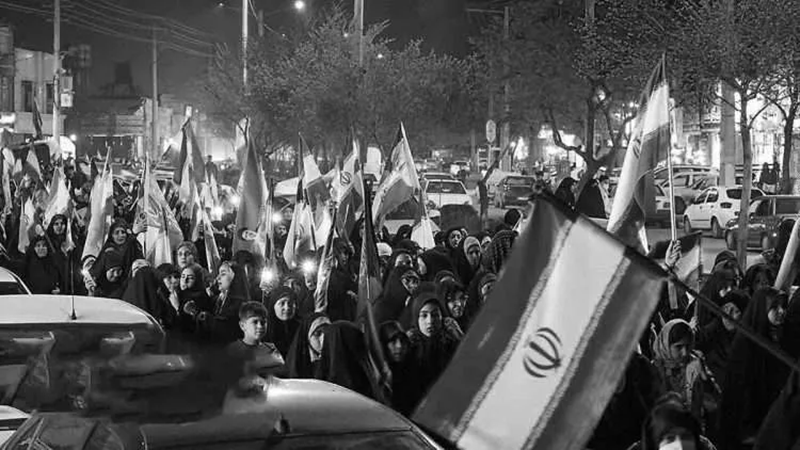

Escalating street deployments reveal a strategy focused on internal suppression rather than external threats
In the aftermath of the recent conflict and subsequent ceasefire, the Iran regime has sharply intensified its street mobilization campaigns across major cities, particularly in Tehran. While the country faces mounting economic hardship—ranging from inflation and unemployment to deepening poverty—the ruling establishment continues to prioritize repression, executions, and intimidation over addressing the population’s urgent needs.
This widespread street mobilization, presented as a show of strength, reflects a deeper reality: the regime increasingly views the Iranian people themselves as its primary adversary. This perception aligns with long-standing public sentiment expressed in protests over the years, where demonstrators have rejected official narratives about foreign enemies and instead pointed directly at domestic governance as the root of their grievances.
Rather than focusing on reconstruction or relief for citizens affected by the recent war, authorities have, from the earliest days of the ceasefire, launched continuous street deployments. These operations now function as instruments of pressure and control, aimed at deterring dissent and preventing the resurgence of nationwide protests.
At the same time, reports indicate a parallel escalation in repression behind the scenes. Under conditions of restricted or disrupted internet access, political prisoners—including members and supporters of opposition movements such as the People’s Mojahedin Organization of Iran (PMOI/MEK)—along with detainees from the January 2026 protests, are facing executions. These actions underscore a broader strategy of silencing opposition while minimizing public visibility.
The regime’s calculations appear rooted in a critical concern: once the external pressure of war subsides, internal contradictions—particularly the confrontation between the state and society—are likely to re-emerge with greater intensity. The mass protests witnessed between 2017 and 2026, including multiple nationwide uprisings, have already demonstrated the depth of public discontent and the potential for rapid escalation.
In response, authorities have expanded their mobilization efforts beyond conventional forces. Reports describe the deployment of a wide spectrum of individuals, including minors, women, and young people, often placed in highly visible and symbolic roles—sometimes even positioned on military vehicles or alongside semi-heavy weaponry. In addition, the regime has reportedly relied on foreign proxy elements from countries such as Iraq, Afghanistan, and Pakistan, integrating them into its domestic security posture.
This strategy reflects a long-standing doctrine within the ruling establishment. For years, senior figures justified regional interventions across the Middle East—spanning Iraq, Syria, Yemen, Lebanon, and beyond—by arguing that confronting threats abroad would prevent conflict inside Iran. The underlying implication was clear: without external engagement, the battleground would shift to Iranian streets.
Today, that projection appears to be materializing. What was once framed as a defensive strategy beyond Iran’s borders has increasingly transformed into direct confrontation within them. The streets of Tehran and other cities are no longer merely spaces of public life—they have become arenas of political tension between the regime and its citizens.
Ultimately, the expansion of street mobilization signals not strength, but vulnerability. It reveals a system preparing for internal crisis, anticipating renewed unrest, and attempting to preempt it through force. However, such measures carry inherent risks, including deepening societal divisions and intensifying fractures within the ruling structure itself.
As internal pressures mount and factional rivalries at the top of the regime continue to evolve, the current trajectory suggests that the conflict between state and society in Iran is entering a more decisive phase—one whose outcome may already be taking shape beneath the surface of these escalating displays of control.