


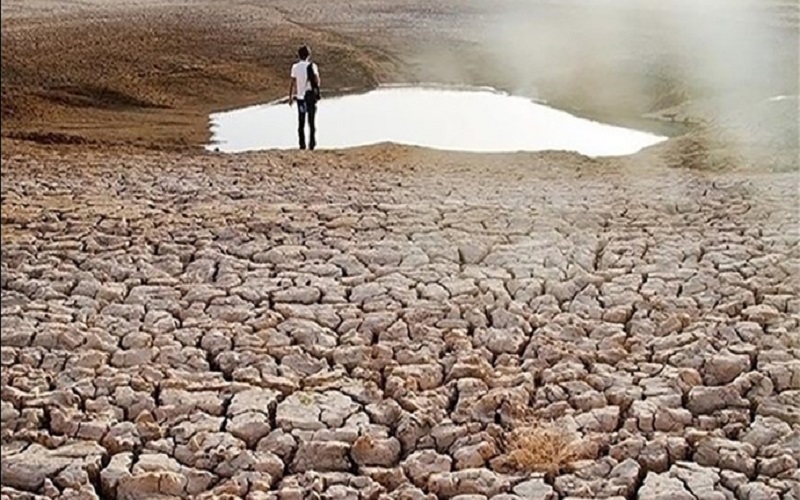

Environmental experts warn that several central provinces in Iran, including Isfahan, Markazi, Tehran, and Yazd, are experiencing a severe water crisis, threatening the region’s livability.
Mohammad Darvish, an environmental expert, highlights the increasing imbalance in Iran’s aquifers, widespread soil surface dryness, and destruction of vegetation. He states, “In the central regions of Iran, including Isfahan, Yazd, Markazi, Semnan, Tehran, Alborz, and Qazvin, we face a series of water-consuming and energy-consuming industries that contribute to significant pollution and make the landscape more prone to dust storms.”
In an interview with the state-run website Entekhab, Darvish criticized the economic development policies of the Iranian regime, particularly the concentration of water-intensive industries in arid and low-water areas. He added, “All economic strategies should not rely solely on water extraction. The government’s responsibility is to create businesses that do not pollute the air and water.”
Environmentalists have consistently warned that the Iranian regime has neglected environmental concerns. They argue that the regime’s development programs have been excessively water-oriented and unbalanced, disregarding the country’s ecological conditions. These policies have led to numerous crises, which could pose significant security threats in the future.
A report by Iran Open Data in February 2024 revealed that Fars, Isfahan, and Kerman provinces have the highest number of deep wells, with one-third of all deep wells in Iran located in these three provinces. The number of legally constructed deep wells has increased by 40%, and semi-deep wells by 1.5 times. However, water production from these wells has decreased by 15%.
According to the Statistical Center of Iran’s yearbook, the number of deep wells increased from approximately 165,000 in 2006 to over 209,000 in 2021. Despite this increase, water production has dropped from about 36 billion cubic meters per year to less than 30 billion cubic meters annually. Similarly, the number of semi-deep wells rose from about 460,000 to around 676,000 over the past 15 years, with a corresponding decrease in water production by about one billion cubic meters.
Various reports indicate that the Ministry of Energy has deconstructed 12,307 illegally constructed wells and halted the construction of 423 unlawful wells to date. However, the actual number of illegal deep and semi-deep wells is likely much higher.
Official data from the Iranian government shows that 97% of the country’s territory is experiencing varying degrees of long-term drought. According to the latest statistics from the National Drought Center, nearly all regions of Iran are dealing with decreased rainfall and increased temperatures. Only in four provinces—Kurdistan, West Azerbaijan, Lorestan, Hamadan, and Kohgiluyeh and Boyer-Ahmad—is the percentage of drought-affected areas less than 90%.
Some experts believe that Iran’s underground water tables have reached an irreparable crisis point. The situation calls for immediate and sustainable action to mitigate the looming environmental disaster.