


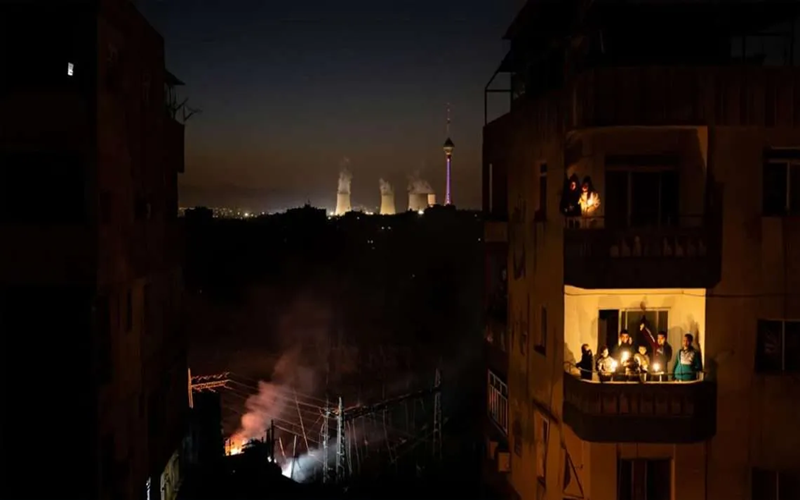

While state media report staggering damage figures, the political roots of Iran’s energy crisis—and the war that deepened it—remain deliberately unexamined
In recent days, Iran’s state-run newspapers have published staggering statistics on the destruction caused by the 40-day war. Yet these reports remain narrowly focused on the scale of financial losses, avoiding a critical examination of the political decisions that led to the conflict and imposed such a heavy burden on the Iranian people.
As the country’s already fragile power grid buckles under both pre-existing imbalances and wartime damage, a fundamental question remains unanswered: why did this confrontation occur in the first place?
Widespread Destruction of Energy Infrastructure
The recent war has inflicted approximately 60 trillion tomans in damage to Iran’s energy infrastructure. This comes on top of a system that was already struggling with chronic supply-demand imbalances.
Compounding the crisis, meteorological forecasts warn of the arrival of the El Niño phenomenon, bringing an unusually hot summer. These conditions are expected to sharply increase electricity demand, raising the likelihood of prolonged blackouts.
In response, officials have turned to public appeals for consumption reduction. The regimes’ president Masoud Pezeshkian urged citizens to drastically cut electricity use, stating: “If ten lights are on at home, what is the harm in keeping only two on?”
During the conflict, U.S. President Donald Trump repeatedly threatened to target Iran’s power plants. Although these threats were not fully realized, the damage inflicted on the grid has been extensive. According to officials, around 2,000 network zones were exposed to direct strikes, while more than 6,400 transmission lines and equipment points sustained serious damage.
Despite these figures, domestic media coverage has largely ignored the strategic and political causes of the war, focusing instead on reconstruction narratives.
Structural Weaknesses and Renewable Energy Setbacks
Official reports indicate that attacks on solar power equipment storage facilities alone caused approximately $1.5 billion in damage—equivalent to roughly 270 trillion tomans.
Even before the war, Iran’s electricity sector was unable to meet about 20% of national demand. Annual consumption grows by 5–6%, while production increases by only around 4%. The current energy shortfall is estimated at 20,000 to 25,000 megawatts.
The system’s vulnerability is exacerbated by its heavy dependence on natural gas, which accounts for roughly 90% of electricity generation. Despite holding the world’s second-largest gas reserves, Iran faces domestic gas shortages, directly undermining thermal power plant operations.
Hydropower, representing about 14% of capacity, is also unreliable due to recurring droughts. Meanwhile, renewable energy contributes only about 3% of total generation—far too little to offset systemic deficiencies.
Most existing power plants are outdated, operating at an efficiency of just 34%, meaning nearly two-thirds of fossil fuel input is wasted. Gas consumption per kilowatt-hour is approximately 1.5 times the global average.
Transmission losses further compound the crisis, ranging between 13% and 18%—significantly above international norms.
Mounting Pressure on a Fragile Grid
Provincial reports highlight the scale of localized damage. In Tehran province alone, 487 network points—including 91 public substations—have been destroyed. Additionally, 129 kilometers of medium-voltage lines were damaged during the conflict.
Nationwide, the destruction of substations, transformers, and transmission lines has placed immense strain on the remaining infrastructure. Uneven load distribution is increasing pressure on surviving transformers, leading to voltage instability and unplanned outages, particularly in residential areas.
The regime’s authorities have acknowledged that ensuring grid stability during the upcoming summer will be one of their most serious challenges. Yet the primary solution offered—consumption management—remains a temporary and insufficient measure.
The Cost Beyond Numbers
While official media continue to emphasize financial losses—estimated at over 328 trillion tomans when combining grid and solar infrastructure damage—they systematically avoid addressing the root causes of the crisis.
Absent from these narratives is any reference to the policies that precipitated the conflict: the regime’s nuclear ambitions, missile programs, and extensive spending on regional proxy networks.
For years, regime propaganda framed nuclear development as a national right and a pathway to energy independence. Yet despite expenditures reportedly reaching trillions of dollars, these investments have failed to deliver tangible benefits to ordinary citizens.
Today, as power outages spread and infrastructure lies in ruins, the consequences of those policies are no longer abstract. The war has not only devastated critical systems but has also deepened the gap between state priorities and public welfare.
What remains is a population facing rising temperatures, failing electricity supply, and a political system unwilling to confront the decisions that led to this crisis.