Environmental activists and experts in Iran are questioning the extent of authority held by the Environmental Protection Organization and the Masoud Pezeshkian government to address the country’s mounting ecological challenges. The nation faces a multitude of environmental issues, from air pollution and deforestation to water scarcity and wildlife depletion, all of which require systemic changes that seem to be beyond the current government’s reach.
The scale of Iran’s environmental problems is staggering. Air pollution, poor fuel quality, widespread landslides, shrinking forests, waste management issues, drying rivers and wetlands, encroachment on forest lands, destructive infrastructure projects, and rampant poaching are just some of the challenges. Addressing these issues requires not only policy changes and increased budgets but also a reduction in the influence of military and governmental agencies in environmental matters.
Sheena Ansari, the new head of Iran’s Environmental Protection Organization, acknowledges that some environmental problems have become “super challenges.” However, the organization’s ability to act is severely constrained by several factors:
- Budget Constraints: The annual budget for environmental protection has not kept pace with inflation, leading to chronic underfunding of critical projects and regional departments.
- Institutional Interference: Powerful institutions like the Islamic Revolutionary Guard Corps (IRGC), the Endowment Organization, Basij Organization, and Astan Quds Razavi have implemented industrial projects that significantly damage the environment, often ignoring expert warnings.
- Sanctions: Western sanctions, a response to the regime’s controversial policies, have made it difficult to access modern green technologies, hampering efforts to transition to cleaner energy sources.
- Political Tensions: The regime’s failure to negotiate effectively with neighboring countries, such as the Taliban regime in Afghanistan, has exacerbated water scarcity issues in southeastern Iran.
- Suppression of Activism: Environmental activists have faced arrest and prosecution under dubious security pretexts, stifling grassroots efforts to address ecological concerns.
The IRGC’s Khatam-al Anbiya Construction Headquarters has been particularly destructive, undertaking numerous projects that have negatively impacted the environment, including dam construction, water transfer schemes, and illegal resource extraction.
Energy shortages have further complicated matters, forcing industries to resort to burning highly polluting fuels like mazut, significantly contributing to air pollution in major cities.
Ansari and her deputy emphasize the need for international cooperation and investment in clean energy to address these challenges. However, given the regime’s increasing tensions with regional and Western powers, along with expanding economic sanctions, such cooperation seems unlikely in the near future.
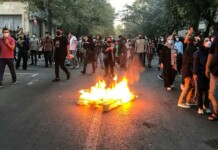
The environmental crisis in Iran has far-reaching social consequences, sparking protests over water scarcity in provinces like Khuzestan and Isfahan, and air pollution in cities like Arak and Ardakan. These issues underscore the urgent need for comprehensive environmental reform.
In conclusion, while the Iranian government acknowledges the severity of its environmental challenges, its ability to effectively address these issues remains severely limited. The complex interplay of political, economic, and institutional factors creates a formidable barrier to meaningful environmental action, leaving Iran’s ecological future hanging in the balance.