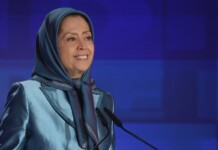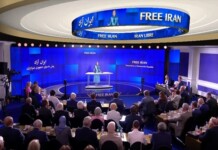
On November 20, 2024, Mrs. Maryam Rajavi, the president-elect of the National Council of Resistance of Iran (NCRI), delivered a compelling speech at the European Parliament. She highlighted the ongoing struggles of the Iranian people under the current regime and the urgent need for democratic change. Rajavi’s remarks offered a clear roadmap for replacing the clerical dictatorship with a free, democratic Iran.
The Iranian Regime’s Persistent Threats
Rajavi began by addressing the Iranian regime’s reliance on exporting fundamentalism and terrorism to suppress internal dissent and destabilize the region. She noted that, despite the European Parliament’s previous resolutions advocating the designation of the Revolutionary Guard Corps (IRGC) as a terrorist organization, the measure remains unimplemented—a missed opportunity to counteract the regime’s malign activities.
Human rights violations under the regime remain a grave concern. Rajavi highlighted:
- More than 100,000 political executions over the past decades.
- 800 executions in 2024 alone, including 500 in the last four months under the regime’s new president.
Rajavi pointed out that the regime’s Supreme Leader Ali Khamenei has openly stated the regime’s survival depends on external conflicts in Syria, Iraq, Yemen, Lebanon, and Gaza. Without these, the regime fears domestic unrest could topple it.
The regime’s nuclear ambitions also remain unchecked. Despite international agreements, Tehran continues its pursuit of nuclear weapons, a project it views as essential for its survival. Rajavi called for the activation of the snapback mechanism and enforcement of six UN Security Council resolutions, emphasizing that such actions are long overdue.
Organized Resistance: A Path to Change
Rajavi underscored the critical role of the Iranian Resistance in challenging the regime, presenting it as a viable and organized alternative. She detailed the following pillars of this resistance:
- Resistance Units:
At the forefront of Iran’s struggle for freedom are the Resistance Units, led by women and driven by a profoundly discontented populace. Their efforts were showcased at the 2024 Free Iran World Summit, where evidence of 20,000 activities across the nation was displayed. - The People’s Mojahedin Organization of Iran (PMOI/MEK):
With a 60-year history of opposing both monarchical and clerical dictatorships, this organization has earned recognition from both allies and adversaries. Its members include 20,000 martyrs whom the regime has labeled its principal enemy. Ashraf-3 in Albania, home to survivors of torture under the Shah and the clerics, serves as a testament to their resilience. - The National Council of Resistance of Iran (NCRI):
Established 43 years ago, the NCRI represents a diverse and enduring political coalition. With women constituting over half of its 457 members, the Council advocates for:- Freedom of speech and religion.
- Rights for ethnic and religious minorities.
- Separation of religion and state.
- A non-nuclear Iran.
- The abolition of the death penalty.
- Diaspora Support:
The Iranian diaspora, organized into 320 associations, provides financial independence and operational strength to the Resistance. This base includes survivors of political imprisonment and families of the 100,000 victims who sacrificed their lives for freedom. - Global Endorsement of the Resistance:
Rajavi noted widespread international support for the NCRI’s 10-point plan for a free Iran, with backing from:- Legislatures in 34 countries across Europe and America.
- Arab nations.
- A declaration signed by 137 former global leaders and 80 Nobel laureates.
A Roadmap for Democratic Transition
Rajavi detailed a concrete process for transferring power post-regime overthrow:
- Provisional Government: A six-month interim government will organize elections for a Constituent Assembly.
- Constituent Assembly: The Assembly will draft and approve a new constitution, ratified through a referendum.
- Sovereignty to the People: The process ensures power is transferred to elected representatives, not the Resistance.
She reassured skeptics by dismissing regime propaganda claiming chaos or partition would follow its collapse. The Iranian people’s unity, demonstrated in uprisings from Kurdistan to Zahedan, reinforces their shared commitment to a democratic Iran.
Western Policy and the Need for Decisive Action
Rajavi criticized Western policymakers for failing to recognize the Resistance as a viable alternative. She attributed three decades of misguided appeasement to this oversight. Addressing the European Union, she called for a decisive stance against the Iranian regime, emphasizing that rejecting appeasement would respect the Iranian people’s aspirations for democracy.
A Vision for a Free Iran
In her closing remarks, Rajavi reiterated the Resistance’s core values:
- No to Compulsory Hijab, No to Compulsory Religion, and No to Compulsory Government.
- Advocacy for equality, freedom, and human rights in Iran.
Rajavi called on the European Parliament and global leaders to align their policies with the Iranian people’s desire for regime change, recognizing it as a prerequisite for regional and global stability.