



Reza Pahlavi’s defense of his family’s rule exposes a stark contradiction between democratic rhetoric and an unrepentant embrace of authoritarian legacy.
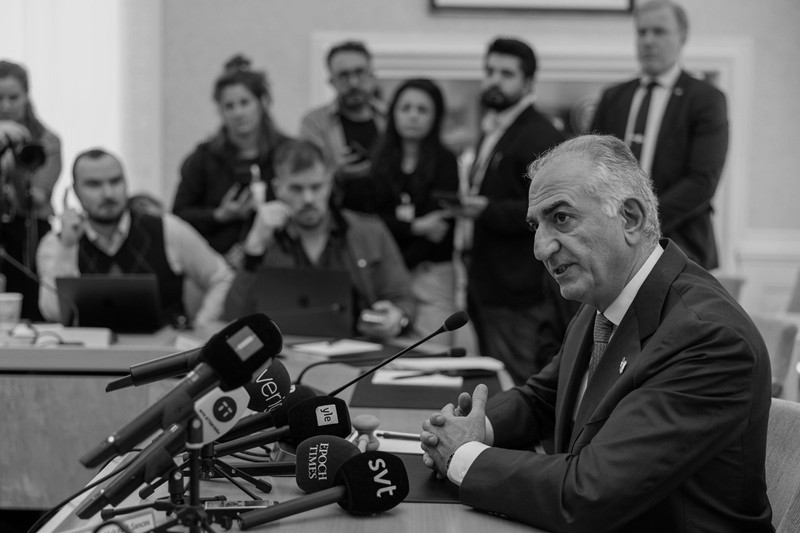
On April 13, 2026, in Stockholm, Reza Pahlavi sat before a microphones, the self-appointed face of a democratic alternative to the current Iranian theocracy. When a journalist asked a straightforward question about whether he took issue with any of the actions of his father, the late Mohammad Reza Shah, the room grew quiet.
Pahlavi did not offer a nuanced reflection on the complexities of power or an acknowledgment of past abuses. Instead, he bristled, dismissing the inquiry as a fixation on the past before declaring his “immense pride” in a heritage defined by absolute rule.
This moment, captured on camera and echoed in a subsequent interview on Swedish state television, raises a fundamental question for the future of Iranian politics: Can a movement for liberation be led by a man who views a history of torture, corruption, and systemic suppression as a “good path” worth resuming?
For decades, the son of the last Shah has carefully cultivated the image of a modern, Western-aligned democrat. He has spoken the language of human rights and pluralism, attempting to present himself as a democrat.
However, his recent statements in Sweden have stripped away this carefully maintained veneer. By explicitly stating that he “supports the actions” of his father and grandfather and dismissing the crimes of their reigns as irrelevant “things that happened 50 years ago,” Pahlavi has signaled that his vision for Iran is not a departure from dictatorship, but a restoration of it. To understand the gravity of this shift, one must look closely at the “legacy” Pahlavi now claims to represent with such pride.
The historical record of the Pahlavi dynasty is not merely a matter of academic debate; it is a ledger of documented state violence and staggering corruption. Pahlavi’s grandfather, Reza Shah, is often framed by monarchists as a modernizer, yet his reign was defined by the brutal consolidation of wealth and power.
By the time he was forced to abdicate in 1941 due to his sympathies for Nazi Germany, he had become one of the wealthiest men on earth, largely by forcibly seizing over 44,000 real estate properties from Iranian citizens. His regime was not just a kleptocracy; it was a graveyard for the country’s burgeoning intellectual class.
At Qasr Prison alone, an estimated 24,000 people—mostly political activists, poets, and ethnic minorities—were killed. This is the “background” that the younger Pahlavi now tells the international community he represents with pride.
The record of his father, Mohammad Reza Pahlavi, is even more harrowing, particularly for those who remember the chilling efficacy of SAVAK, the National Intelligence and Security Organization. Established with the help of foreign intelligence agencies, SAVAK became a “national pastime” of terror, according to contemporary media reports.
Amnesty International’s archives from the 1970s provide a gruesome inventory of the methods used to maintain the Peacock Throne: electric shocks, the extraction of nails and teeth, the use of hot iron rods to burn the mouths of dissidents, and the systematic rape of prisoners.
In 1975, Martin Ennals, then the Secretary General of Amnesty International, noted that the Shah’s regime maintained the highest rate of death penalties in the world and a history of torture that was “beyond belief.”
When Reza Pahlavi speaks of “resuming that good path,” he is asking the Iranian people to forget these horrors. He points to the modernization and economic growth of the 1960s and 70s as a justification for his father’s rule, yet this narrative ignores the reality of a country where, despite oil wealth, the vast majority of the population lived in desperate poverty.
Perhaps most revealing is the elder Pahlavi’s own contempt for the very democratic values his son now claims to champion. In famous interviews with journalists like Oriana Fallaci and Barbara Walters, the Shah ridiculed the concept of freedom of thought and expressed deeply reactionary views on women.
He told Fallaci that women were “only important if they’re beautiful” and argued that they were incapable of producing great scientists or artists. He even defended the right of a husband to take additional wives if his first wife was “ill” or refused “wifely duties.”
When Reza Pahlavi claims to be a leader for the “Woman, Life, Freedom” era while simultaneously praising his father’s record, he is engaging in a profound contradiction. The Shah’s regime was not a champion of women’s rights; it was a patriarchal autocracy that viewed half the population as intrinsically inferior.
The younger Pahlavi’s refusal to condemn these actions is not merely a personal choice; it is a political platform. By telling Swedish television that he “supports the actions” of his family, he validates the 1953 coup against the democratically elected Prime Minister Mohammad Mossadeq.
He validates the 1975 decree that forced all Iranians to join a single legal party, the Rastakhiz, or face imprisonment or exile. He validates the decades of censorship and the execution of poets like Farrokhi Yazdi and Mirzadeh Eshghi.
The danger of Pahlavi’s recent rhetoric lies in its attempt to weaponize the current suffering of the Iranian people under the Islamic Republic to white-wash the crimes of the monarchy. He points to the youth who have “never seen my father” but allegedly “fallen in love with him” as proof of his legitimacy.
This is a classic populist tactic: using the failures of the present to create a mythical, golden past. But nostalgia is a poor foundation for a democracy. The 1979 Revolution did not happen in a vacuum; it was a massive, popular explosion of rage against a system that had spent decades stripping Iranians of their dignity, their wealth, and their lives.
If Iran is to move toward a truly democratic future, it cannot do so by trading one form of unaccountable power for another. A leader who cannot acknowledge the victims of his own family’s secret police is a leader who remains a threat to the rule of law.
Genuine democracy requires a reckoning with the truth, no matter how uncomfortable that truth may be for those who carry a famous surname. By choosing to glorify the “mindset” of the Pahlavi era, Reza Pahlavi has shown that he is less interested in the freedom of the Iranian people than he is in the restoration of a dynasty.
The international community and the Iranian people must ask themselves: if the son of a dictator refuses to condemn the torture of the past, what reason is there to believe he will prevent it in the future?