


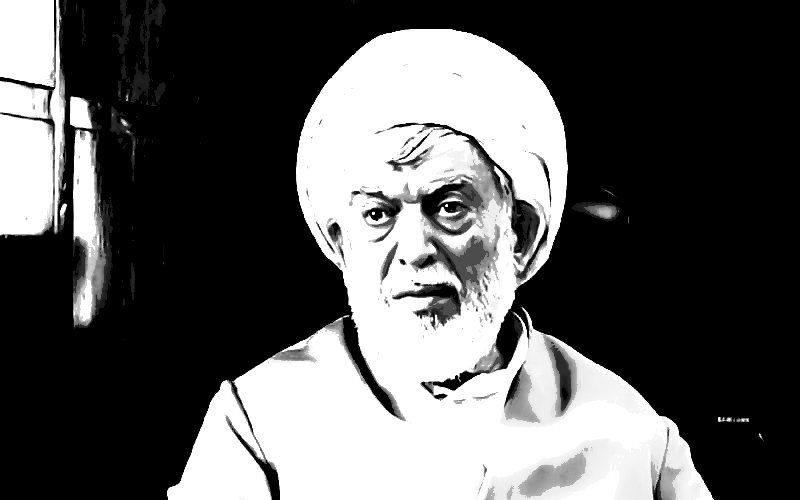

On April 3, 2025, Gholam-Hossein Mohseni-Eje’i, the Chief Justice of Iran’s judiciary, announced the death of Hossein-Ali Nayeri — a name synonymous with repression, brutality, and mass execution in contemporary Iranian history. Far from a figure of justice, Nayeri stands out as one of the Islamic Republic’s most notorious judicial enforcers. His central role in the 1988 massacre of political prisoners marks him as one of the key architects of one of the darkest chapters in the regime’s record of human rights abuses.
Biography and Judicial Career
Hossein-Ali Nayeri began his career in the judiciary shortly after the 1979 Islamic Revolution, having studied at a religious seminary. Over the following decades, he held several senior positions in Iran’s judicial system, including:
-
President of the Supreme Disciplinary Court for Judges (2013–2025)
-
Deputy Chief Justice of the Supreme Court (1989–2013)
-
Religious and Trial Judge at the Revolutionary Courts in Tehran (early 1980s–1989)
-
Trustee for the Execution of Imam Khomeini’s Order (EIKO) — a position involving the systematic confiscation of property on Khomeini’s orders (1989–2000)
Crimes Against Humanity: The 1988 Massacre
Nayeri’s name is most infamously associated with his role as head of the so-called “Death Committee” during the mass executions of political prisoners in the summer of 1988. These secret tribunals, established by order of Ayatollah Khomeini, operated with chilling efficiency. Prisoners were brought before the committee — typically composed of Nayeri, Ebrahim Raisi, Mostafa Pourmohammadi, and Morteza Eshraqi — and asked a handful of ideological questions. Based on their answers, many were immediately sent to their deaths.
Over the span of just a few weeks in August and September 1988, thousands of political prisoners were executed — the vast majority of them having already served their sentences or being held without any new charges. Their bodies were dumped in unmarked mass graves. Most victims were affiliated with the People’s Mojahedin Organization of Iran (PMOI/MEK), as well as leftist and communist groups.
Eyewitness Testimony and Audio Evidence
Ayatollah Hossein-Ali Montazeri, Khomeini’s designated successor at the time, condemned the killings. In an audio recording of a meeting with the Death Committee on August 15, 1988 — later leaked to the public — Montazeri called the massacre “the greatest crime in the history of the Islamic Republic” and warned Nayeri and his colleagues:
“In the future, you will be remembered as criminals.”
This damning audio provided irrefutable evidence of Nayeri’s leading role in the killings, solidifying his place in the regime’s machinery of repression.
Unrepentant to the End
More than three decades later, Nayeri broke his silence — not to express remorse, but to defend the massacre. In a 2022 interview with the Islamic Revolution Documents Center (IRDC), he justified the executions, saying:
“In such critical circumstances, what were we to do? We had to hand down verdicts decisively… We cannot run the country by offering them hugs and kisses!”
He went further, vilifying the victims and claiming they had “staged riots” and plotted conspiracies inside prisons.
“If it wasn’t for Imam [Khomeini]’s decisiveness, maybe we wouldn’t have this security at all,” he added.
These statements reveal a man utterly unrepentant for his role in one of the most egregious mass killings of political prisoners in modern history — killings carried out without due process, legal defense, or appeal.
No Justice, No Closure
Despite international condemnation and calls for accountability, Nayeri lived out his final years with total impunity — a symbol of the Islamic Republic’s deep-rooted culture of unaccountability for gross human rights violations. For the families of the victims, the death of Hossein-Ali Nayeri closes no chapter. The demand for justice remains, along with the memory of those silenced in 1988.