
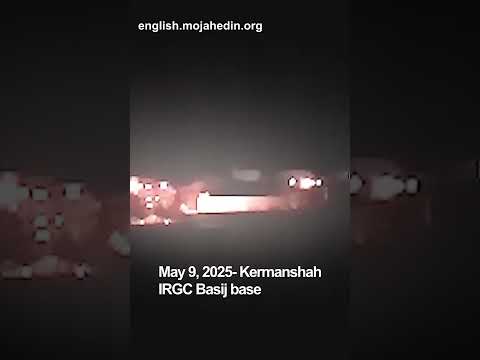
May 28, 2024 — A wave of coordinated attacks by rebellious youth across Iran has targeted bases of the Islamic Revolutionary Guard Corps (IRGC), Basij militia centers, and other symbols of state repression. These actions were carried out in solidarity with Iranian truckers and drivers who are on a nationwide strike, now spanning 140 cities.

The strike, driven by long-standing grievances over poor working conditions, inadequate insurance, unfair freight rates, fuel shortages, and an unsustainable retirement system, has galvanized widespread public sympathy. In response to the regime’s threats, property confiscations, and heavy-handed crackdowns, the rebellious youth launched what they described as revolutionary operations in cities including Tehran, Mashhad, Hashtgerd, Khash, Saravan, Kahnuj, Goujan, Ilam, Birjand, and Hamedan.
Coordinated Actions Across Iran
The attacks, many of which involved incendiary devices, were aimed at regime centers associated with oppression and surveillance. Key actions included:
-
Three separate incendiary attacks on a Basij center in Tehran
-
Attacks on regime buildings in Tehran, Hashtgerd, and Goujan
-
Arson at Basij centers in Mashhad, Saravan, Khash (used for suppressing women), and Kahnuj (used for suppressing students)
-
Burning of propaganda banners featuring images of Ruhollah Khomeini and Ali Khamenei in Tehran, Ilam, and Birjand
-
Destruction of Basij espionage signboards in Karaj and Hamedan
These acts were framed by the youth as a direct response to the regime’s use of intimidation and violence against working-class Iranians. “When the criminal mullahs’ regime answers the people’s demands with arrests and threats,” said a statement attributed to the attackers, “it will face a fitting reply from the true defenders of the oppressed.”
Truckers’ Grievances: Years of Neglect
Truck drivers and freight operators across Iran have long complained of exploitative conditions. In one widely circulated video, a driver from Darreh Shahr addressed regime officials, denouncing the retirement policies that require 35 years of service. “Should a driver retire at 70?” he asked. “Who lives that long in this country, under this pressure?”
The driver went on to address Supreme Leader Ali Khamenei directly: “You have destroyed the people of Iran. Of course, you’re not from among us—you’ve treated this land like it’s not yours. But one day, the people will take back what’s theirs.”
Another striking driver from the Sungun copper mine site summed up the hopelessness many feel: “We want neither the Shah nor the mullahs. We have no fuel, no food—we’re destitute.”

Silent Roads, Loud Message
Video footage from May 28 shows near-empty highways across Iran, a powerful visual confirmation of the strike’s reach. Even drivers of Nissan pickup trucks, a backbone of Iran’s logistics sector, have joined the action. In many cities, protesting drivers left their trucks parked in rows, creating impromptu protest parades in solidarity.
State Propaganda vs. Public Reality
In a bid to suppress the growing unrest, state-controlled media outlets released statements falsely claiming that the truckers’ demands had been met and the strike had ended. However, the persistence of the strike—and the accompanying resistance from Iran’s rebellious youth—suggests otherwise.
Their attacks serve not only as acts of defiance but as signals to the wider public: that resistance is alive, and that the road to justice must sometimes be lit by fire.
Conclusion
The truckers’ strike has become more than a labor dispute—it’s a flashpoint in Iran’s broader struggle against systemic injustice and authoritarian control. As solidarity actions spread, so too does the regime’s anxiety, confronted by a growing alliance of laborers and rebellious youth who refuse to be silenced.
, Basij militia centers, and other symbols of state repression.)