



From security-driven shutdowns to “tiered internet” access, Tehran’s digital policies reveal a long-term strategy with deep economic and social consequences
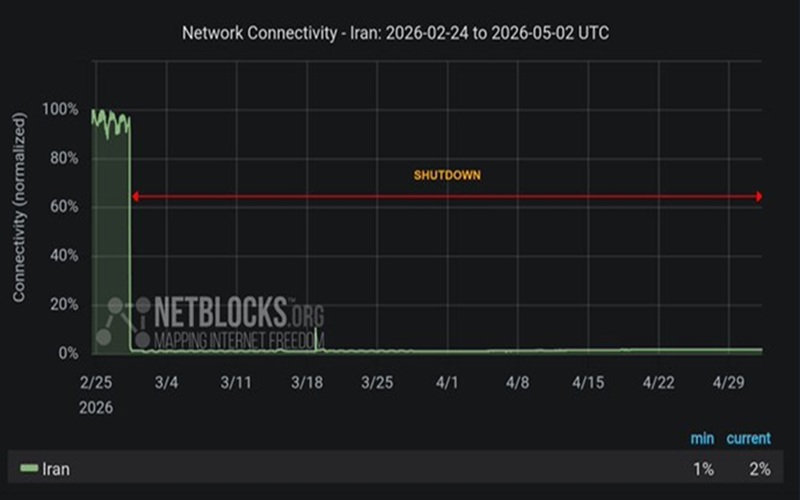
Iran’s ongoing restrictions on international internet access have entered one of their longest phases to date—yet official statements increasingly suggest that this is not a temporary measure. Instead, what is emerging is a structural shift: a model of digital governance in which access to information is tightly controlled, stratified, and aligned with security priorities rather than public need.
Recent remarks by regime officials and members of parliament point to a critical reality: decisions regarding internet shutdowns and limitations are no longer made within the formal remit of the Ministry of Communications. Instead, they are shaped at higher levels, within security-driven institutions. The ministry, by its own admission, functions largely as an implementation arm—implementing policies rather than defining them.
Government spokesperson Fatemeh Mohajerani recently stated that initiatives such as so-called “pro internet” SIM cards are intended to facilitate business activity and should not result in widespread deprivation of access. Yet this assertion sits uneasily alongside mounting evidence that such policies are, in practice, creating differentiated layers of connectivity.
This emerging model—often described by analysts as a “tiered internet”—allows select users to access more open forms of global connectivity, while the broader population remains confined to heavily restricted networks. Critics argue that this constitutes a form of structural discrimination in access to information, deepening the digital divide and institutionalizing inequality in the information sphere.
Even within the regime’s Ministry of Communications, concerns about the economic implications of these policies are becoming more explicit. Officials have warned that a full disconnection from the global internet represents one of the most costly scenarios for the national economy, disrupting supply chains and potentially leading to shortages of essential goods. These warnings underscore a growing tension between security objectives and economic sustainability.
Meanwhile, political figures such as Amirhossein Sabeti have openly linked the continuation of restrictions to “wartime conditions,” confirming that such measures are being enforced under directives from high-level bodies, including the Supreme National Security Council. This framing reinforces the perception that internet governance in Iran has shifted decisively from a technical domain to a securitized one.
The scale and duration of the current restrictions are notable. Since early 2026, widespread disruptions to international connectivity have placed Iran among the countries experiencing the most prolonged internet limitations globally. The consequences have been both immediate and far-reaching.
Economically, sectors reliant on digital infrastructure have borne the brunt of the impact. Online businesses, startups, export-oriented firms, and even traditional industries dependent on international communication channels have faced declining productivity and revenue losses. Many small and home-based enterprises—particularly those operating on social media platforms—have been pushed toward closure.
At the same time, the rollout of “pro internet” access has intensified public debate. Under this system, certain users—after undergoing identity verification and obtaining specific approvals—can purchase limited access to international networks at significantly higher costs. For critics, this represents not only an economic barrier but a fundamental breach of equitable access to information.
Such policies effectively restrict a public right and resell it at a premium to a select group, highlighting both the economic and psychological consequences. The perception of unequal access, analysts warn, risks eroding public trust and widening the gap between society and the state.
Beyond economics, the social implications are equally significant. Reports indicate to growing public dissatisfaction, online protest campaigns, and calls to boycott “pro internet” services. For many, participation in such systems is seen as tacit acceptance of discriminatory policies.
The regime’s justification—grounded in claims of wartime necessity—has also come under scrutiny. Critics argue that in genuine conflict scenarios, communication infrastructure is typically reinforced to ensure coordination and crisis management, not broadly restricted. From this perspective, internet limitations appear less as defensive measures against external threats and more as tool for managing internal information flows.
Mohsen Kahani, a director at Ferdowsi University’s cybersecurity center, has noted that recent experiences challenge the assumption that restricting internet access inherently enhances security. On the contrary, such measures may introduce new vulnerabilities while imposing significant economic costs.
Adding another layer of complexity is the emergence of a parallel market for restricted access. Reports indicate that, alongside official policies, a growing ecosystem of paid configurations and specialized services has developed—often at high prices. This has fueled speculation that certain actors may benefit economically from the continuation of restrictions, raising questions about embedded financial incentives.
Taken together, these developments point to a transformation in Iran’s digital landscape. Internet restriction is no longer a temporary tool deployed in moments of crisis; it is becoming a cornerstone of governance strategy. The implications—economic contraction, social fragmentation, and institutionalized inequality—are already visible.
What remains uncertain is the long-term sustainability of this model. As pressures mount across economic and social domains, the costs of controlled connectivity may prove increasingly difficult to manage—both for the government and for the society it seeks to regulate.