



From water and electricity shortages to looming food insecurity, the regime’s leadership openly acknowledges a governance deadlock.
This is the reality of Iran today: a country mired in structural governance failures, the product of a chronic disease inflicted by the mullahs’ regime. It is a crisis of management, decision-making, legitimacy, and—perhaps most critically—efficiency.
The summer of 2025 has brought scorching heat, but for millions of Iranians, the real burden is a worsening shortage of water and electricity. Instead of addressing the problem, the regime has opted for absurd stopgap measures, such as closing banks and government offices under the pretext of “saving money,” as though running a country could be achieved by shutting it down.
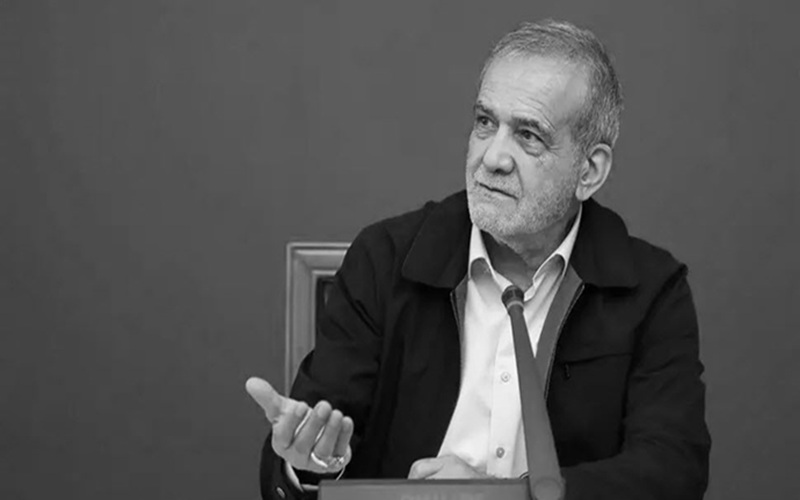
In a striking admission, regime president Massoud Pezeshkian told a gathering of media executives:
“I have no choice. We have no water. We have no electricity. Industry has problems. Everything is forced.”
These words are not a casual complaint—they are an official confession of incompetence in the daily management of the nation. Pezeshkian openly listed the crises: shortages of water, electricity, and gas; rampant inflation; mismanaged subsidies; empty state coffers; and budget imbalances. He further admitted that no decision could be made without the explicit approval of the Supreme Leader. Even if solutions existed—something he did not claim—they could not be implemented without that consent. It is the clearest public definition yet of a complete governance deadlock.
Domestically, Pezeshkian has no real executive power. National resources are funneled into sectors that offer no social benefit, while the country’s basic needs remain neglected. In foreign policy, he made another revealing statement:
“If we build a nuclear program, they will strike again.”
This remark stands in direct contradiction to the regime’s propaganda about its so-called “victory” in the recent 12-Day War. While state-controlled outlets boasted of triumph, the president’s words painted a far more vulnerable reality—one in which even rebuilding sensitive infrastructure could invite another attack.
The crises extend beyond infrastructure to food security. Seventy-six livestock feed importers have warned that their stocks are at the lowest levels in years, threatening an unprecedented collapse in the meat, poultry, and dairy markets.
Any military escalation could push this crisis beyond repair. Yet instead of urgently addressing the problem, the Ministry of Agricultural Jihad has diverted foreign currency allocations to state-owned and “specialized” companies, leaving the private sector—and by extension, consumers—waiting for months.
For decades, Iranians were told: “We have nothing, but we have security.” Today, they have neither. The war has reached Tehran’s neighborhoods. The regime has lost control over its own skies. And the leadership faces constant warnings of renewed strikes.
The reality of Iran in 2025 is a nation split into two irreconcilable paths: a people struggling to survive, and a regime whose actions only deepen the crises. The country is racing toward disaster at full speed. If a government cannot provide water, electricity, security, or even a plan to avert collapse—and if it openly admits this failure—how much longer can it justify its grip on power?