


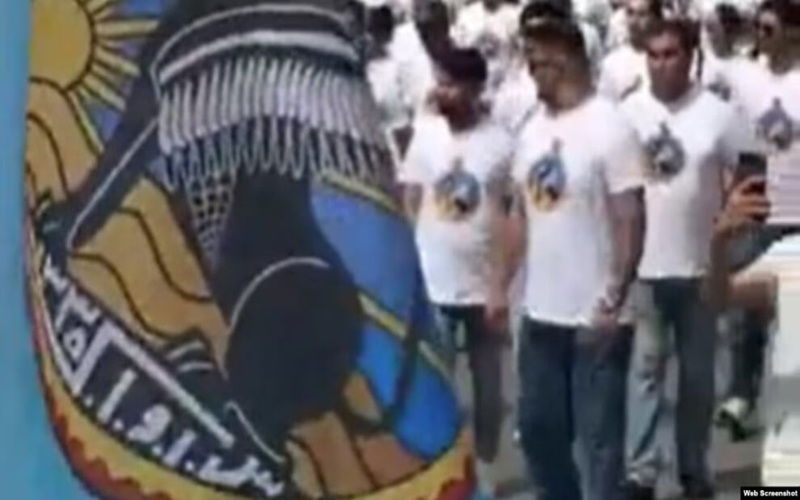

The glorification of SAVAK by extremist monarchist circles is not a sign of political strength, but evidence of a security-driven project rooted in fear, intimidation, and nostalgia for dictatorship.
In the final years of the Weimar Republic, before Adolf Hitler formally consolidated power, it was not only the Nazis who transformed the streets into theaters of uniforms, intimidation, and organized fear. Alongside them stood remnants of nationalist militias and extremist movements born from Germany’s humiliation after World War I — forces defined less by any meaningful political vision than by nostalgia for lost authoritarian grandeur and the performance of violence.
These movements rarely spoke of democracy, freedom, or genuine solutions to social and economic crisis. Instead, they weaponized fear itself, because beneath their theatrical aggression lay something deeper: humiliation, political emptiness, and the belief that they could only matter if others feared them.
That historical pattern offers an unsettling parallel to the recent public display of SAVAK symbols in European streets by extremist supporters aligned with Reza Pahlavi.
This spectacle should not be interpreted as a sign of political confidence or even a credible threat of restored authoritarian rule. Rather, it is a naked confession of the inherent bankruptcy of a security-driven and colonial-style political project built around the “crown prince” (Reza Pahlavi) narrative. The waving of the emblem of an institution synonymous with some of the darkest torture chambers in modern Iranian history exposes the true nature of a movement that has abandoned any attempt to present itself as democratic.
International human rights organizations, including Amnesty International, documented SAVAK’s brutal methods decades ago. Survivors and historical records describe systematic torture techniques that remain horrifying even today: whipping prisoners with electrical cables on the soles of their feet, the use of electric batons on sensitive parts of the body, nail extraction, and suspension from the ankles.
Among the most infamous instruments associated with SAVAK was the so-called “Apollo” device — a metal helmet apparatus placed over prisoners’ heads while they were flogged, amplifying and echoing their screams back into their own ears to intensify psychological torment.
SAVAK was not merely an intelligence agency. It was the calculated machinery of repression serving a Western-backed dictatorship. One of its most notorious crimes occurred in 1975, when nine political prisoners were extrajudicially executed near Evin Prison during a staged “transfer” operation overseen by SAVAK officials linked to Parviz Sabeti.
Today, the reappearance of SAVAK symbols in the hands of monarchist extremists reveals far more than historical nostalgia. It exposes an attempt to rehabilitate one of the darkest eras of torture, repression, and fear in Iranian history and present it as a source of pride.
This is not accidental. The movement orbiting around Reza Pahlavi has long suffered from a lack of social legitimacy, grassroots organization, and democratic political vision. Deprived of any meaningful program for Iran’s future, segments of this current increasingly resort to shock politics, intimidation, and the glorification of authoritarianism in order to manufacture visibility.
Instead of discussing democratic transition, free elections, civil liberties, minority rights, social justice, or political pluralism, these factions invoke the imagery of interrogators and torturers as substitutes for actual politics. The symbol of repression becomes the message itself.
This is not simply bad political taste. It reflects a deeper structural reality.
Historically, whenever an artificial political project begins normalizing the violence of past dictatorships, its real function is not national renewal but preparing public opinion to accept future authoritarianism while simultaneously convincing society that genuine democratic change is impossible.
What is striking is that even many traditional monarchists and constitutionalists in previous decades attempted to distance themselves from SAVAK, portraying it as a historical mistake. But the new generation of radicalized monarchist activists no longer even feels the need to conceal its fascination with authoritarian imagery.
That shift signals the transformation of the movement into something increasingly security-oriented and detached from society itself. Because it lacks authentic social roots, it seeks relevance through provocation, intimidation, and symbolic violence.
The SAVAK flag is ultimately the flag of political emptiness.
Those who have no future to offer inevitably search for identity in the graveyard of past dictatorships. But Iranian society has already paid the price of torture, police rule, censorship, and political suffocation once before. It is highly unlikely to embrace the same chains merely wrapped in the ribbon of nostalgia.
More importantly, the political function of these displays directly benefits the current regime in Tehran.
From the standpoint of intelligence and propaganda operations, few gifts are more useful to the ruling theocracy than images of opposition figures glorifying torture institutions from the Shah’s era. Such scenes allow the regime’s security apparatus to argue: “This is the alternative to the Islamic Republic — those who celebrate interrogation, repression, and extrajudicial violence.”
Many analysts believe that the amplification and media promotion of these spectacles in European cities serve the interests of the Iranian regime’s intelligence apparatus by contaminating the opposition space and obscuring the visibility of genuinely democratic alternatives.
For years, democratic Iranian opposition forces — particularly National Council of Resistance of Iran (NCRI) — have warned that the danger posed by such manufactured currents lies not in their nonexistent political capacity, but in their security and propaganda function: weakening democratic alternatives while reinforcing the false binary between the current theocracy and a return to monarchy.
Indeed, the regime itself has long relied on this manufactured dichotomy between the present and the Pahlavi past to create the illusion that no democratic and independent alternative exists.
Yet outside this false choice stands an organized opposition movement with a long political history, a defined democratic platform, and an established network inside Iran: the National Council of Resistance of Iran.
Unlike externally manufactured projects lacking organizational depth or social roots, the NCRI presents itself as a structured political coalition shaped by decades of struggle against both dictatorships that have ruled Iran. Its emphasis on democratic transition, the prominent role of women in leadership, and its international political recognition sharply distinguish it from movements driven by nostalgia, authoritarian symbolism, or intelligence-linked theatrics.
At a moment when extremist monarchist factions increasingly reveal their fascination with repression and political intimidation, the contrast between democratic resistance and authoritarian nostalgia has rarely been clearer.