


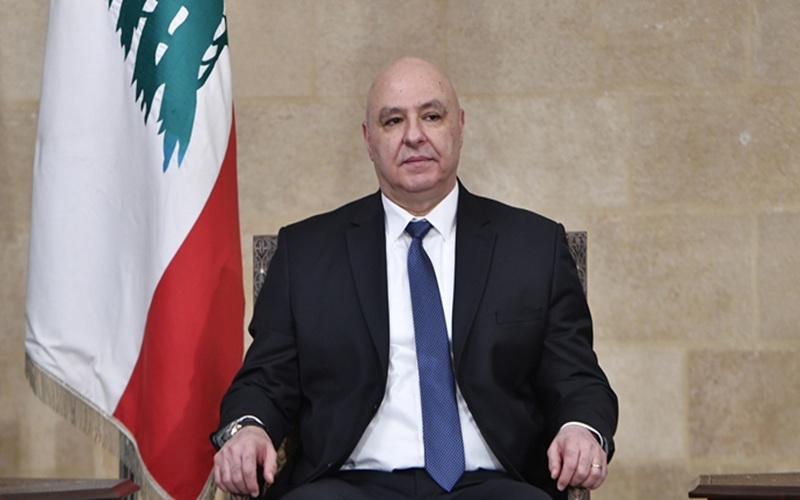

Lebanese President Joseph Aoun delivers a firm message to Tehran, demanding Hezbollah’s disarmament and an end to foreign interference in Lebanon’s affairs.
On August 13, 2025, Lebanese President Joseph Aoun delivered a firm message to the Iranian regime’s Supreme National Security Council (SNSC) Secretary Ali Larijani during a meeting in Beirut on Wednesday, underscoring his government’s commitment to the rapid disarmament of Hezbollah and the prevention of foreign interference in Lebanon’s internal affairs.
Larijani’s visit to Beirut appears aimed at reviving Tehran’s influence in Lebanon and across the Levant following the severe weakening of Hezbollah and the collapse of the Assad regime in Syria.
A Clear Warning to Tehran
During the talks, Aoun, speaking directly to Larijani — the personal representative of regime leader Ali Khamenei — declared that Lebanon would no longer allow any group or movement to maintain weapons or military equipment outside the control of the state. He stressed that the Lebanese government and armed forces are solely responsible for safeguarding all citizens, without exception.
“Israel is a challenge for all Lebanese, not just one group,” Aoun said, rejecting Hezbollah’s and Tehran’s longstanding justification for retaining arms under the pretext of defending Lebanon.
The president emphasized that disarmament and the prohibition of foreign military aid are now central Lebanese policies. While he expressed willingness to advance cooperation with Iran “within the framework of national sovereignty” and based on “mutual respect,” Aoun warned that recent rhetoric from Iranian officials has harmed Lebanon’s stability.
National Unity Over Sectarian Loyalty
Aoun made clear that Lebanon’s friendship with Iran should not be built solely through Hezbollah or any single faction. “Lebanon is the homeland of all its citizens, Christians and Muslims alike,” he said, adding that only legal and security institutions have the mandate to protect all sectors of society.
Reiterating his longstanding stance, Aoun noted that Lebanon respects the sovereignty of other nations, including Iran, and expects the same in return. He cautioned against relying on foreign powers to gain advantage over domestic rivals, warning that such approaches have historically exacted a heavy toll on the Lebanese people.
“Any threat directed at Lebanon is a threat against all Lebanese,” Aoun said. “Our greatest weapon against it is national unity.”
Iran’s Position and Constraints
In response, Larijani praised Aoun’s role in fostering national unity and reaffirmed Tehran’s desire to strengthen ties with the Lebanese state and people. However, his assurances of support for Hezbollah ring largely symbolic in light of Iran’s current limitations.
The fall of the Assad regime in Syria, coupled with Lebanon’s crackdown on Iranian smuggling through airports and border crossings, has slowed and complicated Tehran’s ability to resupply Hezbollah. With weapons shipments severely restricted, Iran has increasingly relied on cash transfers — some of which Lebanese authorities have successfully intercepted.
The Iranian regime’s financial strain, particularly as it focuses on rebuilding domestically after the recent Israel–Iran war, is expected to further restrict its ability to fund Hezbollah. While Tehran is likely to seek ways to maintain its influence in Lebanon, its capacity to provide meaningful support appears increasingly constrained.