

Tehran Daily Warns of Budget Deficit, Subsidy Cuts, and Risk of Social Unrest
A striking article published on August 25 by the Iranian regime’s state-run daily Jahan-e Sanat has revealed deepening concerns within the establishment over Tehran’s unsustainable financial commitments to its proxy forces and bloated domestic institutions, even as millions of citizens are stripped of subsidies.
The paper drew a direct comparison between the Soviet Union under Mikhail Gorbachev and today’s Iranian regime, noting that the USSR collapsed after it was forced to choose between sustaining its own people or maintaining costly foreign commitments. “The resources obtained from oil exports no longer suffice for timely and adequate payments to the people, making other expenditures extremely difficult,” the daily admitted.
It further acknowledged that “a portion of resources, small or large, is given by Iran to pro-Iran groups in various forms and with different objectives.” The article also pointed to “dozens of organizations and institutions connected to the state budget” that consume public funds without delivering meaningful benefits for citizens.
The government has already begun removing millions of households from the subsidy list by the end of September, a move the paper conceded will impose severe hardship on low-income families. “Millions of families whose subsidies have been cut will face tough conditions,” the article warned.
Meanwhile, regime president Masoud Pezeshkian is described as facing a “hard choice” between allocating revenues to struggling citizens or continuing to finance foreign militias and regime-affiliated bodies. “Pezeshkian must decide whether he will use available revenues for citizens and the poor, or continue spending on foreign aid and institutions that produce nothing for the country,” the daily declared.
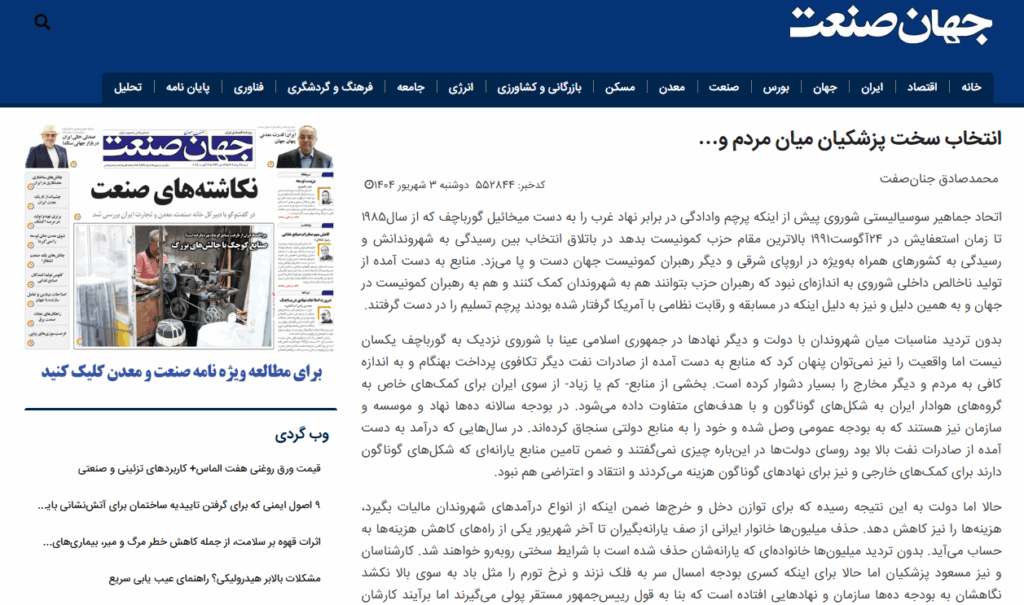
The article further cautioned that unless drastic measures are taken, “the horrific budget deficit will only worsen, and inflation will soar like the wind.” By invoking the Soviet Union’s collapse, the paper implicitly warned that the Iranian regime could face the same fate if it fails to change course.
This rare criticism underscores the depth of the regime’s financial crisis and growing recognition that its policy of prioritizing foreign adventurism over domestic welfare is eroding its legitimacy at home.
From the beginning of the clerical regime’s rule, proxy groups have operated under the direct sponsorship of its core pillars—Khomeini, Khamenei, and the Revolutionary Guards.
Repeatedly, even regime insiders such as Behzad Nabavi have admitted that 60 percent of Iran’s economy is controlled by four entities: the “Execution of Imam Khomeini’s Order Headquarters,” the “Foundation of the Oppressed,” the “Astan-e Quds,” and the IRGC’s “Khatam al-Anbiya Construction Headquarters”—all directly under Khamenei’s supervision.
This reality means that government administrations—appointed and powerless caretakers—play no real role in these decisions. Iran’s national wealth is siphoned off into the hands of these institutions and funneled toward proxy groups and corrupt networks.
When Jahan-e Sanat points toward Masoud Pezeshkian’s budgetary dilemmas, it is deliberately diverting attention. The true “address” lies not with Pezeshkian but with the clerical establishment itself, and above all with Khamenei and his office.
As long as they remain in power, Iran’s wealth will continue to be plundered to fund foreign adventurism at the expense of its people. It is the regime in its entirety, and Khamenei personally, whose hands must be cut off from the nation’s resources.