


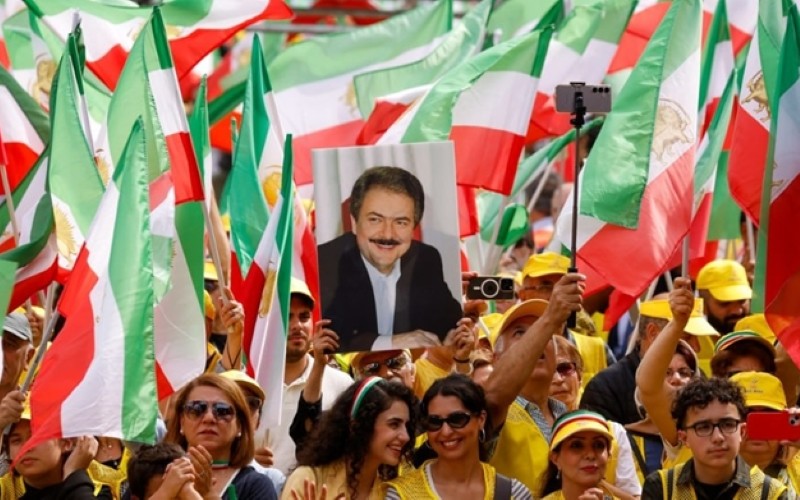

Thousands of Iranians gathered in Brussels to underscore the stark choice between dictatorship and democracy in post-war Iran.
On Saturday, September 6, thousands of Iranians and supporters of the resistance movement gathered in Brussels. The rally was far more than a routine political gathering; it was a direct response to the exceptional circumstances facing Iran and the broader region today.
The event highlighted a central truth: Iran’s future is defined by two opposing fronts. On one side stands a repressive and authoritarian regime; on the other, a genuine and organized opposition that has committed itself to the struggle for freedom and democracy.
A Post-War Context
The rally came at a time when Iran’s regime is reeling from a series of setbacks. Its decades-long regional interventions — from Iraq and Syria to Yemen and Lebanon — have ended in failure, with the costs of war and terrorism now returning to destabilize the regime at home. Meanwhile, tensions with the United States and Europe are intensifying, adding to Tehran’s internal crises.
Against this backdrop, the regime has intensified its propaganda and security efforts against the opposition, particularly the People’s Mojahedin Organization of Iran (MEK) and the National Council of Resistance of Iran (NCRI). The very scale of this effort underscores the reality that the organized resistance poses the most serious threat to the regime’s survival.
Clarity in the Battle Lines
The Brussels rally responded directly to this reality. Its central message was the need for clarity: the defining struggle in Iran is not between reformists and hardliners or between competing political factions within the regime, but between dictatorship and the movement that rejects any form of dictatorship.
The regime’s increasingly hostile rhetoric toward the resistance, including warnings about the growing support of Iranian youth for the MEK, has only underscored the significance of the movement’s appeal. Despite strict censorship inside Iran, the rally succeeded in drawing international attention to the NCRI as a viable democratic alternative.
An Organized Alternative
Speakers at the rally emphasized that the strength of the Iranian opposition lies in its persistence and organizational structure. Unlike spontaneous or fragmented protests, the resistance has built a resilient and active network that continues to project the struggle for freedom onto both the national and international stage.
This is precisely why the regime has concentrated its political, security, and media apparatus against the MEK and NCRI. The organized nature of the opposition not only ensures continuity but also provides a credible political alternative that resonates with Iranians inside the country and with the international community.
A Turning Point
The Brussels rally marked a pivotal moment in this struggle. It reaffirmed the primary dividing line in Iran: on one side, a ruling system entrenched in repression and war-mongering; on the other, an organized resistance devoted entirely to the pursuit of freedom and democracy.
The message was unambiguous: Iran’s future cannot be shaped in the ambiguity of half-measures or false alternatives. It will be determined by the clear choice between dictatorship and a democratic alternative. The tens of thousands of voices raised in Brussels made this truth impossible to ignore, both for Iranians and for the international community.