


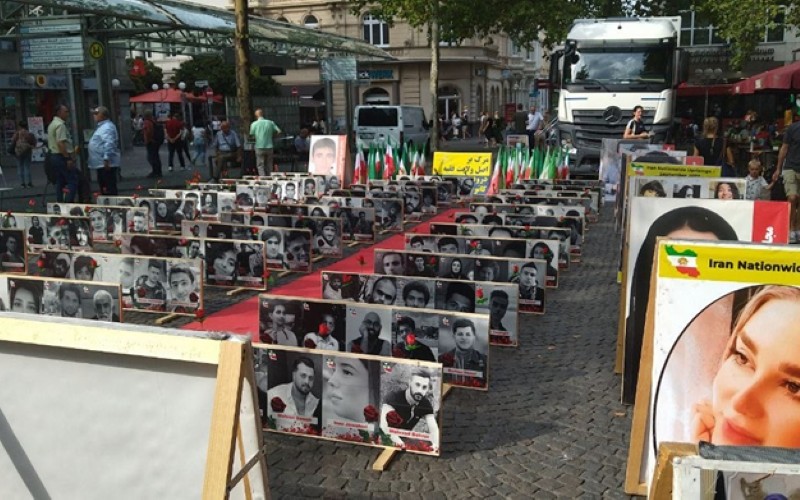

In the wake of the 12-Day war, Iran’s regime has turned to a brutal wave of executions, mass arrests, and censorship at home while expanding propaganda and cyberwarfare abroad—revealing its fear and fragility.
A Brutal Response to Defeat
The June 12-day war, which culminated in coordinated U.S.-Israeli strikes on the regime’s nuclear facilities, has left the clerical regime exposed and weakened. In response, Tehran has turned inward with unprecedented repression, using executions, mass arrests, and security crackdowns as tools to reassert control.
The regime’s police announced the arrest of more than 21,000 people in the weeks that followed. Reports from inside Iran indicate a suffocating security environment, with more than 50,000 security forces deployed in Tehran alone. Checkpoints proliferated across the country, random phone searches became routine, and rumors of neighbors’ arrests spread fear. Internet shutdowns, now a well-honed tactic, further silenced dissent.
Execution as a Tool of Terror
August marked the beginning of a surge of executions carried out under vague charges such as “moharebeh” (enmity against God) and “efsad fel-arz” (corruption on earth).
One example is Mehran Bahramian, a protester from the 2022 uprising, who was executed after what activists described as a secret and unjust trial. Critics argue his death, like so many others, reflects the regime’s desperation to instill fear rather than dispense justice.
The pace of killings has accelerated at a shocking rate.
- September 17: Babak Shahbazi, 44, was executed in Qezel Hesar Prison on charges of espionage for Israel, condemned by the notorious “hanging judge” Abolqasem Salavati. At least three others were hanged the same day in the same prison.
- September 16: Five prisoners were executed across three cities, including two in Qezel Hesar and three in Birjand and Gonabad.
- September 15: Six prisoners were executed in Ramhormoz, Jiroft, and other prisons.
- September 14: At least sixteen prisoners were hanged nationwide, among them young Baloch protesters in Zahedan, Shiraz, Kashmar, Mashhad, and Ilam.
With at least 27 executions between September 14 and 16, the toll since March 21, 2025—the start of the Iranian year—has surpassed 800 executions, the highest figure in 35 years.
Maryam Rajavi, President-elect of the National Council of Resistance of Iran (NCRI), stated: “Khamenei, gripped by fear of the people’s rising anger, is desperate to extend the disgraceful rule of the Velayat-e Faqieh regime. Every day more families are left grieving, yet this blood-stained regime cannot last. Its decaying power will fall to the courage of Iran’s rising generation.”
Expanding Repression Into Cyberspace
The regime’s crackdown is not confined to prisons and streets. It is increasingly waging war in cyberspace and media.
- Meta removed a large-scale Iranian influence network in early 2025.
- Microsoft traced Tehran’s operations to interfere in the 2024 U.S. elections.
- OpenAI blocked a regime-led campaign that used generative AI to spread propaganda.
- The notorious hacker group “Charming Kitten” (APT42), linked to the regime, continues to impersonate journalists and conferences to target activists through phishing schemes.
These operations reveal a regime intent not only on silencing domestic dissent but also on shaping narratives abroad, weaponizing technology to compensate for its eroding legitimacy.
A Regime on Shaky Ground
Experts view this intensified repression as a direct reflection of the regime’s vulnerability after the June war. The battle is no longer only over nuclear facilities but over the regime’s survival. Divisions inside the ruling establishment are widening, particularly between the Revolutionary Guards, who seek absolute dominance, and other factions trying to maintain balance.
President Masoud Pezeshkian’s attempt to soften rhetoric—claiming, “Those who oppose us are not necessarily our enemies”—was quickly attacked by hardliners. Even Khamenei, invoking “unity among all Iranians,” appeared less as a confident leader and more as a ruler clinging to power. Analysts see these gestures as desperate maneuvers, not genuine reforms.
Fear Masquerading as Power
The clerical regime’s reliance on mass executions, sweeping arrests, and cyberwarfare exposes its weakness rather than its strength. Far from projecting stability, these actions confirm that the greatest threat to Tehran comes not from foreign powers but from within: the Iranian people, who continue to resist despite repression.
The regime’s brutality is a grim reminder that its survival rests on fear and bloodshed. Yet history shows that such systems cannot endure indefinitely. As Maryam Rajavi and the NCRI emphasize, the courage of Iran’s youth and the organized resistance will ultimately bring justice, human rights, and democracy to a nation held hostage for far too long.