The cancellation of Iran’s annual military parade, escalating nuclear threats, and sharp political divisions reveal a regime in disarray after the reactivation of UN sanctions.
The reactivation of UN sanctions against the Iran’s regime through the snapback mechanism has triggered visible tremors across Tehran’s political and military establishment. In a striking sign of weakness, the authorities canceled their annual September 22 military parade, a long-standing ritual intended to showcase power and deterrence.
Official spokesmen attempted to mask the decision by citing “operational priorities,” but senior commanders admitted the truth: the regime fears domestic unrest and external threats in the wake of its losses on the battlefield through proxy forces. The parade’s cancellation underscores the degree to which the regime has lost confidence in projecting even symbolic strength.
At the political center, the regime’s Supreme National Security Council convened under President Masoud Pezeshkian the day after the UN vote. Its statement announced a suspension of cooperation with the International Atomic Energy Agency (IAEA), presenting this as a retaliatory step against Europe. In reality, it reflects Tehran’s limited options. Continued cooperation has failed to shield it from sanctions, while further escalation risks deepening its isolation.
The crisis has also exposed stark divisions within the regime’s political and media elite. Reformist-leaning Ham-Mihan urged Pezeshkian to act “honestly” and coordinate closely with the Supreme Leader, warning that indecision would only worsen the situation. By contrast, Farhikhtegan, tied to regime insider Ali Akbar Velayati, called for urgent nuclear negotiations with Europe, even suggesting that Tehran might have to concede on uranium enrichment to secure relief. Meanwhile, Kayhan, Khamenei’s mouthpiece, denounced any prospect of dialogue, demanding withdrawal from the Non-Proliferation Treaty (NPT) and an end to all cooperation with the IAEA.
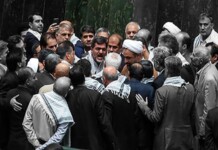
Most striking are the open calls from senior parliamentarians to pursue nuclear weapons. Members of the regime’s parliament, including Mohammad Naderi, Kamran Ghazanfari, and Mohammad Manan Raisi, have now explicitly urged Tehran to leave the NPT, adopt a policy of nuclear ambiguity, and prepare for a weapons test. These declarations cross a line that the regime has historically avoided, abandoning even the pretense of denial and signaling the desperation of an establishment cornered by international isolation.
Amid this crisis, regime insiders evoke historical parallels to 1988, when the regime’s founder Ruhollah Khomeini was forced to accept a ceasefire with Iraq after years of war. Prominent figures like Gholamhossein Karbaschi suggest that President Pezeshkian must play the role of Rafsanjani, persuading Khamenei to accept a humiliating retreat. The comparison to Khomeini’s “poison chalice” is not accidental; it underscores how the regime’s elite now sees itself at the edge of another historic capitulation.
Taken together, these developments paint a portrait of a regime trapped between paralysis and overreach. Unable to display strength at home, isolated abroad, and fractured within, Tehran oscillates between the mirage of negotiation and the fantasy of nuclear deterrence. But the revival of sanctions and the collapse of its carefully constructed façade of strength have left the regime with fewer cards to play.
The cancellation of the parade is more than a tactical retreat; it is a symbol of a regime that no longer believes in its own power to intimidate. The calls for nuclear weapons are less a sign of confidence than of desperation. And the fractures among its factions reveal the deep uncertainty about whether the Islamic Republic can survive another confrontation with the international community.