
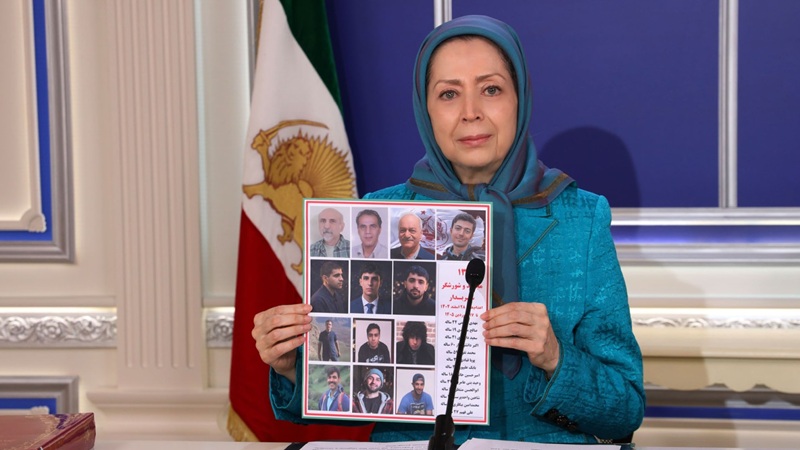

In a message to Italian officials, the Iranian opposition leader warns of a regime on the brink and calls for international recognition of a democratic alternative
In a decisive and politically charged message to officials in Italy’s Marche region, Maryam Rajavi framed Iran’s current trajectory as a historic turning point—one that, in her view, signals both the intensification of repression and the imminent collapse of the ruling theocracy.
Addressing regional leaders including Francesco Acquaroli, Rajavi’s remarks were not merely ceremonial. They amounted to a strategic appeal: recognize the Iranian resistance as a viable democratic alternative and reject both appeasement and authoritarian restoration.
Message to the Official Meeting of the Region of Marche, Italy
A Regime Responding with Violence
Rajavi situated her argument in the aftermath of the January uprising, which she described as nationwide in scope and transformative in consequence.
“A major uprising spread across all 31 provinces of Iran,” she noted, emphasizing both its scale and its socio-political breadth. The regime’s response, she added, was predictably brutal: “the killing of thousands of young people, including teenagers.”
Yet, rather than suppress dissent, this violence appears—by her account—to have produced the opposite effect. “This violence… increased the determination of our people to bring an end to the regime,” Rajavi said, pointing to a pattern observed across multiple protest cycles in Iran over the past decade.
Central to this evolving dynamic is the expansion of organized resistance. Rajavi highlighted the growing operational capacity of so-called “resistance units,” describing them as having “developed into organized units of a liberation army inside Iran.” She cited a February 23 operation targeting a highly secured site linked to Supreme Leader Ali Khamenei as evidence of this capability.
Historical Parallels and Political Legitimacy
Rajavi drew a deliberate parallel between Iran’s present struggle and Italy’s own resistance history during World War II. By invoking the anti-fascist uprisings in the Marche region, she sought to establish moral and historical continuity between the two movements.
“Such a people can truly understand the emotions, the determination, and the conviction of the Iranian people who have risen up,” she said, positioning the Iranian resistance within a broader tradition of anti-dictatorial struggle.
At the same time, she rejected any return to monarchical rule, warning against “attempts by remnants of the previous dictatorship to hijack the people’s uprising.” According to Rajavi, Iran’s political evolution—shaped by “120 years of struggle for freedom”—has matured beyond both religious and royal authoritarianism.
Executions as a Strategy of Survival
Rajavi argued that the regime’s increasing reliance on executions reflects structural weakness rather than strength.
“Today, the regime stands on the brink of collapse. For this reason, it has turned to the execution of political prisoners,” she stated. She cited the execution of 13 political prisoners between March 19 and April 6, including members of the People’s Mojahedin Organization of Iran, portraying them as “heroes” of the resistance.
This framing aligns with a broader narrative advanced by the opposition: that repression is no longer a tool of consolidation, but a sign of systemic fragility.
Rejecting Appeasement and Intervention
A central pillar of Rajavi’s message was her rejection of both Western appeasement and foreign military intervention as viable solutions to the Iranian crisis.
“Neither the appeasement policy of Western governments nor foreign military intervention can resolve the issue of Iran,” she asserted. Instead, she emphasized endogenous regime change: “The solution lies in regime change carried out by the people, through resistance and organized uprising.”
This position attempts to differentiate the opposition from both external interventionist strategies and passive diplomatic engagement, advocating instead for international political recognition rather than military involvement.
The NCRI as a “Credible Alternative”
Rajavi presented the National Council of Resistance of Iran as a structured and viable alternative to the current regime. She described it as a coalition capable of managing a democratic transition through a provisional government framework.
At the core of this proposal is the Ten-Point Plan, which outlines a post-regime political order based on democratic norms: separation of religion and state, gender equality, ethnic autonomy, abolition of the death penalty, and a non-nuclear Iran.
She also challenged regime narratives directly. Referring to claims by the leadership’s inner circle that millions remain loyal, Rajavi countered: “If this claim is true, [they] should accept free elections… under United Nations supervision and based on the principle of popular sovereignty.”
The implication is clear: legitimacy must be tested through democratic mechanisms—something she argues the current system fundamentally rejects.
A Call to Europe
Rajavi concluded with a pointed appeal to European policymakers, particularly in Italy. She urged them to take concrete steps: recognize the NCRI’s provisional government, shut down Iranian diplomatic missions, and apply pressure to halt executions.
Her closing assertion encapsulated the message’s central thesis: “No system built on fear can endure.”
For European audiences—especially those with historical memory of authoritarian rule—this is both a moral argument and a policy proposition. Whether it translates into tangible shifts in European policy remains uncertain. But as Iran enters what Rajavi describes as an decisive phase, the question of international alignment is becoming increasingly difficult to avoid.