As 1,500 prisoners in Ghezel Hesar prison launch a hunger strike against executions, Amnesty International urges UN action amid Iran’s worst execution spree in decades.
“The gallows must be dismantled from Iran. Raise your voices and gather in front of the prisons. We, the prisoners on death row, have no refuge but you, the people.”
— From the statement of 1,500 hunger-striking prisoners in Ghezel Hesar Prison, October 14, 2025.
These few lines, written behind the bars of Ghezel Hesar Prison near Karaj, carry a message with historic resonance — a call for a nationwide movement to end executions in Iran. Since October 13, around 1,500 prisoners in Ward 2 of Ghezel Hesar have launched a mass hunger strike in protest against the transfer of fellow inmates to solitary confinement for execution.
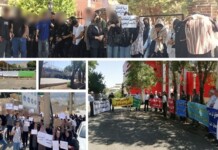
Their appeal has already spread beyond prison walls. Political prisoners in Evin and other wards of Ghezel Hesar have announced solidarity with the strikers. Across the country, activists and PMOI Resistance Units have echoed the demand to stop executions and support the prisoners’ courage.
Iran’s rebellious youth target regime centers of repression, support striking prisoners in Ghezel Hesar https://t.co/70LYC3eq7h
— People's Mojahedin Organization of Iran (PMOI/MEK) (@Mojahedineng) October 17, 2025
A collective cry against state killing
The prisoners’ statement reflects a moment of extraordinary defiance. It denounces what they describe as a state-run “machine of death,” warning that Supreme Leader Ali Khamenei is executing Iranian youth “one by one and in groups” in an attempt to suppress dissent and sustain his rule through fear and intimidation.
Observers note that the current wave of executions marks one of the darkest chapters in Iran’s contemporary history. Rights groups estimate that the regime has executed more than 1,000 people since the beginning of 2025—an average of four every day.
Amnesty International, in a statement issued on October 16, 2025, called on UN member states to confront this “shocking execution spree” with the urgency it demands.
October 16—Ghezel Hesar Prison, Karaj, Iran
The hunger strike of death-row prisoners marks its fourth day as inmates refuse to be intimidated by the regime's repressive measures.
This protest movement began on October 13 as 1,500 death-row inmates in Unit 2 began a hunger strike… pic.twitter.com/5PUpp46axs— People's Mojahedin Organization of Iran (PMOI/MEK) (@Mojahedineng) October 16, 2025
“More than 1,000 people have already been executed in Iran since the beginning of 2025 – an average of four a day,” said Hussein Baoumi, Amnesty’s Deputy Regional Director for the Middle East and North Africa. “Since the Woman, Life, Freedom uprising of 2022, the Iranian authorities have increasingly weaponized the death penalty to instill fear among the population, crush dissent, and punish marginalized communities. This year, executions have reached a scale not seen since 1989.”
Baoumi emphasized that “executions are being carried out following grossly unfair trials held behind closed doors, amid widespread patterns of torture and forced confessions.” He urged UN member states to demand an immediate moratorium and to hold Iranian officials accountable for crimes under international law.
“Even by Iran’s own bleak record, this is a grim moment that demands a serious and coordinated international response,” he warned.
UN urged to act as executions soar
In a post shared on X (Twitter), Amnesty Iran underscored the urgency of global action:
“UN member states must confront the Iranian authorities’ shocking execution spree with the urgency it demands. More than 1,000 people have already been executed in Iran since the beginning of 2025 – an average of four a day. … This grotesque assault on the right to life must not be treated like business as usual while the lives of thousands more on death row are at risk.”
🧵UN member states must confront the Iranian authorities’ shocking execution spree with the urgency it demands. More than 1,000 people have already been executed in Iran since the beginning of 2025 – an average of four a day. 1/4 https://t.co/sCe2a7oRpJ
— Amnesty Iran (@AmnestyIran) October 16, 2025
Amnesty called on all states participating in the upcoming UN Third Committee Interactive Dialogue on Iran to “demand that Iranian authorities immediately halt executions, quash death sentences imposed after unfair trials, revoke lethal anti-narcotic laws, and establish an official moratorium.”
The organization also urged governments to pursue accountability through universal jurisdiction, investigating torture and other international crimes committed by Iranian officials and issuing arrest warrants where evidence supports criminal responsibility.
A regime sustained by fear
Inside Iran, the regime has made the death penalty a central pillar of repression. Analysts say that Khamenei’s government has turned execution into both a punishment and a language of power — a daily spectacle meant to terrorize society into silence, particularly after the regime’s legitimacy was deeply shaken by the 2022–2023 protests and ongoing political isolation.
October 15—Ghezel Hesar Prison, Karaj, Iran
On the third day of their hunger strike, prisoners protest executions and violations of the right to life. Despite weakness and fainting, they continued their brave resistance against injustice.#IranProtests pic.twitter.com/AJdVxB3ypc— People's Mojahedin Organization of Iran (PMOI/MEK) (@Mojahedineng) October 16, 2025
President Masoud Pezeshkian, despite portraying himself as a reformist, has done little to challenge this machinery of death. His administration continues to authorize executions and to ignore appeals for clemency or fair trials.
Meanwhile, reports from human rights organizations reveal that ethnic minorities — especially Baluchis, Kurds, and Ahwazi Arabs — remain disproportionately targeted, often convicted under vaguely defined charges such as “enmity against God” or “corruption on earth.”
A historic moment of moral resistance
The hunger strike at Ghezel Hesar represents not only a protest but a demand for moral awakening. The prisoners’ courage has resonated across Iranian society, uniting calls from activists, families of the executed, and international organizations in a single cry: No to executions.
As their statement concludes:
“The gallows must be dismantled from Iran. Raise your voices and gather in front of the prisons. Support, by every possible means, the prisoners under death sentence.”
For the strikers, the struggle for life is now inseparable from the struggle for freedom. For the Iranian people and the international community, their message poses a question that cannot be ignored: If the gallows sustain tyranny, then breaking them is a national and human responsibility.