Security forces violently disperse peaceful demonstrators outside Iran’s parliament as 1,500 prisoners in Ghezelhesar mark the seventh day of their hunger strike.
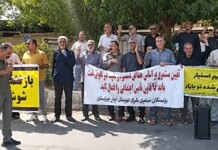
On Sunday, October 19, 2025, Tehran’s Baharestan Square — home to Iran regime’s parliament — became the scene of a rare and defiant protest. Families of prisoners sentenced to death in Ghezel Hesar Prison gathered peacefully, holding photos of their loved ones and banners reading “No to executions” and “Don’t kill.”
October 19—Tehran, Iran
Families of death-row prisoners rally in front of the Majlis (parliament), demanding an end to death sentences and the alarming rise of executions in Iran.#IranProtests #StopExecutionsInIran pic.twitter.com/grJsGcjqMB— People's Mojahedin Organization of Iran (PMOI/MEK) (@Mojahedineng) October 19, 2025
Their demand was clear and simple: an immediate halt to the execution wave sweeping through Iran’s prisons. But what began as a silent plea for life soon turned violent.
Peaceful protest met with brutal force
According to eyewitnesses, security and police forces launched an unprovoked attack on the demonstrators. Officers used batons and excessive force to disperse the crowd, beating several men and women and detaining an unspecified number of participants.
“They came only to make their voices heard,” one witness said. “No one had a weapon. The officers attacked without warning or even a word.”
Despite the crackdown, many protesters stood their ground, shouting “No to executions!” even as they were pushed back. Onlookers and drivers nearby expressed support by honking their car horns and chanting “Let them go!” and “It’s their right to protest!” The atmosphere around the parliament grew increasingly tense as authorities sought to prevent the gathering from spreading.
Connection to the Ghezel Hesar prison hunger strike
The demonstration came as 1,500 prisoners in Ward 2 of Ghezel Hesar Prison in Karaj entered the seventh day of their hunger strike. The prisoners, many of whom have reportedly sewn their lips shut, are protesting against mass executions and what they describe as “inhuman prison conditions.”
Sources from inside the prison report that authorities have cut off water supplies to the ward and that many strikers are in critical condition, suffering from fainting, dehydration, and dangerously low blood pressure.
Families at the Tehran protest said they had gathered to amplify the prisoners’ call for life.
“More than 1,500 people are facing death,” said one woman holding a picture of her son. “We came here only to say: enough.”
October 18—Ghezel Hesar prison, Karaj, Iran
On the sixth day of their hunger strike, death-row prisoners plead with the people to help send their message to the world and bring a halt to executions in Iran.#IranProtests #StopExecutionsInIran pic.twitter.com/w2jE2No2Yu— People's Mojahedin Organization of Iran (PMOI/MEK) (@Mojahedineng) October 19, 2025
Authorities suppress coverage
Local sources said security forces tried to block news of the demonstration from reaching the media. Several protesters’ phones were reportedly confiscated. Nevertheless, images and short video clips circulated on social media showed men and women standing empty-handed but resolute in the face of police violence.
Human rights observers see the protest outside parliament as a continuation of the silent defiance taking place inside Ghezel Hesar — a convergence of resistance both behind bars and on the streets. Together, they represent a growing national rejection of Iran regime’s escalating use of the death penalty.
An international crisis of conscience
Iran’s execution rate has surged to its highest level in decades, prompting alarm among rights organizations. Amnesty International recently reported that over 1,000 people have been executed since the start of 2025, averaging four executions per day.
In a statement issued on October 16, 2025, Hussein Baoumi, Amnesty’s Deputy Regional Director for the Middle East and North Africa, said:
“Since the Woman, Life, Freedom uprising of 2022, the Iranian authorities have increasingly weaponized the death penalty to instill fear among the population, crush dissent and punish marginalized communities. This year, executions have reached a scale not seen in Iran since 1989.”
Amnesty has urged UN member states to use the upcoming UN General Assembly’s Third Committee Interactive Dialogue on Iran to demand an immediate moratorium on executions and pursue accountability through universal jurisdiction for officials implicated in torture and unlawful killings.
A cry that cannot be silenced
Despite repression, the families’ protest and the prisoners’ hunger strike have reignited the nationwide call to end executions in Iran — the “No to Executions” movement that continues to gather moral and social force.
What began as the echo of stitched lips inside prison walls is now resounding across Iran’s streets. For many Iranians, it symbolizes not only opposition to the death penalty but resistance against a system that sustains its power through fear and death.