


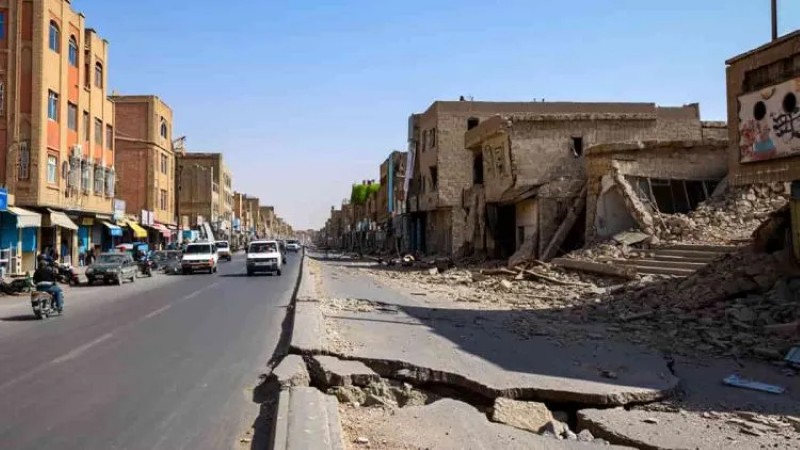

Iran Faces a Structural Environmental Collapse
Iran is experiencing one of the most severe cases of land subsidence in the world — a slow but devastating sinking of the ground caused by overextraction of groundwater. Once dismissed as a localized environmental issue, land subsidence has now become a national structural crisis, threatening lives, infrastructure, and the long-term stability of the Iranian economy.
Experts estimate that around 45% of Iran’s 94 million inhabitants (including about 7 million migrants) now live in or near subsiding areas. This translates to nearly 42 million people facing serious environmental and economic risks.
The Ground Beneath Iran Is Collapsing
Approximately 3.5% of Iran’s total land area — around 58,000 square kilometers — is affected by subsidence. Built environments such as cities, villages, industrial zones, and road networks make up about 7% of Iran’s surface, or 115,000 square kilometers, much of which lies in high-risk areas.
While mountains and deserts cover more than half the country, over 75% of Iranians live in densely populated urban regions, many of which are now vulnerable to ground collapse.
The most affected provinces include Tehran, Isfahan, Fars, Semnan, Kerman, Khorasan Razavi, and Alborz, encompassing major cities such as Tehran, Mashhad, Isfahan, Yazd, and Kerman.
Satellite and geospatial data reveal that some of these regions are subsiding at more than 30 centimeters per year — a catastrophic rate by global standards. The Tehran Mapping Organization confirmed that 11% of Tehran Province is now within active subsidence zones.
Overexploitation of Groundwater: The Root of the Crisis
The primary cause of Iran’s land subsidence is unchecked groundwater extraction. Expanding urban populations, intensive agriculture, and mismanagement of water resources have pushed aquifers beyond recovery.
In Tehran Province alone, 37% of groundwater withdrawal is used for agriculture, 44% for urban drinking water, 9% for parks and green spaces, and 3% for rural consumption. Despite drilling 100 new deep wells around Tehran, the capital now faces a 30-million-cubic-meter annual water deficit.
Satellite data show dramatic examples:
- Rafsanjan, home to Iran’s pistachio orchards, is sinking by 34–37 cm per year.
- Varamin Plain, near Tehran, is subsiding by over 31 cm annually due to urban and agricultural demand.
- Behraman Plain (Kerman Province) reports 31 cm per year, while Karaj Plain (Alborz Province) saw up to 30 cm per year between 2016 and 2021.
A Threat to Infrastructure, Heritage, and Human Life
Land subsidence is tearing apart Iran’s infrastructure. Cracks, uneven sinking, and ground fractures damage roads, railways, bridges, metro systems, pipelines, and airports. Approximately 15% of the national railway network (around 1,380 km) and eight major airports, including Tehran’s Imam Khomeini Airport, are now located in high-risk areas.
The destruction of groundwater reservoirs — which can take thousands of years to recover — is irreversible. Even Iran’s cultural heritage sites, such as Persepolis and Naqsh-e Rostam, face structural damage.
Tehran and other major cities are also witnessing the emergence of sinkholes and ground fissures, endangering densely populated neighborhoods.
The Economic Cost: Billions Lost and Growth Undermined
The economic implications of land subsidence are enormous. Repairing damaged infrastructure consumes massive public funds and diverts private investment from productive sectors. Economists warn that subsidence will impose a long-term structural limit on Iran’s GDP growth between 2025 and 2035.
Direct economic losses include:
- Infrastructure repairs and maintenance costs for roads, rail, and utilities.
- Rising transportation costs due to damaged highways and railways.
- Water and gas pipeline ruptures, leading to massive waste and service disruptions.
- Emergency repairs that strain local and national budgets.
Industries that depend heavily on water — including steel production, agriculture, and manufacturing — are already suffering billions in losses. Service sectors, which make up over 50% of Iran’s GDP, are also hit by power outages, water rationing, and transport disruptions, reducing productivity and investor confidence.
A Nation Sinking — Literally and Economically
Out of Iran’s 429 cities, 256 are now affected by subsidence, particularly across the central plateau — home to the country’s major population and industrial centers. Experts estimate that 25–40% of Iran’s built environment is exposed to active land sinking.
The displacement of millions of residents from subsiding urban zones could trigger a mass labor migration and devastating regional economic losses.
Iran’s land subsidence crisis is not merely an environmental disaster — it is a national emergency. Unless the regime addresses the root causes of water mismanagement, overextraction, and corruption in environmental policy, large parts of the country may become uninhabitable within a generation.