


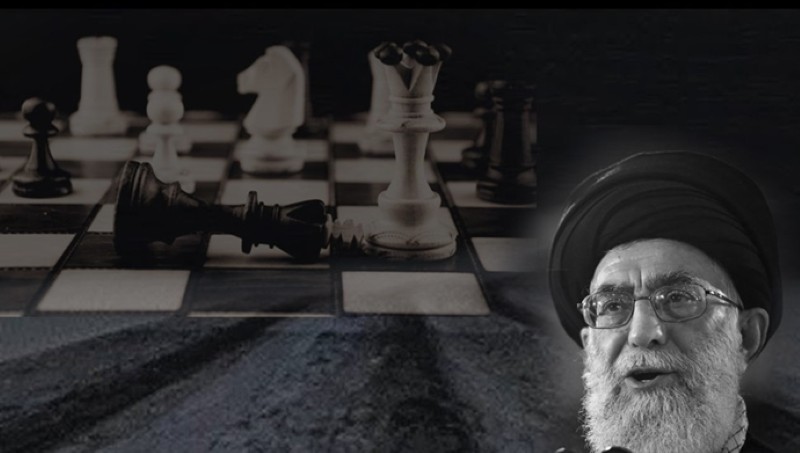

Internal divisions, regional confrontation, and an unsustainable nuclear policy have trapped the regime between war and peace
Khamenei’s Policies Push the Regime Into Strategic Stalemate
Under Ali Khamenei’s leadership, Iran’s regime has become trapped in a strategic deadlock—neither at peace with the international community nor engaged in open war. The deadlock stems from a combination of ideological rigidity, domestic repression, and regional adventurism. Analysts say this condition reflects the cumulative result of Tehran’s theocratic policies, its export of terrorism, and internal contradictions within the ruling elite.
Growing Factional Divisions Within the Regime
Recent years have seen widening rifts within Iran’s power structure. The divides are no longer limited to reformists and hardliners but now cut across principlist factions themselves. These tensions arise from ideological disputes, conflicting economic interests, and divergent views on foreign policy.
Observers note that Khamenei’s once-dominant authority to mediate among factions is fading. The disagreements over how to handle nuclear negotiations and relations with the West—particularly following the U.S. withdrawal from the JCPOA in 2018 and the EU’s activation of the snapback mechanism in 2025—have further exposed the leadership’s fragmentation.
The regime’s internal paralysis has become increasingly visible in public statements. In October 2025, Gholamhossein Karbaschi, editor-in-chief of Ham-Mihan daily, criticized the lack of a coherent decision-making system, describing the situation as the outcome of a “47-year impasse.” He also faulted President Masoud Pezeshkian for failing to deliver on campaign promises such as lifting internet restrictions and engaging with the international community.
Experts Cite Governance Failures and Economic Isolation
Economist Mehdi Pazouki recently highlighted the absence of good governance and noted that Iran’s foreign policy serves ideological and military goals rather than national development. He pointed to the regime’s refusal to comply with the Financial Action Task Force (FATF) standards as a barrier to trade and foreign investment.
Pazouki argued that as long as Tehran avoids clarity in its international relations, technology transfer and capital inflows will remain impossible. The remarks underline how the regime’s decision-making apparatus prioritizes ideological projects and military spending over economic stability.
Ideological Foreign Policy and Regional Ambitions
Khamenei’s foreign policy continues to be driven by an ideological opposition to universal principles of peace and human rights. This doctrine sustains both internal repression and external militarism. By supporting proxy groups such as Hezbollah in Lebanon, the Popular Mobilization Forces in Iraq, and the Houthis in Yemen, Tehran seeks to project regional influence under the guise of resistance.
This militarized approach, enables the regime to justify domestic crackdowns as part of a broader “defensive” strategy.
Diplomatic Isolation and Escalating Tensions
In his October 2025 speech, Khamenei rejected direct talks with former U.S. President Donald Trump, calling negotiations “a form of surrender.” He dismissed U.S. domestic unrest as proof of Western decline, while Washington reiterated that diplomacy remains possible only if Tehran ends its support for terrorism. The exchange reflected Tehran’s entrenched diplomatic isolation and inability to transition from confrontation to constructive engagement.
Following the 12-day conflict in June, Tehran reportedly allocated around €2 billion to expand the Revolutionary Guards’ missile capabilities, despite poor performance by the regime air defenses and drones during the fighting. This renewed military spending underscores the regime’s preference for escalation over reform.
Nuclear Program at the Core of the Stalemate
Iran regime’s advancing nuclear program remains a central element of its strategic deadlock. According to Rafael Grossi, Director-General of the International Atomic Energy Agency (IAEA), Tehran now possesses roughly 400 kilograms of uranium enriched to 60 percent—enough to build up to ten nuclear weapons if further refined.
Regime Foreign Minister Abbas Araghchi dismissed Grossi’s comments as “threatening,” while intelligence reports cited by the Institute for Science and International Security revealed new construction at the Taleqan-2 site, signaling Iran’s intent to continue nuclear activities despite international pressure.
This course has intensified sanctions and heightened the risk of future military strikes, further isolating the regime.
Mounting Domestic and Leadership Crises
At home, the government faces economic stagnation, inflation, and growing disillusionment. Masoud Pezeshkian has publicly criticized the “hidden government” and compared the condition of Iranian cities to “Afghanistan,” citing structural inefficiencies and corruption.
Former Planning and Budget Organization head Masoud Roghani stated that the regime has consistently sacrificed public welfare for ideological purity. He recalled how the Supreme Leader’s ban on Western COVID-19 vaccines led to over 750,000 deaths, describing it as one of the most devastating decisions of his rule.
Between Surrender and Resistance
Analysts agree that Khamenei’s regime is caught between “surrender and resistance,” clinging to confrontation as a means of survival. However, by isolating the country economically and diplomatically, the regime has created a fragile equilibrium—unable to secure peace, yet unprepared for war.
The deepening fractures within the power structure, continued sanctions, and recurring waves of social unrest have all underscored the unsustainability of Khamenei’s strategy. Iran’s current trajectory, shaped by decades of repression and ideological rigidity, leaves the regime facing an uncertain future in which its own survival is increasingly at risk.