


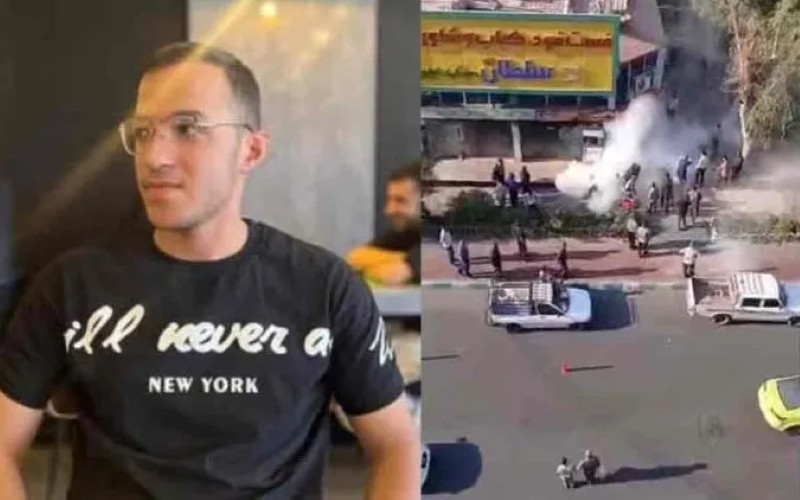

The tragic act of 20-year-old Ahmad Baladi sparks public anger and condemnation of the regime’s corruption and brutality
On Thursday night, November 6, 2025, a wave of grief and outrage swept through the city of Ahvaz after 20-year-old student Ahmad Baladi set himself on fire in protest against the violent demolition of his father’s small kiosk by municipal agents. Dozens of angry citizens gathered outside Taleghani Hospital, where Ahmad is being treated with over 70 percent burns and remains in critical condition.
According to eyewitnesses, municipal agents from District 3 of Ahvaz, accompanied by security forces, arrived without prior notice to demolish the kiosk belonging to Mojahed Baladi, Ahmad’s father. In the absence of the owner, his wife and son tried to stop the demolition by staying inside the kiosk. Witnesses said that the deputy mayor physically assaulted and humiliated Ahmad’s mother, dragging her out of the kiosk. In response to this public humiliation and injustice, Ahmad poured gasoline over himself and set himself ablaze.
Eyewitnesses reported that the regime’s agents not only failed to help him but mocked and watched indifferently as the young man burned.
The horrific event immediately sparked protests outside the hospital, where demonstrators denounced the Ahvaz municipality’s brutality and demanded the immediate dismissal of Mayor Amini, his deputies, and the prosecution of all officials involved. Security forces quickly surrounded the hospital and nearby streets to prevent the protests from spreading.
Maryam Rajavi’s Statement
Mrs. Maryam Rajavi, President-elect of the National Council of Resistance of Iran (NCRI), responded to the tragedy with a powerful message:
“The flames that engulfed 20-year-old Ahmad, a student and son of the people of Ahvaz, may have wounded the hearts of all Iranians, but they are the very fire that will consume the foundations of the mullahs’ regime. For decades, the rulers of the clerical regime and the commanders of the Revolutionary Guards have plundered the wealth of the Iranian people, while their corrupt children live lavish, ultra-luxurious lives both inside and outside Iran. Meanwhile, they have wasted hundreds of billions of dollars on anti-national nuclear and missile projects and foreign warmongering, yet they show no concern for the most deprived citizens at home. Ahmad’s blaze of protest is a warning to this criminal regime: it cannot escape the fury of the Iranian people. The fire will reach the gates of Khamenei’s residence. The day of reckoning for the executioners of Iran’s people is drawing near.”
The flames that engulfed 20-year-old Ahmad, a student and son of the people of Ahvaz, may have wounded the hearts of all Iranians, but they are the very fire that will consume the foundations of the mullahs’ regime.
For decades, the rulers of the clerical regime and the… pic.twitter.com/sXKqGhPSWx— Maryam Rajavi (@Maryam_Rajavi) November 7, 2025
A Tragic Symbol of Social Injustice
Many observers and social activists have compared Ahmad Baladi’s act to that of Mohamed Bouazizi, the Tunisian street vendor whose 2010 self-immolation in protest against municipal oppression ignited the Arab Spring uprisings. Like Bouazizi’s act, Ahmad’s protest has become a symbol of deep-seated anger against systemic injustice, corruption, and inequality.
Analysts describe Ahmad’s self-immolation as a desperate cry from within a society long oppressed by poverty, humiliation, and repression.
Over recent days, Iranian social media has been flooded with messages of solidarity and fury. Users have shared photos of Ahmad and his father’s burned kiosk, calling the tragedy a reflection of institutionalized injustice under the clerical regime. Many demand accountability and an independent investigation into the case.
Despite growing public outrage, local officials have yet to issue an explanation for the violent municipal operation or the abusive conduct of the regime’s agents. Human rights defenders have warned that continued repression and silence could ignite a new wave of protests across Khuzestan Province and beyond.
Observers note that Ahmad’s self-immolation is not only a personal tragedy but also a stark manifestation of the widening rift between the Iranian people and the ruling regime, which responds to every cry for justice with violence and contempt. Just as Bouazizi’s act sparked a revolution, Ahmad’s fire stands as a warning — when dignity is crushed, the flames of anger can consume an entire system.