


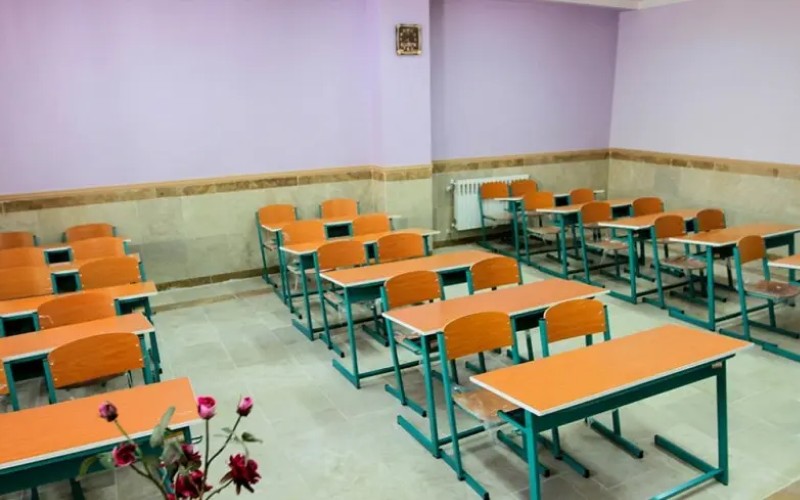

Despite official claims of new hires, Iran faces a widening gap in teachers, classrooms, and educational funding—placing the country’s human capital at profound risk.
A School System Reduced to Buildings Without Education
According to Bahar News, Iran’s education crisis is no longer a looming threat—it is an ongoing collapse. The new school year has already reached its midpoint, yet in a public high school in southeast Tehran, math classes are still left without teachers. Every morning, the school’s deputy administrator searches the grounds hoping to find “anyone” who can simply walk into the classroom.
This scene is not an exception. It is the new normal.
The Parliament Research Center officially estimated that for the 1403–1404 school year, Iran would face a shortage of 176,000 teachers, even under the most optimistic scenario that includes rehiring retirees and relying heavily on part-time instructors.
At the same time, around 72,000 teachers retired by Mehr 1403 (September 2024). The year before, the regime’s Ministry of Education reported a shortage of 179,000 teachers, partially covered through emergency hiring—at the cost of severely overcrowded classrooms.
A Severe Classroom Deficit: Schools Without Space
Beyond the lack of teachers, a structural crisis of space hangs over Iran’s schools. According to the School Renovation Organization, the country faces an accumulated shortage of 102,000 classrooms. With 13.5 million students and over 534,000 active classrooms, capacity has long been surpassed.
This means more double-shift schools, more cancelled lessons, and less learning time for millions of children.
A Crisis Decades in the Making
The teacher shortage is not the result of a single year or a single administration. It is the outcome of a long-term demographic and policy failure—what experts call a “reverse scissor effect.”
On the one hand, Iran is witnessing a massive wave of teacher retirements. On the other, the country’s teacher-training universities—Farhangian University and Shahid Rajaee University—can graduate only about 20,000 new teachers annually, far below the number required to maintain staffing levels.
This gap widens every year.
Hiring of new teachers began declining in the mid-1990s and sharply worsened by the mid-2010s, eventually turning into a nationwide crisis. Despite numerous government plans to address the issue in recent years, none have succeeded in closing the gap. Provinces such as Tehran, Alborz, Khuzestan, and Sistan and Baluchestan continue to report the most severe shortages.
Teachers Living Below the Poverty Line
Teacher livelihoods have become a “deadlocked knot.” Even with formal wage increases, the average monthly salary for teachers remains around 15 to 20 million tomans, far below the urban poverty line. This has turned “education under the teacher poverty line” into a widely discussed reality.
As salaries stagnate and inflation rises, more educators are filing early retirement requests or leaving public schools for the private sector, where conditions—while still difficult—may offer slightly better compensation.
Governance Failure, Not Just a Lack of Personnel
While the government portrays the problem as a temporary shortage of teachers, the crisis is rooted in persistent mismanagement and inadequate budgeting. Even the largest hiring claims of 2024—72,000 new recruits plus 20,000 university graduates—barely made a dent in the shortfall. The system continues to lose experienced educators faster than it can replace them.
In this deteriorating environment, millions of students—particularly in public schools—bear the consequences of a system unable to uphold even the most basic standards of education.
A Human Capital Threat With Long-Term Consequences
Iran’s education crisis is not merely an administrative challenge. It is a direct threat to the country’s human capital, social stability, and long-term development. Schools that operate without enough teachers, without adequate classrooms, and without sustainable budgets cannot prepare the next generation for any meaningful future.
The warning from Bahar News is stark: when a school is reduced to just a building, the entire society pays the price.