


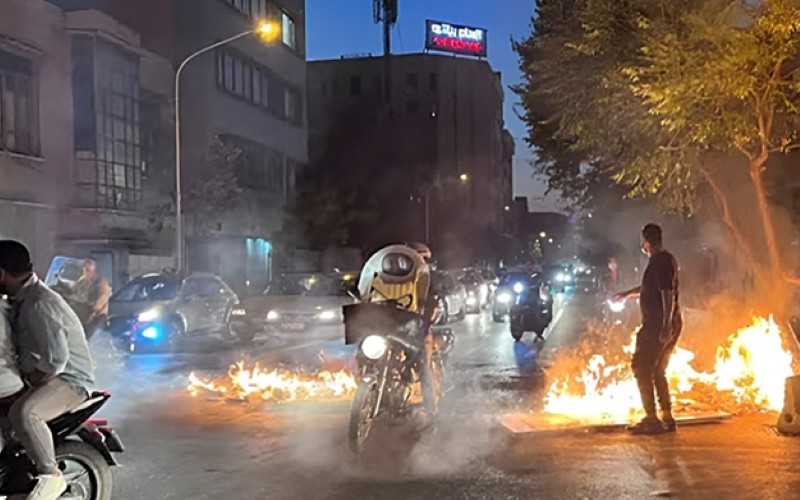

Growing poverty, deepening social fractures, and unprecedented admissions by regime insiders reveal a system increasingly unable to contain public anger.
The Regime’s Daily Anxiety Is No Longer Hidden
Whatever occupies the regime’s day-to-day concerns, it inevitably surfaces through the remarks of its officials, state-aligned experts, and controlled media. These warnings, though often wrapped in cautious language, reveal a deeper reality: an entrenched fear inside the ruling establishment.
The central question is no longer whether the regime is worried, but what it fears most. What force drives this persistent sense of insecurity? What is the underlying cause of this permanent state of alarm?
At the heart of Iran’s political and social landscape lies an unstable relationship between society and state. Tensions—both visible and hidden—are continuous. The wider the gap between popular demands and the rigid, closed political structure, the louder the warnings in official discourse become. Even heavily censored media cannot fully conceal the tremors shaking the foundation beneath the ruling elite.
The Fear of a Sudden Social Eruption
In recent weeks, the regime’s primary concern has been the imminent threat of a social outburst—an explosion of accumulated anger and frustration. This fear is not speculation. It is acknowledged from within the very institutions built to suppress and deny crises.
A striking example came on November 13, 2025, when Mohammad-Hossein Adeli, former head of the Central Bank, spoke openly on state television:
“Young people already have grievances. If they rise up over this issue, whether you have 80,000 forces or even 800,000, an uprising will happen. If it erupts—and if two or three other factors coincide, including war—you won’t be able to control it.”
This is not a technical warning; it is a strategic assessment of the collapsing effectiveness of the regime’s repression machinery. Adeli openly admitted that at a certain threshold, the security forces become irrelevant. While similar warnings appear from time to time in official rhetoric, their meaning today is far more urgent: the regime recognizes that society is approaching a state of “overcoming fear.”
Poverty Surge Pushes Society Toward the Breaking Point
To this political fragility, another explosive component must be added: unprecedented poverty. A Bahar News report on 16 November underscores the steep social decline.
Experts warn that poverty, alongside unemployment, water shortages, and emigration, now threatens Iran’s social stability. When millions feel they have nothing left to lose, collective decisions can rapidly lead to unpredictable and uncontrollable reactions.
According to data from the Parliament Research Center:
- In February 2016, the poverty line for a family of four in Tehran stood at 2.5 million tomans.
- This figure remained unchanged until 2018, then jumped 25% to about 3 million tomans.
- In 2018, 16% of Iran’s population lived under absolute poverty—a figure that abruptly rose to 23%.
- The sharpest escalation came later:
- By end of 2021, the national poverty line for a family of four was estimated at 4.5 million tomans, which surged to 7.5 million tomans within six months.
- By the same year, 25 million people were living below the poverty line.
The World Bank reports that in 2025 alone, more than 2.5 million additional Iranians fell into poverty. The share of the population living on less than $8.30 a day increased from 33.2% in 2024 to 35.4% in 2025, and is expected to reach 38.8% in 2026, with another 3 million people falling into hardship.
Economist Alireza Eshragh attributes the 1,200% increase in the poverty line over a decade to failed economic strategies in inflation control, production, and livelihoods. Sociologist Amanollah Gharaei warns that poverty, combined with unemployment, water shortages, and migration, directly threatens social stability.
A Multi-Layered Social Fracture
The growing divide in Iranian society is no longer merely economic. It now encompasses political, generational, cultural, and livelihood-based grievances. Protests, once sporadic, are evolving into a form of collective awareness. The increasing number of internal admissions by regime-connected institutions demonstrates that even the regime’s own strategists can no longer deny the onset of major transformation.
A Regime Growing More Fragile by the Day
Given these circumstances, Iran’s trajectory points toward escalating instability. Accumulated grievances continue to build, and any unexpected event—economic crisis, political shock, or external conflict—could trigger an uncontrollable eruption.
The regime knows this. That is why its inner circle’s tone of anxiety has grown louder than ever. The future of Iran will not be shaped by state propaganda, but by the will of the majority—by the rising generation, the population demanding change, and the organized resistance units determined not to stand on the margins of their own destiny.