


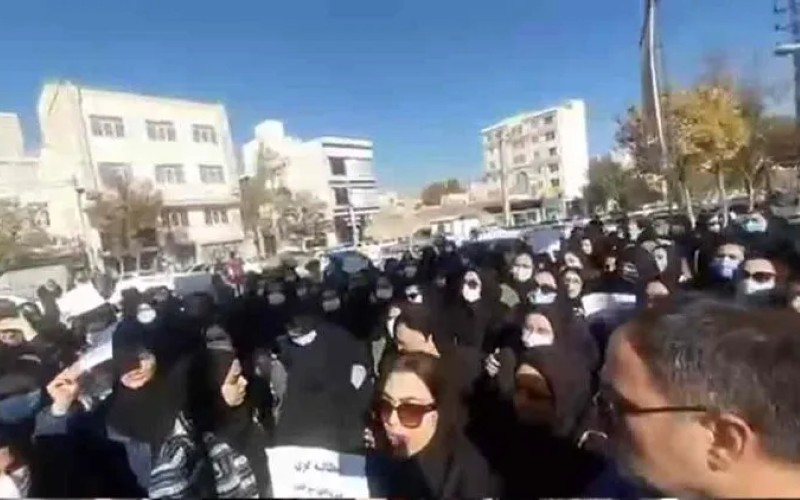

Retirees, farmers, teachers, healthcare workers, environmental activists, and families of political prisoners unite in a sweeping wave of demonstrations.
A new wave of nationwide protests is sweeping across Iran, reflecting deepening anger over corruption, mismanagement, and the collapse of public services. Cities across the country have become the stage for forceful demonstrations by retirees, farmers, teachers, workers, and families of political prisoners who say they are fighting for their basic right to live.
In Kermanshah, a large gathering of retirees in front of the provincial retirement fund became one of the day’s most prominent protests. Chanting “Reformists, hardliners — you’ve dragged the country into ruin!” and “Your pain is our pain; people, join us!”, demonstrators expressed their fury at a system that has ignored their needs for years. Their presence highlighted the erosion of purchasing power, unpaid benefits, and the government’s persistent disregard for the elderly who rely on meager pensions to survive.
Kermanshah, Nov 25 — Residents of Mehr Housing protested today after 16 years of broken promises. Families still have no homes, forced into crushing rents and economic hardship while officials remain indifferent and absent. #FreeIran2025 #IranProtests #IranRevolution pic.twitter.com/Fi2b6tVa0F
— Iran News Update (@IranNewsUpdate1) November 25, 2025
Farmers in Shahr-e Kord gathered outside the electricity department after water pumps were shut down, leaving their land dry and their crops destroyed. They condemned the government’s policies as a deliberate assault on their livelihoods. With no water, no electricity, and no official willing to respond, farmers described the situation as a visible collapse of Iran’s agricultural backbone.
Protests continued in Chaharmahal and Bakhtiari, where another group of farmers confronted authorities over ongoing neglect. The demonstration escalated amid growing public outrage, yet officials again offered no answers. The gathering underscored a broader sentiment shared across the region: communities can no longer tolerate the incompetence of state institutions.
Moghan, Nov 25 — Farmers held a protest today, demanding urgent action as worsening neglect and economic pressure continue to devastate their livelihoods. #FreeIran2025 #IranProtests #IranRevolution pic.twitter.com/bXKNNJnyMr
— Iran News Update (@IranNewsUpdate1) November 25, 2025
In Rask, part-time teachers staged a powerful protest after months of broken promises. Many have gone without salaries or insurance, leaving classrooms understaffed. Their message was unequivocal: schools will not return to normal until justice is served. The protest doubled as a warning that Iran’s educational future is endangered by systemic neglect.
Healthcare workers in Arak assembled outside the University of Medical Sciences to demand fair payment of wages and bonuses. Nurses who sacrificed through years of crisis now say they face unclear formulas, incomplete payments, and empty pledges. Their protest signaled deep frustration within a sector essential to public safety yet repeatedly dismissed by authorities.
In southern Kerman, farmers protested outside the agricultural ministry, demanding fuel for their greenhouses. With gas lines unfinished and engineering authorities ignoring them, the demonstration became another emblem of institutional collapse. Protesters said the situation reflected a wider pattern: decisions are made without planning, and consequences fall solely on the public.
Golestan, Nov 25 — Residents protested today against a local cement factory, denouncing the destruction of trees, soil degradation, and the regime-backed environmental devastation threatening their communities. #FreeIran2025 #IranProtests #IranRevolution pic.twitter.com/hnFevMq0Qo
— Iran News Update (@IranNewsUpdate1) November 25, 2025
Residents of Golestan also rallied in front of a cement factory to denounce the destruction of Hyrcanian forests by state-backed projects. Their protest accused officials of complicity in environmental devastation and highlighted widespread fear that one of Iran’s oldest natural treasures is vanishing under government-sanctioned exploitation.
Workers in Kut-e Abdollah held their own protest after a contractor deducted part of their already meager wages without explanation. Many juggle multiple jobs and still go unpaid. Their demonstration was a direct response to systemic worker exploitation and the widening economic crisis.
Jiroft, Nov 25 — Farmers rallied today to protest the lack of fuel, condemning the regime’s neglect that has pushed agricultural livelihoods to the brink. #FreeIran2025 #IranProtests #IranRevolution pic.twitter.com/CM6P4E3a8H
— Iran News Update (@IranNewsUpdate1) November 25, 2025
Back in Kermanshah, residents of the Mehr Housing project once again gathered to demand the homes they were promised sixteen years ago but never received. Their protest represented ongoing frustration with economic pressure, political negligence, and the government’s refusal to deliver even on its most basic commitments.
Families of political prisoners also joined the weekly “No to Execution Tuesdays” campaign, marking its 96th week. Holding signs that read “No to execution” and photos of their loved ones, the families stood in solidarity with a growing anti-execution movement that has persisted despite state intimidation.
Nov 25 — Families of political prisoners on death row joined the No to Execution Tuesdays campaign, holding photos of their loved ones and “No to Execution” placards in the 96th week of this nationwide call for justice. #FreeIran2025 #StopExecutionsInIran #NoDeathPenalty pic.twitter.com/muB5xBS3RT
— Iran News Update (@IranNewsUpdate1) November 25, 2025
In Moghan, farmers demonstrated to demand two years’ worth of unpaid corn payments after the agricultural minister failed to deliver on his deadline. Their protest highlighted widespread anger over broken promises and financial hardship.
At the J Copper Mine, workers protested after going four to six months without pay. Fifty miners labor in extremely harsh conditions, yet their wages remain overdue. Their demonstration underscored the chronic injustice built into Iran’s labor system.
Arak, Nov 25 — #Healthcare workers held a protest today, condemning unbearable workloads, unpaid wages, and the regime’s ongoing neglect of #Iran’s collapsing health sector. #FreeIran2025 pic.twitter.com/MNhuLwkjyE
— Iran News Update (@IranNewsUpdate1) November 25, 2025
Together, these protests reveal a country where citizens from all walks of life are rising to confront a regime they say has failed them. From pensions to agriculture, education to healthcare, wages to environmental survival, the message is the same: people will no longer remain silent in the face of corruption, deprivation, and systemic neglect.