
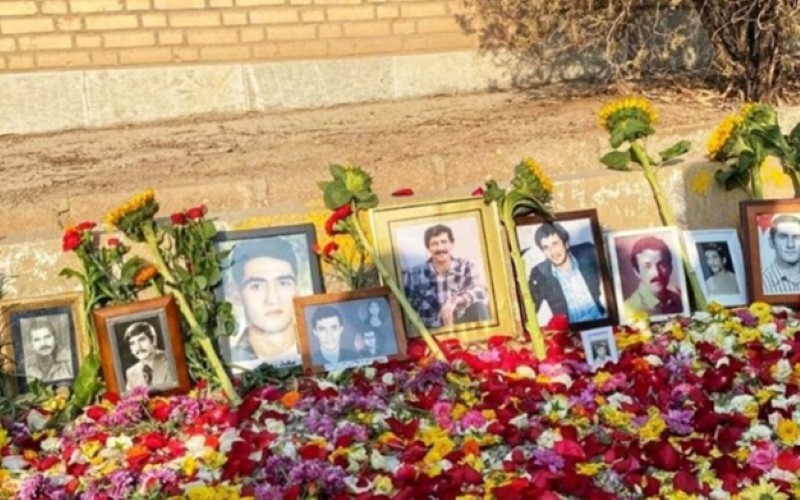

In a powerful act of civil resistance, the families of the 1988 massacre victims transform repression into a renewed political message of defiance.
The first Friday of Azar (November 28, 2025) once again carried the weight of a ceremony that has endured for four decades against the regime’s war on memory. The mothers and fathers of the political prisoners massacred in the summer of 1988 made their way toward Khavaran, the restless burial ground that has become one of the most powerful symbols of resistance in contemporary Iranian history.
Many still carry the youthful photographs of their children tucked into the inner pocket of a coat or between the pages of a Quran, holding onto them as pieces of their own souls. They came to lay red roses on the unmarked graves of their loved ones and to declare, as every year, “We do not forgive and we do not forget.”
This year, the walls around Khavaran stood higher, fortified both physically and symbolically. The regime had turned the cemetery entrance into a militarized zone, sealing off access and enforcing mechanical, barked commands: “National ID!” “Immediate family only!” “No groups over five!” “No flowers!” “No cameras!”
It was as if the regime needed to transform a resting place of heroes into an anxiety-ridden security perimeter, where even the act of remembering is viewed as a threat. Through these restrictions, the authorities sought not only to block the path but to suffocate the possibility of remembrance itself.
The families stood silently before the locked gates, and the weight of the moment was almost unbearable. Then one of the mothers, who for four decades has whispered to her son’s photograph before sleep, took red roses from her bag and placed them gently on the cold ground in front of the sealed entrance.
Another mother joined her. Then a third. Within minutes, the closed gate of Khavaran had been transformed into a delicate carpet of flowers, blooming defiantly beneath the boots of the officers ordered to prevent mourning. The roses announced their presence loudly, not on the graves inside but beyond the walls of cement, reclaiming the space the regime had attempted to deny them.
In its simplicity, this gesture carried immense political force. The families created, without a single spoken word, a new vocabulary of resistance. Their silent act seemed to say to the architects of repression: If you block the path, we will remake the path. If you close the gates of Khavaran, we will turn the street into a memorial.
If you forbid flowers, we will turn the ground itself into a garden of remembrance. This symbolic shift was not merely an act of protest; it was a redefinition of space, meaning, and history. In that moment, Khavaran ceased to be a geographic point. It became an ever-present event, one that will live anywhere it is honored.
The flowers laid outside the walls were more than a mourning ritual; they were a political declaration. The families, through this meaningful act, told the regime plainly that it may erect walls, install cameras, or pave over the soil, but it cannot kill memory. Wherever the families stand, Khavaran stands with them.
This message exposed a deep truth: after four decades, the regime of massacre still fears the victims of 1988. That fear is an admission of fragility, a recognition that even absolute power cannot control collective memory.
History has shown that authoritarian systems seek to erase memory as part of their political survival strategy. The Nazis attempted to destroy the traces of their crimes, but the historical record—from truth commissions to the Nuremberg Trials—proved that no amount of destruction could eliminate the memory of Auschwitz.
Just as the Nazi regime failed, Ali Khamenei, the self-styled successor to Khomeini’s legacy, cannot erase Khavaran from the history of Iran.
Each red rose placed on the cold asphalt before the sealed gates of Khavaran became a cry against forgetting. Every mother with trembling hands, every father straightening his broken posture to lay a flower, established a symbolic courtroom against the crime that history still holds open.
With every image shared on social media, young Iranians formed new connections to the heroes the regime has spent forty years trying to erase. Such connections are the lifeblood of collective memory and a bridge between generations.
What unfolded outside Khavaran was not just the failure of a police operation. It was a moment of profound humiliation for a regime that has built its rule on repression and the manipulation of history.
The families revealed, yet again, that no amount of force can uproot a memory rooted in justice, love, and persistence.
As long as these mothers and fathers stand firm, Khavaran endures. Whether in the soil, in the collective consciousness, or in the red roses now blooming outside the walls, Khavaran speaks louder than ever.