



When a nation loses its forests, its air, its soil, and its hope, it hasn’t been struck by fate—it has been abandoned by those who were supposed to protect it.
We Are Running Out of Air, Water, Soil—and Patience
Every country faces natural disasters. But in Iran, what we face today is something else: a manufactured catastrophe, engineered through decades of negligence, ideological appointments, and the systematic hollowing-out of state capacity. The country is running out of air to breathe, water to drink, forests to protect, and soil to stand on. And the officials responsible cannot even pronounce “ecosystem,” let alone defend one.
The latest infernos devouring the Hyrcanian forests—one of Iran’s most ancient and irreplaceable biomes—have once again exposed the tragedy. As flames spread, the regime’s response was painfully familiar: late, chaotic, under-equipped, and shockingly indifferent.
While the world deploys fleets of firefighting aircraft for similar disasters, Iran relies on volunteers with shovels, blankets, and bare hands—including a disabled man with one leg who became a symbol of the state’s abandonment. In a nation drowning in budgets for propaganda, parallel institutions, and ideological bodies, buying firefighting aircraft is apparently too much to ask.
Instead, they built an “Institute for Governance Studies.” But they didn’t build the capacity to govern.
A Regime Without Scientific Literacy Cannot Protect a Nation
Former MP Gholamali Jafarzadeh Imenebadi put it bluntly: Iran’s environmental decay stems from a ruling class that does not understand the environment at all. Many senior officials responsible for water, land, forests, energy, and climate policy hold degrees in theology, Islamic studies, or disciplines wholly unrelated to environmental science.
How can officials who have never studied hydrology comprehend the collapse of groundwater tables? How can policymakers who cannot read scientific models respond to dust storms, wildfires, or soil erosion? How can a government that denies climate realities protect a nation already in ecological free fall?
They can’t. And they haven’t.
Iran today is a country where forests burn because equipment is lacking, groundwater sinks because overextraction is ignored, air becomes toxic because fuel standards remain medieval, soil erodes because land-use policies are dictated by patronage, and hope evaporates because no official is held accountable.
As Imenabadi said: “We have no soil, no air, no forests, no sea, no shores.” And perhaps most tragically, no functioning government to protect what remains.
Tehran Joins the World’s Toxic Megacities—And the Regime Pretends This Is Normal
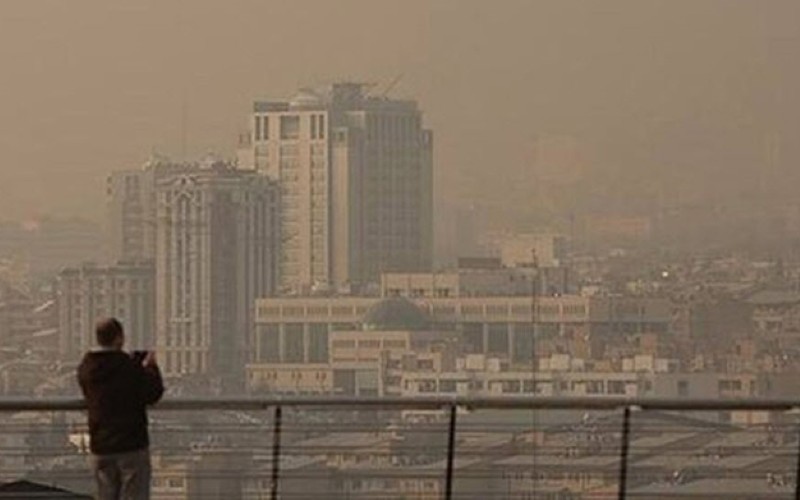
The environmental decay is not limited to forests. It sits on the lungs of 15 million people every morning.
According to global air-quality rankings, Tehran has now joined Cairo, Lahore, and Tashkent among the 10 most polluted cities on Earth. With an Air Quality Index reading of 203, the capital entered the “very unhealthy” category—levels that can cause long-term neurological, respiratory, and cardiovascular damage.
This crisis is not an act of nature but the product of unchecked industrial emissions, obsolete vehicle fleets, low-quality diesel and gasoline, unregulated construction dust, aging power plants that burn mazut, and a government more focused on policing its citizens than protecting their lives.
Even as children faint in playgrounds and hospitals fill with respiratory patients, officials continue to blame “weather patterns” instead of the systemic negligence that created this disaster.
Environmental Collapse Is Not Separate From Political Collapse
What is unfolding in Iran is not a random string of misfortunes but the predictable result of a governing model rooted in anti-science ideology, loyalty to the regime over expertise, unchecked expansion of state institutions, the absence of accountability, and an economy that depletes resources instead of preserving them.
A state that cannot put out a forest fire cannot manage a nation. A government that cannot provide clean air cannot claim legitimacy. A system that ignores environmental destruction will eventually destroy itself.
The tragedy is not only the burning trees or the poisoned air—it is the knowledge that none of this was inevitable. Iran is rich in natural resources, biodiversity, and scientific talent. What it lacks is a government capable of valuing and protecting them.
In the End, the People Are Left to Fight for What Remains
Once again, ordinary Iranians—volunteers, activists, local communities—are the only ones standing between disaster and total collapse. As forests burn, as air thickens with toxins, as rivers dry and soil turns to dust, the people act where the state refuses.
But the question remains:
How long can citizens fight for a land that their own government treats as expendable?
Iran’s environmental crisis is not the result of nature’s fury. It is the result of a regime that governs without knowledge, without responsibility, and without regard for life.