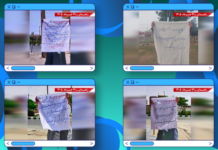
Revolutionary messages in Zahedan underscore nationwide rejection of both monarchy and theocracy, calling for organized uprising and a democratic Iran.
Iran – Sistan and Baluchestan | December 12, 2025 — The PMOI’s Resistance Units have resumed coordinated anti-regime activities across Sistan and Baluchestan, disseminating messages and revolutionary slogans that reflect a growing, organized challenge to Iran’s ruling dictatorship. The campaign emphasizes the Iranian people’s determination to overthrow authoritarian rule and establish a free, democratic republic grounded in popular sovereignty.
Messages circulated by the Resistance Units stress that the guarantee of nationalities’ rights—outlined by the National Council of Resistance of Iran (NCRI)—is inseparable from the integrity of a democratic Iran, explicitly rejecting both monarchical restoration and clerical rule. The slogans reaffirm a central demand echoed nationwide: neither a shah nor mullahs, but a future decided by the vote of the people.
The campaign frames Iran’s current condition as an “exceptional moment,” arguing that society and history neither regress to the past nor remain frozen in the present. It asserts that there is no space left for “fabricated alternatives,” contending that the regime faces a single path forward—its overthrow by the Iranian people through organized resistance.
A core focus of the messages is the regime’s reliance on executions as a primary instrument of repression. The Resistance Units denounce capital punishment as a tool to maintain power against society and organized opposition, while underscoring that Iranian society has risen against the policy of executions. They argue that demonization campaigns and sweeping accusations are designed to manufacture pretexts for crushing the resistance and executing its members.
The slogans also highlight the regime’s fear of a converging nationwide movement—linking regional struggles and the rights of Iran’s diverse ethnicities with a unified national resistance. According to the messages, this linkage secures historical and social recognition of ethnic rights while decisively rejecting allegations of secessionism.
Honoring those who sacrificed their lives for freedom, democracy, and human rights, the campaign condemns Supreme Leader Ali Khamenei for holding political prisoners hostage under inhumane conditions. It reiterates confidence that freedom and democracy will be realized through the organized resistance and uprising of the Iranian people.
On the strategic front, the messages note that regional developments—the fall of Bashar al-Assad’s dictatorship, the weakening of Hezbollah in Lebanon, and the neutralization of Tehran’s proxies—have stripped the regime of external support, leaving it exposed to domestic overthrow.
The campaign crystallizes its political platform around three principles: the downfall of the mullahs’ regime through the struggle of the Iranian people rather than foreign intervention; a firm demarcation from both monarchy and theocracy; and the separation of religion and state. Repeated slogans capture this stance succinctly: “No to monarchy, no to the mullahs—yes to democracy and equality,” and “Dictatorship is dictatorship, whether with a turban or a crown.”
Addressing repression in Sistan and Baluchestan directly, the messages reject attempts to silence the Baluch people through executions, declaring an unwavering commitment to an Iran without execution and torture.