



A sharp rise in executions in 2025 exposes the clerical regime’s deep crisis and its reliance on mass killing to suppress a defiant society.
A close examination of execution statistics in Iran reveals far more than numbers. It exposes the political logic, fears, and failures of a regime that increasingly relies on killing to sustain itself.
The first chart illustrates executions in Iran over four years, from 2022 through early 2026. The trajectory is unmistakable: a steep, accelerating rise under clerical rule that evokes not law enforcement, but mass killing. What emerges is not a criminal justice trend, but a pattern of state violence directed against society itself.
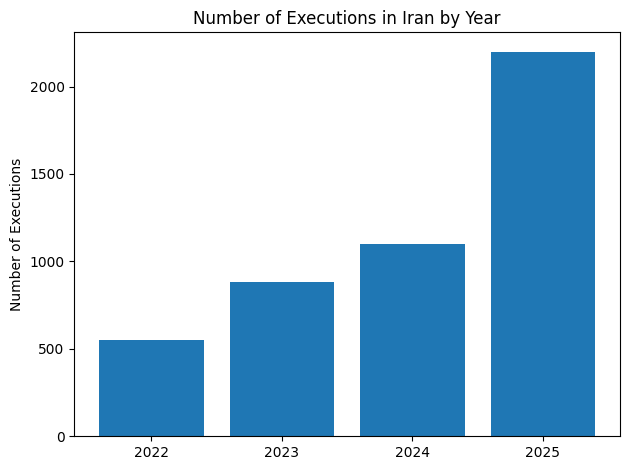
The scale of the escalation is staggering. Executions in 2025 were more than double those recorded in 2024, two and a half times higher than in 2023, and nearly four times the number in 2022. No political, legal, or social justification can explain such a surge. It can only be understood as a deliberate policy choice.
Even within 2025, the acceleration intensified. Executions in the second half of the year exceeded those in the first half by more than twofold. December 2025 alone saw 376 executions, an unprecedented figure in the past 37 years. This was not an anomaly—it was the culmination of a year-long campaign of terror.
The most striking feature of the chart is the column for 2025, which rises abruptly above all previous years. It forces a critical question: why did executions explode so dramatically in this specific year? Why did the regime turn to systematic killing on such a scale?
The answer exposes the emptiness of the regime’s own propaganda. 2025 was the year of the 12-day war, after which regime leaders claimed that the Iranian people had rallied behind the clerical dictatorship. Even if one were to accept this claim—which reality firmly rejects—does mass execution constitute gratitude? Is hanging citizens the reward for alleged loyalty? This contradiction alone dismantles the regime’s narrative.
Here, the veil is lifted from years of deception. The reality is not popular support, but sustained resistance. It is the resilience of an oppressed population refusing to submit, and the courage of women and youth who confront repression at great personal cost. It is this social defiance—this living resistance—that has pushed the regime into panic and driven it toward executions as a last resort.
The second chart focuses on executions across three seasons of the Iranian year 1404 (2025–2026), revealing how the killing intensified month by month.
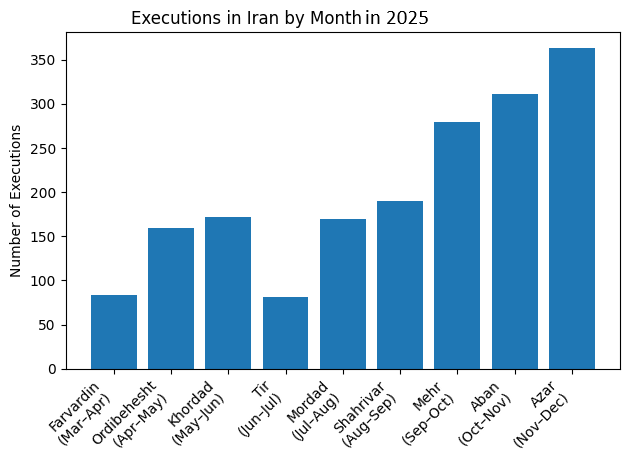
The upward trend is relentless. In Azar (November–December) alone, 363 people were executed—an average of 12.1 executions per day. This means that less than every two hours, one human being was sent to the gallows by the clerical state.
Only one temporary decline appears in Tir (June–July), coinciding with the immediate aftermath of the 12-day war. During that period, the regime’s Supreme Leader abruptly adopted nationalist rhetoric, invoking “Iran” and “the homeland” in an attempt to mask the regime’s vulnerability. Once that moment passed, executions resumed with even greater intensity.
The pattern has not slowed. In the first three days of Dey, at least 52 people were executed, signaling that the machinery of death remains fully operational.
Yet this rising curve of executions tells only one side of the story—the dark face of repression. The other side, often absent from official statistics, is the persistence of resistance. Every execution reflects not regime strength, but fear. Fear of uprising. Fear of a generation that no longer accepts intimidation. Fear of women and youth who continue to organize, protest, and challenge the foundations of clerical rule.
Opposite the regime’s chart of executions stands another, unwritten chart: the growth of rebellion, the spread of defiance, and the determination of a society pushed beyond endurance.
As witnessed in the nationwide protests of Dey, the Iranian people have set their sights on the overthrow of this system. History offers little ambiguity about the fate of regimes that rule by the gallows. No dictatorship has ever secured its survival through mass killing.
The responsibility now rests with a suffering yet rebellious nation—to follow the path forged by its most courageous sons and daughters, to intensify resistance, and to deliver the final blow to a decaying system. The spring of freedom, reconstruction, and dignity in 1405 is not a fantasy, but the inevitable outcome of a struggle already underway.